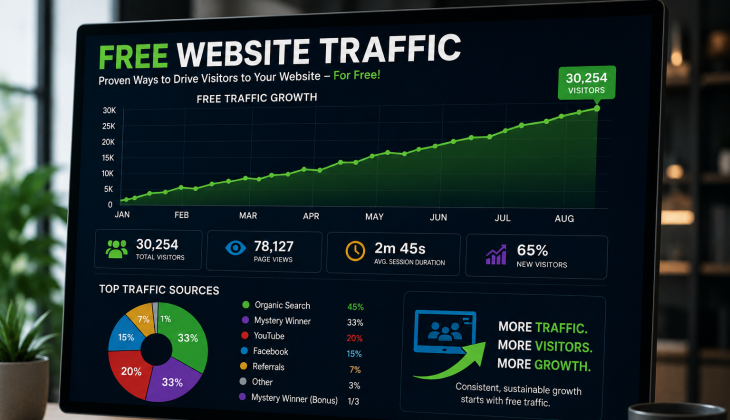
The fastest way to get free buyer traffic in 2026 is simple: build content that AI engines cite and search algorithms reward, then distribute it across hundreds of high-authority platforms simultaneously. This isn’t a theory — it’s being executed right now across premium retail, fine wine, furniture, automotive, and fitness, with documented traffic increases of 250–400% within 12 months and zero paid advertising involved.
Key Takeaways
- • Free buyer traffic compounds over time — content published today keeps returning traffic at zero additional cost, with documented cases showing 73% of monthly visits coming from content published 6+ months earlier.
- • AI engines like ChatGPT, Perplexity, and Google AI Overviews are now sending referral traffic — and most businesses have no strategy to capture it.
- • MultiCasting — publishing one topic across 8 formats on 300+ trusted platforms — is the method behind traffic increases of 250–400% within 12 months across multiple industries.
- • Paid ads stop the day you stop spending. Content-based free traffic keeps building, and in documented campaigns, it overtakes paid ROI within 6 to 12 months.
- • A car dealership increased organic visitors by 76.7% without a single paid ad — and the same approach is being used across watches, wine, furniture, and fitness.
Article at a Glance: This guide walks you through the exact mechanics of free buyer traffic in 2026 — why it’s faster than paid ads, how AI citations create a new referral channel worth 21% of total visitor volume, and the specific methodology (MultiCasting) that produces traffic increases of 250–400% within 12 months across documented client campaigns. You’ll see real case studies from premium watches, fine wine, furniture, automotive, and fitness — each showing identical compounding patterns. You’ll learn why old SEO and paid advertising playbooks are breaking down, how free traffic makes paid ads work harder when both run together, and the exact timeline showing when free traffic investments overtake paid ROI. By the end, you’ll understand why 2026 is the inflection point for free traffic strategies, and why the businesses acting now will be building a compounding asset while their competitors keep paying rising cost-per-click with nothing to show for it when spend pauses.
Table of Contents
- Free Buyer Traffic in 2026 Is Faster and Bigger Than Paid Ads
- Why the Old Traffic Playbook Is Broken
- MultiCasting: The Strategy Behind the Numbers
- The Compounding Effect That Makes This the Cheapest Traffic Available
- Real Results Across Real Businesses
- What the Pattern Shows Across Every Client
- How Paid Ads Actually Perform Better With This Running Alongside
- Free Traffic Is the Biggest Marketing Shift Since Social Media
- How Media Strobe Can Help
- Frequently Asked Questions
Paid advertising is getting more expensive, less precise, and more fragile — and the businesses winning in 2026 figured out a better way before everyone else did.
The shift is measurable. Customer acquisition costs have climbed steadily across most industries over five years. A single algorithm change on Meta or Google can eliminate a profitable campaign overnight. And the moment ad spend stops, paid traffic stops with it — no carry-over, no compounding, no asset left behind. Media Strobe has documented this pattern across dozens of client campaigns, and the conclusion is consistent: free traffic built through content and AI visibility outperforms paid traffic on return within the first year, and it keeps delivering in year two at no additional media cost.
Free Buyer Traffic in 2026 Is Faster and Bigger Than Paid Ads
The numbers sound too good until you understand the mechanics. Organic traffic up 35%. AI-engine citations growing at roughly 32% per month. Content-sourced customers showing higher lifetime value than paid. These aren’t projections — they’re documented results from campaigns already running.
Organic Traffic Up 35% — No Ad Spend Required
In one documented fitness campaign, monthly organic visits climbed from baseline to approximately 6,000 visits per month within 15 months, with zero paid promotion driving the increase. The growth didn’t come from a single viral post or a lucky ranking. It came from a systematic approach to publishing answers across every surface where buyers were asking questions — search engines, AI tools, video platforms, and social channels simultaneously.
By month 15 of that same campaign, 73% of all traffic was arriving from content published six or more months earlier. That’s the compounding effect in practice. Old content keeps returning visits at no extra cost. The content library becomes an asset — one that keeps paying out long after the initial investment.
Traffic Source Breakdown From One Documented Campaign
Search Engines: 62% of total traffic
AI Engines (ChatGPT, Perplexity, Google AI Overviews): 21% of total traffic
Video and Social: 17% of total traffic
That 21% from AI engines is the number most businesses are missing entirely — and it’s growing fast.
ChatGPT Referrals: The New Traffic Source Nobody Is Talking About
ChatGPT doesn’t just answer questions from its training data anymore. It browses the live web via Bing, and it cites sources. Perplexity does the same with visible citations on every response. Google AI Overviews pulls from indexed content and evaluates it using E-E-A-T signals. Together, these platforms are creating an entirely new referral traffic channel — one that reaches buyers specifically at the consideration and decision stages, when purchase intent is highest.
Most businesses have built no strategy for this channel. They’re not being cited. They’re not appearing in AI answers. And they’re handing that visibility — and those buyers — to competitors who got there first.
How an $11,000 Order Arrived From a Channel That Didn’t Exist a Year Before
One premium watch retailer documented an $11,000 order that originated from a ChatGPT referral — a buyer who had asked an AI engine a comparative shopping question, received a recommendation citing the retailer’s content, and arrived on the site already pre-sold. The channel that delivered that order didn’t exist as a meaningful traffic source twelve months prior. That’s how quickly the AI traffic landscape is shifting in 2026.
Why the Old Traffic Playbook Is Broken
The traditional paid traffic model had a simple logic: spend money, get visitors, convert them into customers. That logic still works — but the economics have deteriorated sharply. Cost-per-click has risen across most industries, targeting precision has fallen as privacy changes limit data collection, and the buyer journey has grown far more complex than a single ad-to-landing-page funnel can capture.
GA4, Hyros, and Triple Whale Can’t See Where Buyers Actually Go
Modern attribution tools are sophisticated, but they’re measuring a fraction of the actual buyer journey. Research shows buyers now move across 7 to 12 touchpoints before making a purchase decision. They search on Google, ask ChatGPT a follow-up question, watch a YouTube comparison video, check Reddit, and then finally click an ad — which gets 100% of the credit in most attribution models. The ad didn’t sell them. The content ecosystem did. The ad just happened to be the last thing they clicked.
Modern buyers move across 7 to 12 touchpoints before purchase. Your paid ad might be the last click — but the content ecosystem pre-sold them long before that.
The Invisible Research Journey That Kills Your Conversions
When a buyer spends three weeks researching a product category and your brand never appears in any of those research moments — not in search, not in AI answers, not in video — you don’t exist to that buyer. They arrive at a purchase decision having already formed strong preferences, usually toward the brands that showed up consistently during their research. Paying to interrupt that buyer at the end of their journey with a cold ad is the most expensive, least efficient moment to reach them.
Why Running Traffic Straight to an Offer No Longer Works
The direct offer model — ad to product page, ad to checkout — sees its worst performance in years precisely because buyer trust has to be built before the click, not after it. Documented campaign data shows that prospects who had encountered a brand across search, social, video, and AI before seeing a paid ad converted 2.4 times better on that paid ad than cold audiences with no prior exposure. Free traffic doesn’t just replace paid traffic. It makes paid traffic work harder when you run both together.
Conversion Lift From Pre-Qualified Traffic
2.4x
Better conversion rate on paid ads when prospects had prior brand exposure across search, social, video, and AI vs. cold audiences
MultiCasting: The Strategy Behind the Numbers
MultiCasting is the specific methodology behind the traffic results being documented across industries in 2026. The core principle is straightforward: take one well-researched topic, publish it in eight content formats, and distribute it across 300+ trusted, high-authority platforms simultaneously — in exactly the way that Google and AI engines reward.
One Topic, Every Format, Every Platform Buyers Use
A single MultiCast campaign doesn’t produce one blog post. It produces a content footprint across every surface where buyers are actively asking questions. The eight formats span written articles, video scripts, social content, Q&A formats, and structured data — each adapted for the platform it lands on. The result is that when a buyer asks a question in any channel, the brand has a relevant, authoritative answer already in place.
The reach difference between publishing to one site versus publishing across 300+ high-authority platforms is not incremental. One documented campaign found that expanding distribution to larger, higher-authority sites earned 14 times more AI citations and 6 times more organic traffic from the same content. The content didn’t change. Only the reach did.
AI Citations
14x
More citations from expanding distribution to high-authority platforms
Organic Traffic
6x
More organic traffic from same content on wider distribution
Why AI Engines Like ChatGPT Now Send Referral Traffic
AI engines don’t invent answers — they retrieve and synthesize information from sources they consider credible. ChatGPT browses the live web via Bing. Perplexity runs live web searches and shows visible citations on every response. Google AI Overviews pulls from indexed content and evaluates it against E-E-A-T signals: Experience, Expertise, Authoritativeness, and Trustworthiness. When a brand’s content appears on hundreds of trusted platforms, it signals exactly those qualities. The AI engines start citing it. Citations generate referral traffic. That traffic arrives at the decision stage, pre-qualified and ready to buy.
| Platform | How It Sources Content | Traffic Impact |
|---|---|---|
| Google AI Overviews | Indexed web with E-E-A-T evaluation | Drives direct search traffic within Google ecosystem |
| ChatGPT | Training data + live Bing browsing | Reaches buyers at consideration and decision stage |
| Perplexity | Live web searches with visible citations | Delivers high-intent referral traffic with source attribution |
How MultiCasting Differs From Standard SEO or Content Marketing
Standard SEO focuses on ranking a single domain. Standard content marketing publishes to a brand’s own channels. MultiCasting does neither of those things exclusively — it publishes across 300+ external, high-authority platforms so that the brand’s answers appear wherever the search or AI query lands, not just on the brand’s own site. Generic AI-generated content posted to one site gets volume. MultiCasting gets authority. Google and AI engines reward both quality content and authority mentions, and generic volume delivers neither.
The Compounding Effect That Makes This the Cheapest Traffic Available
The reason free traffic built through MultiCasting outperforms paid on return within 6 to 12 months isn’t complicated. Paid ads deliver traffic while you’re paying for them. Content delivers traffic permanently. Every piece of content published is an asset that keeps generating visits, AI citations, and inbound buyer intent — at zero ongoing media cost.
The 15-Month Compounding Timeline
Months 1–3: Foundation
Content goes live across platforms, initial AI citations begin appearing, and baseline visibility starts to establish. Results are modest — but the foundation being built is what drives the dramatic numbers in months 7–12. For deeper insights, explore this comparison of content creation agencies.
Months 4–6: Traction
Search rankings begin climbing as authority signals from 300+ platform placements accumulate. AI citation rates increase steadily. Social channels begin generating consistent engagement. Traffic is growing, but the most significant acceleration is still ahead.
Months 6–12: Momentum
Organic traffic climbs sharply. AI engine referrals become measurable. Inbound buyer intent increases as the brand’s content footprint reaches more touchpoints in the research journey. In the documented fitness campaign, organic visits reached approximately 6,000 per month by month 15, with YouTube growing to 3,900 monthly views — all without paid promotion. For more insights, check out this guide on ecommerce product visibility.
Month 12 and Beyond: The Library Does the Heavy Lifting
After twelve months, the content library becomes self-sustaining. New campaigns add to a working base rather than starting from scratch. Each month’s content compounds on previous authority. By month 15, 73% of all monthly traffic was arriving from content published six or more months prior. That’s the single most important number in the free traffic argument for 2026. Old content keeps delivering visits at zero cost — and the older the library gets, the cheaper every new visitor becomes. Paid advertising, by contrast, delivers the same cost-per-click in month 15 as month one, often higher.
Paid Ads vs. Free Traffic: Cost Per Visitor Over Time
Paid Ads: Same cost-per-click in month 1, month 6, and month 15. Often increases due to competition.
Free Traffic from Content: Cost per visitor decreases continuously as the content library grows and compounds.
Real Results Across Real Businesses
The case for free traffic in 2026 isn’t theoretical. Across premium retail, fine wine, furniture, automotive, and professional services, the same compounding pattern appears consistently. Industries vary, timelines vary slightly — but the direction is always the same: more AI visibility, more organic traffic, more inbound buyer intent, without ongoing media spend.
Premium Watches: 10x More Leads in 90 Days
A premium watch retailer built a content footprint that AI tools could reference when buyers asked comparative shopping questions. Within 90 days, inbound leads increased 10 times over baseline. The $11,000 ChatGPT-referred order mentioned earlier came from this exact campaign — a buyer who asked an AI engine a comparative question, received a citation pointing to the retailer’s content, and arrived on the site pre-sold. The retailer was competing against brands with significantly larger marketing budgets. Free traffic through AI visibility eliminated that budget gap entirely in the categories where the content was published.
Fine Wines: 1,100% Growth With Zero Ad Spend
A fine wine business documented 1,100% traffic growth with no paid advertising involved at any stage of the campaign. The growth came entirely from search visibility and AI citations built through consistent MultiCast publishing across high-authority platforms. Content-sourced customers also showed higher lifetime value than customers acquired through paid channels, meaning the free traffic wasn’t just cheaper — it was better quality.
Bedroom Furniture: 417% Traffic Growth in 14 Months
A bedroom furniture brand achieved 417% growth in organic traffic over 14 months through MultiCasting. The campaign ran during a period when paid advertising costs in the home furnishings category were rising sharply, making the zero-ad-spend approach not just effective but strategically significant for margin protection. Content-attributed sales from this campaign reached $307,500 in a single month, sourced from an average of 41,000 monthly Google visitors converting at 0.5% on a $1,500 average order value — all from organic search traffic alone.
Car Dealership: 76.7% More Visitors Without a Single Paid Ad
A car dealership optimized for Google Shopping and AI visibility, building a content footprint specifically designed to appear when buyers asked comparative and research questions at the consideration stage. The result was a 76.7% increase in organic website traffic, driven entirely by improved search and AI visibility. No paid advertising was involved at any point in the campaign.
Watches
10x
More leads in 90 days
Wine
1,100%
Traffic growth, zero ad spend
Furniture
417%
Organic traffic growth
Automotive
76.7%
Visitor increase, no paid ads
What the Pattern Shows Across Every Client
The four case studies above aren’t outliers. They’re the expected outcome when the same methodology is applied consistently across industries. The pattern that emerges across every documented campaign points to three specific, repeatable results.
5–20x Return on Content Spend
Across the client base, the documented return on content spend runs between 5 and 20 times, with 10 to 20 times being the typical range for campaigns that have reached month 12 and beyond. That figure accounts for the full cost of content production and distribution — not just media spend, which is zero.
The $307,500 in content-attributed monthly sales from the bedroom furniture campaign is a concrete example of what that return looks like in practice. The content investment that produced those sales was a fraction of what equivalent paid traffic would have cost — and the content keeps delivering in month 16, month 20, and beyond at no additional media cost.
What makes this return sustainable is the asset nature of the content library. Paid advertising spend produces traffic while active. Content spend produces an asset that compounds. Every month that passes after publication, the cost per visitor from that content decreases — while the cost per click in paid channels typically increases as competition rises.
Traffic Increases of 250–400% Within 12 Months
Across documented campaigns, organic traffic increases of 250% to 400% within 12 months are the consistent outcome. The fitness campaign reached 6,000 monthly organic visits. The fine wine business grew 1,100%. The furniture brand hit 417%. The car dealership added 76.7% without any paid support. The range varies by industry competitiveness and content quality, but the direction across every campaign is identical.
Three Repeatable Results Across Documented Campaigns
Return on Content Spend: 5–20x
Typical range for campaigns reaching month 12, accounts for full production and distribution costs
Traffic Growth: 250–400% in 12 Months
Consistent outcome across watch, wine, furniture, automotive, and fitness verticals
Conversion Improvements: 15–35%
Pre-qualified traffic from content and AI visibility converts better than cold paid audiences
Conversion Improvements of 15–35% From Pre-Qualified Traffic
Free traffic built through content and AI visibility doesn’t just deliver more visitors — it delivers better ones. Buyers who arrive through organic search or AI citations have already engaged with content that answered their research questions. They arrive pre-qualified, with higher purchase intent and stronger brand familiarity than cold paid traffic. Documented campaigns show conversion improvements of 15% to 35% from this pre-qualified traffic compared to cold paid audiences.
How Paid Ads Actually Perform Better With This Running Alongside
One of the most counterintuitive findings from these campaigns is that running free traffic strategies doesn’t replace paid ads — it makes them work harder. Prospects who had encountered a brand across search, social, video, and AI before seeing a paid ad converted 2.4 times better on that paid ad than cold audiences with no prior exposure. The content ecosystem pre-sells the buyer. The paid ad closes what the content already warmed up.
This means businesses running both approaches simultaneously get a double return: the compounding free traffic asset builds over time, while the paid campaigns they’re already running immediately improve in conversion efficiency. The content spend isn’t just generating free traffic — it’s lowering the effective cost per acquisition across every paid channel running in parallel.
Free Traffic Is the Biggest Marketing Shift Since Social Media — And 2026 Is the Tipping Point
Four converging trends make 2026 the inflection point for free traffic strategies. Demand for visibility across search, social, video, and AI is rising simultaneously. Paid costs are climbing while targeting precision falls. AI engines are growing as buyer research tools at roughly 32% per month in documented citation data. And multi-channel presence is becoming mandatory as buyers research across 7 to 12 touchpoints before purchasing. Every one of these trends favors content-based free traffic over paid acquisition.
The businesses that act on this shift in 2026 will be building a compounding asset while their competitors keep paying the same rising cost-per-click, month after month, with nothing to show for it the day they pause spend. The window to establish authority in AI engines before those surfaces become saturated is open right now — and the campaigns already running are proof that it closes faster than most businesses expect.
How Media Strobe Can Help
The results in this guide are real, but they require a systematic, expert-executed approach to content strategy and distribution — exactly what most internal marketing teams lack the bandwidth or specialized expertise to execute. That’s where Media Strobe’s MultiCast campaigns come in.
What Is a MultiCast Campaign?
A MultiCast campaign takes one well-researched topic and transforms it into eight distinct content formats (written articles, video scripts, Q&A content, social posts, structured data, infographics, and more), then distributes that content ecosystem across 300+ high-authority platforms simultaneously. The result is that your brand’s answers appear wherever buyers are asking questions — not just on your own website, but across search engines, AI platforms, social channels, video networks, and industry-specific directories.
Key Benefits:
- • Increased visibility — leading to increased ranking across search and AI platforms
- • Increased warm/hot traffic — buyers arrive pre-qualified from multiple touchpoints
- • Reduced customer acquisition costs — free traffic compounds over time
- • Predictable growth that can be scaled — apply the same framework to new topics
- • Generate more revenue with higher net profit — no ongoing ad spend required
- • True control over lead generation — your strategy, your timeline
- • Better return on paid ads — pre-qualified traffic makes every paid dollar work harder
All MultiCast campaigns are expertly created to answer highly relevant questions about your service or product that your future customers are asking all over the internet before they make their purchase decision. Your MultiCast is distributed to hundreds of high authority sites in the exact way that Google and AI love, and in 8 formats so that your answers show up everywhere people are asking questions.
Learn more about MultiCast campaigns and schedule a strategy consultation with Media Strobe.
Frequently Asked Questions
How Long Does It Take to See Free Traffic Results With MultiCasting?
Initial AI citations and early search visibility typically appear within the first one to three months. Meaningful traffic traction builds between months four and six as authority signals accumulate across 300+ platforms. The most significant growth phase runs from month seven through month twelve, and from month twelve onward the content library compounds on itself — delivering an increasing share of traffic from content published in prior months at zero additional cost. The fitness campaign documented 73% of month-15 traffic arriving from content published six or more months earlier, which illustrates exactly how the timeline plays out in practice.
Does This Work for Local Businesses, Not Just E-Commerce?
The same mechanics that drive traffic for e-commerce brands apply directly to local businesses — and in some ways local businesses benefit more, because local search and AI query competition is lower than national e-commerce categories. A local service business that builds a content footprint answering the specific questions buyers in its geography are asking will appear in Google AI Overviews, Perplexity citations, and local search results for those queries with far less competition than a national retailer faces.
The car dealership case — 76.7% organic traffic growth with zero paid advertising — is a local business example. Automotive retail is a high-competition, high-cost-per-click paid category. Free traffic through AI and search visibility eliminated the need for paid acquisition entirely during the campaign period.
Local Business Free Traffic Reality
Local search queries have lower content competition than national categories. A local business publishing authoritative answers to local buyer questions can achieve AI citation visibility and search rankings that a national brand would require far more resources to match. The same MultiCasting methodology applies identically, with local search intent built into the content strategy.
Can Free Traffic From AI Engines Like ChatGPT Be Relied On Long-Term?
AI engine traffic is growing at roughly 32% per month in documented campaign data — and the structural reason it will continue is that AI tools are becoming the default starting point for buyer research across every product category. ChatGPT, Perplexity, and Google AI Overviews all retrieve content from the live web, meaning businesses that maintain authoritative content across high-authority platforms will continue to be cited as these tools expand their user bases. The 21% of total traffic coming from AI engines in documented campaigns today is a floor, not a ceiling.
How Is MultiCasting Different From Hiring a Standard SEO Agency?
A standard SEO agency focuses on improving rankings for a single domain — your website. MultiCasting distributes content across 300+ external, high-authority platforms so that your answers appear wherever the search or AI query lands, not just on your own site. Standard SEO builds authority for one destination. MultiCasting builds authority signals across the entire web that AI engines and search algorithms use to evaluate credibility. The result is AI citations, search rankings, and referral traffic from platforms your own domain could never rank for independently. Generic AI content posted to one site gets volume. MultiCasting gets authority — and Google and AI engines reward authority, not volume.
What Is a Realistic Return on Content Spend in the First Year?
Based on documented campaign data, the realistic return on content spend in the first year runs between 5x and 20x, with 10x to 20x being the typical range for campaigns reaching month 12. The bedroom furniture campaign produced $307,500 in content-attributed monthly sales by month 15. The fine wine business documented 1,100% traffic growth. The premium watch retailer generated 10x more leads within 90 days.
First-year returns vary by industry competitiveness, content quality, and how aggressively the distribution strategy is executed. Campaigns in lower-competition niches or with strong existing domain authority tend to see faster early traction. Campaigns in highly competitive categories take slightly longer to compound but deliver the same pattern of results by month 12.
The most important number isn’t the first-year return — it’s the second-year return. Because content published in year one keeps delivering traffic in year two at no additional media cost, the effective return per dollar spent continues climbing after the campaign investment ends. That’s the compounding dynamic that separates free traffic built through content from every paid channel available in 2026.
Why Choose a MultiCast Campaign by Media Strobe?
All MultiCast campaigns are expertly created to answer highly relevant questions about your service or product that your future customers are asking all over the internet before they make their purchase decision. Your MultiCast is distributed to hundreds of high authority sites in the exact way that Google and AI love, and in 8 formats so that your answers show up everywhere people are asking questions.
The benefits of running a MultiCast campaign are:
- • Increased visibility (leading to increased ranking)
- • Increased warm/hot traffic
- • Reduced customer acquisition costs
- • Predictable growth that can be scaled
- • Generate more revenue with higher net profit
- • True control over your lead generation
- • Better return on paid ads
Ready to start your MultiCast campaign? Schedule a consultation with Media Strobe today.