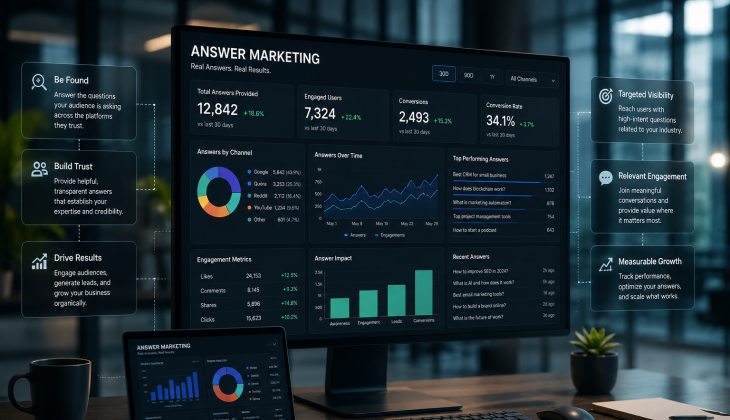
What is answer marketing? It’s the practice of structuring content so AI platforms like ChatGPT, Google AI Overviews, and Perplexity use it as a direct answer instead of just ranking it in search results. As over half of all searches now end without a click, businesses that adopt answer marketing early are already earning brand mentions inside AI-generated responses at the moment customers make decisions.
Key Takeaways: What is Answer Marketing
-
Answer marketing is the practice of structuring content so AI-driven platforms like ChatGPT, Google AI Overviews, and Perplexity use it as a direct answer — not just rank it in search results.
-
Over half of all searches now end without a single click, meaning traditional SEO alone is no longer enough to maintain visibility.
-
Answer marketing and SEO are not the same thing — they share tactics but serve different goals, and the gap between them is widening fast.
-
Businesses that adopt answer marketing early are already earning brand mentions inside AI-generated responses, building trust at the moment decisions are made.
-
Keep reading to find out which industries are winning fastest with answer marketing — and the five steps you can take right now to start optimizing.
Article at a Glance: Understanding what is answer marketing and how it differs from traditional SEO is critical as search behavior evolves. This guide covers the fundamentals of answer marketing strategy, why answer marketing matters for your business, how to implement answer marketing across your content, and which industries see the fastest results. You’ll learn what is answer marketing, why what is answer marketing different from SEO, and exactly how to position your brand to be the answer AI platforms deliver to your customers.
Table of Contents
- Search Has Changed — Here’s What That Means for You
- What is Answer Marketing?
- Why More Than Half of Searches Never Lead to a Click
- How Answer Engines Decide Whose Content to Use
- Should You Be Using Answer Marketing?
- How to Start Optimizing for Answer Engines
- Real Businesses Already Winning With Answer Marketing
- Answer Marketing Is Not Optional Much Longer
- How Media Strobe Can Help
- Frequently Asked Questions
Search Has Changed — Here’s What That Means for You
The search bar looks the same, but what happens after you hit enter has completely changed.
A few years ago, a search query returned a list of links. You clicked one, read the page, and made a decision. That chain of events — query, click, visit, convert — was the backbone of digital marketing for two decades. SEO was built around it. Content strategies were built around it. Entire businesses were built around it.
That chain is breaking. Google’s AI Overviews now generate direct answers at the top of the results page. ChatGPT handles millions of informational queries every day without sending users anywhere. Perplexity, Microsoft Copilot, and voice assistants are doing the same. The user gets their answer and moves on — no click required.
The shift in plain terms: Search engines used to help people find information. Answer engines now deliver it. If your content isn’t being used as the answer, it may not be seen at all.
This is not a future problem. It’s happening now, and marketers who recognize it early have a significant advantage over those still optimizing exclusively for page-one rankings.
What is Answer Marketing?
Answer marketing is the practice of structuring and formatting your content so that AI-powered platforms can extract it, trust it, and deliver it as a direct response to a user’s question. Where traditional SEO earns you a spot in a list of results, answer marketing earns you the answer itself.
Answer Marketing vs. Traditional SEO: The Core Differences
SEO and answer marketing are related, but they are not interchangeable. SEO focuses on earning rankings. Answer marketing focuses on earning answers. The tactics overlap — quality content, authority signals, technical structure — but the goals and formats are different.
Answer Marketing vs. Traditional SEO Comparison
| Factor | Traditional SEO | Answer Marketing |
|---|---|---|
| Primary Goal | Rank on search engine results pages | Be used as the direct answer by AI |
| Content Format | Keyword-optimized pages | Question-and-answer structure, schema markup |
| Success Metric | Rankings, organic traffic, clicks | Answer inclusions, AI citations, brand mentions |
| Search Environment | Traditional SERPs, blue links | AI Overviews, ChatGPT, Perplexity, voice search |
| User Behavior | Users click through to a website | Users get answers without leaving the platform |
Understanding this comparison is critical. Answer marketing doesn’t replace your SEO investment — it extends it into the environments where modern users are actually getting their information.
What Counts as an “Answer Engine” in 2026
An answer engine is any platform that interprets a user’s question and delivers a synthesized, direct response rather than a list of links. In 2026, that includes Google AI Overviews, ChatGPT, Perplexity AI, Microsoft Copilot, Apple’s Siri with expanded AI capabilities, and Amazon Alexa. Featured snippets on traditional Google SERPs also function as answer engine placements, making them an important early target for answer marketing strategy.
Why Answer Marketing and SEO Are Not the Same Thing
The easiest way to understand the difference: SEO helps users find your page. Answer marketing helps AI use your content as the answer. A page can rank on page one of Google and still never appear in a single AI-generated response. Conversely, content optimized for answer marketing can earn citations in ChatGPT or Perplexity without ranking highly in traditional search at all. Both matter. Treating them as identical is one of the most common mistakes marketers make right now. To effectively integrate both strategies, consider exploring a comprehensive AI search strategy that aligns with your marketing goals.
Why More Than Half of Searches Never Lead to a Click
Zero-click search is not a new concept, but its scale has reached a tipping point that most marketing teams haven’t fully accounted for. When a user types a question and Google’s AI Overview delivers a complete answer at the top of the page, there is simply no reason to scroll down. The answer is already there. This dynamic is fundamentally changing what traffic from search actually looks like — and what it’s worth.
How AI Overviews and Featured Snippets Are Replacing Links
Google’s AI Overviews pull from multiple sources to synthesize a response and display it before any traditional results. Featured snippets have worked similarly for years, but AI Overviews are more comprehensive, more conversational, and more likely to fully satisfy the user’s query on the spot. For informational queries — “how does X work,” “what is the best Y for Z,” “why does A happen” — the click-through opportunity is shrinking rapidly.
Marketers working with platforms like Media Strobe are already seeing firsthand how content structured for direct answers outperforms traditionally optimized pages in these new AI-generated placements. The evidence is in the brand mentions showing up inside AI responses — visibility that doesn’t show up in standard traffic reports but drives real awareness and trust. For more insights, explore how AI search can generate free traffic and enhance your marketing strategy.
What Zero-Click Search Means for Your Traffic
Zero-click doesn’t mean zero value. A brand mentioned inside a ChatGPT response or cited in a Google AI Overview is being seen by a user who asked a specific, high-intent question. That’s a qualified impression — arguably more valuable than a ranking for a broad keyword that drives unqualified clicks. The metric you optimize for has to evolve. Answer inclusions and AI citations are the new placements worth competing for.
The traffic model built on clicks alone is becoming unreliable. Brands that adapt their content strategy to earn answer placements will maintain visibility. Those that don’t will find themselves invisible to a growing portion of their audience — even if their rankings stay the same.
How Answer Engines Decide Whose Content to Use
Answer engines don’t pick content randomly. They follow a logic built on clarity, structure, authority, and trustworthiness. Understanding what signals these platforms look for is the foundation of any effective answer marketing strategy. Get this right, and your content becomes the source AI tools reach for. Get it wrong, and you’re invisible regardless of how well you rank. For more insights, explore our guide on AI search and free traffic strategies.
The good news is that the factors answer engines evaluate are largely within your control. You don’t need a massive domain authority or a million backlinks to earn answer placements. You need content that is structured correctly, answers specific questions directly, and comes from a source that demonstrates expertise and consistency.
Clarity and Structure: Why Simple Wins
Answer engines are built to extract information quickly and present it in plain language. Content that buries its main point in long preambles, uses vague language, or lacks clear formatting is hard for AI to parse and unlikely to be used. The content that wins answer placements is direct, well-organized, and written at a level that’s easy to understand — which is also, not coincidentally, content that human readers prefer.
Authority Signals AI Tools Actually Trust
Authority in answer marketing isn’t just about backlinks. AI platforms evaluate a broader set of trust signals when deciding which content to cite. Consistent brand mentions across reputable sites, author credentials tied to specific topics, accurate and up-to-date information, and alignment with established facts all contribute to how much an answer engine trusts your content. Think of it as digital reputation — built across every platform where your brand exists, not just your website.
Earning citations from authoritative third-party sources matters significantly. When other trusted sites reference your content, your brand, or your expertise, answer engines interpret that as a validation signal. This is why thought leadership content, press mentions, industry publications, and even well-structured social profiles all play a role in answer marketing — they build the trust layer that AI platforms rely on when choosing whose answer to deliver. For a deeper understanding of how AI search and free traffic can impact your strategy, explore further insights.
The Role of Schema Markup in Answer Marketing
Schema markup is structured data added to your HTML that tells search engines and AI platforms exactly what your content is and what it means. For answer marketing, the most valuable schema types include FAQPage, HowTo, Article, Product, and Speakable — each designed to help answer engines quickly identify and extract relevant information. Without schema, an AI platform has to guess at your content’s context. With it, you’re handing the answer engine a labeled map.
Adding FAQ schema to a page that already answers common questions in your niche is one of the fastest wins in answer marketing. It signals to Google’s AI Overview and other platforms that your content is structured specifically to answer questions — which is precisely what those platforms are looking for. Implementation doesn’t require a developer for most CMS platforms; plugins like Yoast SEO or Rank Math on WordPress make schema addition straightforward.
Conversational Queries vs. Keyword Queries
Traditional SEO was built around short, intent-driven keywords — “best running shoes,” “cheap flights London.” Answer marketing targets a different kind of search: the full-sentence, conversational question that mirrors how people actually talk. “What are the best running shoes for flat feet under $150?” is an answer marketing query. Voice search, ChatGPT prompts, and AI Overview triggers all skew heavily toward this conversational format, which means your content needs to anticipate and directly answer the full question — not just match isolated keywords.
Should You Be Using Answer Marketing?
The short answer is yes — but the urgency and approach depend on your business type, your audience’s search behavior, and how much of your current visibility relies on informational content. If any meaningful portion of your traffic comes from how-to queries, comparison searches, or definition-style questions, answer marketing is not optional. Those query types are being answered directly by AI platforms at a rapidly increasing rate.
Even businesses in highly transactional niches — e-commerce, local services, SaaS — benefit from answer marketing because their customers ask informational questions before making purchase decisions. Being the source that answers those pre-purchase questions positions your brand as the trusted option before the buyer even reaches a product page.
Signs Your Business Would Benefit From Answer Marketing Now
The clearest indicator is a drop in organic traffic despite stable or improving rankings. If your pages are still ranking but getting fewer clicks, zero-click search is likely eating your impressions. That’s an answer marketing problem with an answer marketing solution.
Other Strong Signals That Answer Marketing Matters for Your Business
- Your competitors are showing up in Google AI Overviews and you are not
- A significant portion of your content is informational or educational
- Your audience uses voice search or AI assistants regularly
- Your brand is rarely mentioned when AI tools answer questions in your niche
- You operate in a high-consideration category where trust is a purchase factor
If two or more of those apply to your business, answer marketing should already be part of your content strategy. The longer you wait, the more answer real estate competitors claim in your space — and AI platforms tend to reinforce established sources over time, making it harder to break in later.
Industries Where Answer Marketing Delivers the Fastest Results
While answer marketing benefits nearly every industry, certain sectors see measurable impact faster due to high volumes of question-based search behavior. Healthcare and wellness content earns answer placements quickly because users ask specific, high-intent health questions constantly. Legal and financial services benefit because users seek trustworthy explanations of complex topics. SaaS and B2B technology companies win because buyers research extensively before purchase. E-commerce brands with robust how-to and comparison content also see early wins. If your industry involves educating a buyer before they convert, answer marketing accelerates that process significantly.
How to Start Optimizing for Answer Engines
You don’t need to rebuild your entire content library to start seeing answer marketing results. The most effective approach is targeted — identify your highest-traffic informational pages, restructure them using answer marketing best practices, add schema markup, and expand your authority signals across platforms. The five steps below give you a clear, actionable sequence to follow regardless of where your current content strategy stands.
1. Find the High-Intent Questions in Your Niche
Start with tools like Google’s “People Also Ask” boxes, AnswerThePublic, or Semrush’s Keyword Magic Tool filtered by question-type queries. Look for questions that your existing content already addresses — these are your fastest optimization opportunities. Prioritize questions that trigger AI Overviews in Google Search, which you can identify by simply searching the query and noting whether an AI-generated response appears at the top of the results page.
2. Rewrite Key Pages to Lead With Direct Answers
The most common answer marketing mistake is burying the answer. If someone asks “What is schema markup?” your content should answer that in the first one to two sentences — clearly, directly, and completely. Supporting detail, examples, and context come after the direct answer. This inverted pyramid structure is exactly how answer engines prefer to extract and present information, and it also improves time-on-page for human readers who want the answer first.
3. Improve Content Structure With Headers and Formatting
Answer engines parse content hierarchically, which means your H2 and H3 headers carry significant weight in signaling what each section covers. Every major question your content addresses should have its own clearly labeled header — phrased as the question itself where possible. Use short paragraphs, bulleted lists for multi-part answers, and bold text to highlight key terms. Walls of unbroken text are difficult for AI to extract from and create friction for human readers simultaneously.
4. Add Schema Markup to Your Most Valuable Pages
Start with your highest-traffic informational pages and add FAQPage schema to any section that already answers common questions. If you have step-by-step guide content, HowTo schema is your next priority. For pages that discuss products or services directly, Product and Article schema help answer engines categorize and trust your content faster. You don’t need to implement every schema type at once — focused, accurate schema on your best pages outperforms scattered, incomplete markup across your entire site.
Google’s Rich Results Test tool lets you validate schema implementation before it goes live, confirming that your structured data is readable and error-free. For WordPress users, plugins like Rank Math or Yoast SEO include built-in schema generators that handle the technical side without requiring you to write JSON-LD manually. The priority is accuracy — schema that misrepresents your content can hurt credibility with answer engines rather than help it.
5. Build Authority and Trust Signals Across Platforms
Answer marketing authority isn’t built on your website alone. Answer engines evaluate your brand’s credibility across the entire web — which means your presence on third-party platforms, industry publications, social profiles, and review sites all contribute to how much AI tools trust your content. Start by ensuring your brand information is consistent everywhere: same name, same descriptions, same core messaging. Inconsistency across platforms is a trust signal problem that undermines even excellent on-site content.
Beyond consistency, actively pursue external mentions and citations in your niche. Guest articles on reputable industry sites, interviews, podcast appearances, and PR placements all generate the kind of third-party validation that answer engines use to confirm authority. The goal is to become the brand that other trusted sources reference when your topic comes up — because that pattern of citation is exactly what AI platforms replicate when they choose whose answer to deliver.
Real Businesses Already Winning With Answer Marketing
Answer marketing isn’t theoretical — brands across industries are already capturing answer placements that generate measurable awareness and qualified traffic without relying solely on traditional ranking positions. The common thread among businesses winning with answer marketing right now is content that was deliberately structured to answer specific questions, backed by consistent authority signals and proper schema implementation.
The patterns showing up in early answer marketing success stories are consistent and repeatable across different industries and business sizes:
How Different Industries Win With Answer Marketing
- Healthcare brands with structured symptom and treatment explainers are being cited regularly inside Google AI Overviews for high-intent health queries
- SaaS companies that publish clear, jargon-free explanations of industry concepts are earning ChatGPT citations that introduce their brand to buyers in the early research phase
- Legal and financial firms with FAQ-rich content and verified author credentials are appearing in Perplexity AI responses for questions that previously drove traffic to generic aggregator sites
- E-commerce brands with detailed how-to and comparison content are earning voice search answers that position them as the trusted recommendation before a purchase decision is made
- Local service businesses with consistent NAP data and structured service pages are showing up in AI-driven local answer results that bypass traditional map pack competition
What separates these businesses from those still invisible in AI-generated responses isn’t budget or domain size — it’s content structure, clarity, and the decision to treat answer engine visibility as a real marketing objective rather than a side effect of SEO.
Answer Marketing Is Not Optional Much Longer
The window for early adoption is open, but it won’t stay that way. Every month that passes, more brands structure their content for answer engines, more AI platforms reinforce their existing trusted sources, and the gap between answer marketing-ready businesses and those still running a pure SEO playbook gets wider. The brands earning answer placements today are building a compounding visibility advantage — one that gets harder to close the longer competitors wait to act. Answer marketing is not a trend to monitor. It’s a shift to move on.
How Media Strobe Can Help
Media Strobe’s MultiCast campaigns are specifically designed to position your brand as the answer that AI platforms deliver. A MultiCast campaign takes your most important content about what is answer marketing, how to implement it, and the specific solutions you offer — then distributes it across eight different formats to hundreds of high-authority websites in the exact way that Google and AI love.
What makes a MultiCast campaign different:
- AI-optimized structure — Every piece of content is formatted to be extracted and used as a direct answer by ChatGPT, Google AI Overviews, and Perplexity
- Multi-channel distribution — Your answer marketing strategy reaches eight different content formats, ensuring your brand appears wherever your customers are asking questions
- Authority amplification — Content distributed across hundreds of high-authority sites builds the third-party citation signals that answer engines trust
- Measurable results — Track brand mentions inside AI-generated responses, featured snippets, and voice search placements — visibility that traditional ranking reports miss
Instead of waiting months for organic answer marketing results, a MultiCast campaign compresses the timeline by distributing your answer marketing content to the exact platforms answer engines source from. You’re not competing for answer placements — you’re being positioned as the answer.
Learn how a MultiCast campaign can accelerate your answer marketing strategy →
Frequently Asked Questions
These are the questions most marketers ask when they first encounter answer marketing — and they’re the right questions to ask. Understanding what is answer marketing, how it differs from SEO, which platforms to prioritize, and realistic timelines are all essential to building a strategy that actually delivers results rather than just checking boxes.
The answers below are direct and practical. No theoretical frameworks — just clear guidance you can apply to your content strategy immediately, regardless of your current level of SEO experience or the size of your marketing team.
What is the difference between answer marketing and SEO?
SEO focuses on ranking your content in traditional search engine results pages so users click through to your website. Answer marketing focuses on structuring your content so AI-powered platforms extract it and deliver it as a direct answer — often without the user clicking anything. Both require quality content and authority signals, but answer marketing adds a layer of structural formatting, schema markup, and question-based organization that traditional SEO doesn’t prioritize. Think of SEO as earning a place in the library, and answer marketing as becoming the answer the librarian gives when someone asks a question out loud. For more insights on how to get your e-commerce store found online using AI search strategies, explore our detailed guide.
Does answer marketing replace traditional SEO entirely?
No — and anyone telling you otherwise is oversimplifying. SEO and answer marketing are complementary strategies. Traditional search still drives significant traffic, and rankings still matter for transactional queries where users intend to click through and compare options. Answer marketing extends your visibility into the growing portion of search behavior that never produces a click. A complete digital marketing strategy in 2026 invests in both, using SEO for ranking and click-through traffic while using answer marketing to earn brand presence inside AI-generated answers.
How do I know if my content is optimized for answer engines?
Run your most important informational queries through Google Search and check whether an AI Overview appears — and whether your content is cited inside it. Do the same in Perplexity AI and ChatGPT. If your brand is absent from AI-generated responses for questions you should own, your content is not yet optimized for answer marketing. Tactically, check whether your pages lead with direct answers, use clear question-based headers, include FAQ or HowTo schema, and are cited by other authoritative sources in your niche. If multiple elements are missing, you have a clear answer marketing optimization roadmap in front of you.
Which AI platforms should I be optimizing for?
Prioritize Google AI Overviews first — it has the largest user base and is already reshaping organic search behavior at scale. Perplexity AI is the second most important target for informational and research-driven queries, particularly in B2B and technology categories. ChatGPT with browsing enabled is increasingly used for branded and product research. Microsoft Copilot matters for enterprise and productivity-adjacent content. Voice search through Siri and Google Assistant remains relevant for local and quick-answer queries. The good news: content structured well for one answer engine tends to perform across all of them, since the underlying principles — clarity, structure, authority — are universal. For more on optimizing your eCommerce store for AI, check out this strategy guide.
How long does it take to see results from answer marketing?
Answer marketing results move faster than many marketers expect, particularly for content updates on pages that already have some authority. Adding FAQ schema to an existing high-traffic page can produce changes in Google’s AI Overview behavior within days to weeks of Google re-crawling the page. New content built from scratch with full answer marketing optimization typically takes one to three months to earn consistent answer placements, depending on your domain authority and the competitiveness of your target queries.
The fastest results come from optimizing content that already ranks on page one for informational queries but isn’t yet appearing in AI-generated responses. These pages have the authority — they just need the structural and schema signals to get extracted by answer engines. Treating those pages as your first answer marketing sprint gives you the clearest and fastest path to measurable answer engine visibility.
Why Choose a MultiCast Campaign by Media Strobe?
All MultiCast campaigns are expertly created to answer highly relevant questions about your service or product that your future customers are asking all over the internet before they make their purchase decision. Your MultiCast is distributed to hundreds of high-authority sites IN THE EXACT WAY that Google and AI love, and in 8 formats so that your answers show up everywhere people are asking questions.
The Benefits of Running a MultiCast Campaign by Media Strobe
- Increased visibility (leading to increased ranking)
- Increased warm/hot traffic
- Reduced customer acquisition costs
- Predictable growth that can be scaled
- Generate more revenue with higher net profit
- True control over your lead generation
- Better return on paid ads
Answer marketing specializes in helping brands build the content structure, schema strategy, and authority signals needed to earn consistent placements across today’s leading answer engines. For more insights on how customers engage with online content, explore how customers conduct online research across various platforms before making a purchase.
Answer marketing is a relatively new concept that focuses on optimizing content to provide direct answers to users’ queries. This approach is becoming increasingly important as more people use voice search and digital assistants to find information quickly. By tailoring content to answer specific questions, businesses can improve their chances of appearing in featured snippets and voice search results. For those looking to enhance their online presence, understanding the impact of AI on search strategies can be invaluable.
Ready to launch your answer marketing strategy? Start with a MultiCast campaign →