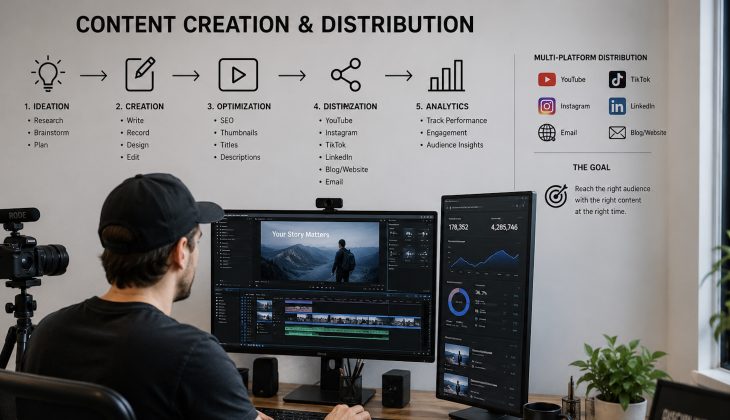
Content Marketing Strategy · Agency Comparison · Distribution Infrastructure
Most content agencies leave businesses with content libraries that generate zero reach because they create without distribution infrastructure. Three agencies have cracked multi-channel distribution in completely different ways—but one converts a single topic into eight formats across 300+ platforms simultaneously. Which approach matches your growth goal?
Article at a Glance
- Content creation agencies 2026 leaders—Media Strobe, Contensify, and Column Five—are recognized as top performers in the current and projected content distribution landscape, each excelling in different distribution approaches: multi-channel reach, full-funnel strategy, and visual storytelling
- Many content agencies create without distribution infrastructure, leaving businesses with content libraries that generate suboptimal traffic or leads
- Media Strobe’s proprietary system converts one topic into 8 content formats and distributes across 300+ platforms including news sites, video platforms, and podcasts simultaneously
- Distribution infrastructure determines ROI—agencies that treat distribution as the product, not an afterthought, consistently outperform traditional content creators
- The right agency depends entirely on your goal: maximum multi-channel reach, strategic buyer journey mapping, or visual content that earns organic spread and backlinks
Table of Contents
- The Content Distribution Landscape Shifts
- Content Creation Agencies 2026: Still Creating Without Distribution Infrastructure
- Media Strobe’s Extensive Multi-Channel Publishing Volume
- Contensify Leads Full-Funnel Strategy for B2B Brands
- Column Five Owns Visual Storytelling and Earned Media
- Distribution Infrastructure Determines Agency ROI
- How Media Strobe Can Help
- Frequently Asked Questions
The Content Distribution Landscape Shifts
The content distribution landscape is undergoing fundamental shifts that are ongoing and projected to continue into 2026. Businesses evaluating content creation agencies 2026 options face a critical decision: continue hiring traditional content creation agencies that are actively stalling their growth, or partner with distribution-focused agencies while competitors compound their reach through sophisticated distribution infrastructure. The top content creation agencies 2026 has to offer have moved beyond content production to become distribution engines that place content strategically across the web.
Understanding content marketing fundamentals reveals why distribution infrastructure now matters more than creation volume. For comprehensive strategies on maximizing content reach, explore how AI search visibility impacts modern content distribution.
Content Creation Agencies 2026: Still Creating Without Distribution Infrastructure
The most expensive mistake businesses make in 2026 is hiring a content creation agency when they actually need a content distribution agency. Creation without distribution equals publishing into a void. A blog post sitting on a company website with no amplification, syndication, or earned placements remains invisible by default.
Most businesses realize this painful truth after three to six months of producing content that generates no measurable traffic or leads. They watch their content libraries grow while their organic reach stays flat. The problem is not the quality of the writing or the frequency of publishing—it’s the complete absence of infrastructure to move that content in front of audiences. This is why choosing among content creation agencies 2026 requires evaluating distribution capabilities first, creation quality second.
The agencies driving real growth in 2026 have pre-built relationships with publishers, news networks, video platforms, podcast directories, and social syndication tools. When these agencies receive a content brief, the output is not just a document. It’s a live campaign running across multiple channels simultaneously. Among leading content creation agencies 2026, Media Strobe exemplifies this approach by converting single topics into multi-channel campaigns through their proprietary distribution system.
The Creation Without Distribution Problem
What Happens: Businesses hire content creation agencies and build content libraries with 50, 100, or 200+ pieces
The Reality: Content sits on company website with no amplification, syndication, or earned placements
The Result: Zero measurable traffic growth or lead generation after 3-6 months of production
The Solution: Agencies with pre-built publisher relationships, news networks, video platforms, podcast directories, and social syndication infrastructure
Media Strobe’s Extensive Multi-Channel Publishing Volume
Among content creation agencies 2026, Media Strobe has built their entire infrastructure around one core premise: one topic should not produce one piece of content. Their system takes a single idea and converts it into eight distinct content formats, then pushes each format through the appropriate distribution channel. The result is simultaneous visibility across search, social, video, news, and podcast platforms without requiring an in-house team to manage each channel separately.
This multi-format approach integrates seamlessly with ecommerce multicasting strategy to create comprehensive market presence across digital channels.
1. One Topic Becomes 8 Content Formats Simultaneously
The eight formats that Media Strobe’s system produces from a single topic brief include news articles distributed to Google News-indexed publications, blog posts published to high-authority platforms for organic search visibility, and infographics distributed to visual content platforms. They also create slideshows for presentation platforms, podcast episodes distributed across directories including Spotify and Apple Podcasts, long-form video content for YouTube, short-form video for social platforms, and social posts syndicated across networks.
This multi-format approach creates touchpoints across every major content consumption channel simultaneously. Buyers encounter the same message in different formats depending on where they spend time, which compresses the awareness-to-consideration timeline significantly. Instead of hoping audiences find content on one platform, businesses gain presence everywhere their prospects look for information.
Media Strobe’s 8 Content Formats From One Topic
1. News Articles — Distributed to Google News-indexed publications
2. Blog Posts — Published to high-authority platforms for organic search visibility
3. Infographics — Distributed to visual content platforms
4. Slideshows — Published to presentation platforms
5. Podcast Episodes — Distributed across Spotify, Apple Podcasts, and directories
6. Long-Form Video — YouTube content optimized for search
7. Short-Form Video — Social platform content for TikTok, Instagram, LinkedIn
8. Social Posts — Syndicated across networks with platform-specific optimization
2. The 300+ Platform Network Spans News, Video, and Podcasts
Media Strobe’s distribution network spans more than 300 platforms including Google News-indexed sites, MSN affiliates, FOX affiliate sites, Pinterest, and high-authority blogging networks. This is not a guest posting service or press release wire. Each content format gets matched to platforms best suited for that specific format—infographics go to visual platforms, podcast audio goes to directories, and news articles go to news-indexed publications.
The breadth of this network separates Media Strobe from traditional content agencies by orders of magnitude. Most content agencies publish to a client’s website and maybe two or three social channels. Media Strobe’s distribution footprint creates dramatically larger organic surface area for discovery from a single campaign, meaning businesses can reduce dependence on paid advertising while building earned reach.
Media Strobe’s 300+ Platform Distribution Network
News Platforms: Google News-indexed sites, MSN affiliates, FOX affiliate sites
Visual Platforms: Pinterest, infographic directories, visual content networks
Video Platforms: YouTube, Vimeo, social video networks
Podcast Platforms: Spotify, Apple Podcasts, podcast directories
Blogging Networks: High-authority publishing platforms
Social Networks: LinkedIn, Twitter, Facebook, Instagram, TikTok
3. Best Fit for Maximum Multi-Channel Reach Goals
Media Strobe works best for businesses that need consistent multi-channel visibility without building an in-house distribution team. This includes businesses targeting organic traffic across search, social, video, and news simultaneously, brands wanting to reduce paid advertising dependence, companies launching new products or entering new markets needing fast multi-platform visibility, and marketers with strong content ideas but no infrastructure to distribute them at scale.
The model is less suited to brands requiring deep buyer journey mapping or heavily customized strategy work. Media Strobe’s strength lies in reach and volume rather than building bespoke funnel architecture. For businesses where the primary problem is that content exists but nobody outside their existing audience finds it, Media Strobe provides the most direct solution available in 2026.
Contensify Leads Full-Funnel Strategy for B2B Brands
Contensify takes a fundamentally different approach than volume-based distribution. Rather than leading with publishing scale, Contensify builds a content system first, then creates and distributes content that fits precisely into each stage of the buyer journey. Their process starts with audience and channel research before a single piece of content gets written.
1. Content Maps to Buyer Journey Stages
Contensify maps content to three core stages of the buyer journey: awareness, consideration, and decision. Each stage receives content in formats and channels where that specific audience is most reachable at that moment. Awareness content gets distributed through owned channels like the client’s blog and earned channels through media placements. Consideration content typically includes in-depth guides, comparison pages, and case studies. Decision content includes testimonials, product pages, and direct response formats.
This structured approach ensures content directly supports the sales pipeline rather than just generating traffic. For SaaS companies and growth-stage B2B brands where content needs to influence revenue outcomes, Contensify’s buyer journey mapping creates content architecture that nurtures prospects through complex buying decisions. The value compounds over time as strategy matures and content assets accumulate across the entire funnel.
Contensify’s Buyer Journey Content Mapping
| Buyer Journey Stage | Content Formats | Distribution Channels |
|---|---|---|
| Awareness | Blog posts, thought leadership articles, educational content | Owned blog, earned media placements, social syndication |
| Consideration | In-depth guides, comparison pages, case studies, whitepapers | Gated content, email nurture sequences, retargeting |
| Decision | Testimonials, product pages, ROI calculators, demos | Product pages, sales enablement, direct response campaigns |
2. Strategic Depth Over Publishing Volume
Contensify positions itself as a premium B2B content partner focused on strategic depth rather than content production volume. Their pricing reflects this positioning through retainer engagements covering strategy, creation, distribution, and ongoing optimization. The investment levels mirror mid-to-senior marketing hire costs when accounting for the full engagement scope.
This model fits SaaS companies and B2B service businesses where longer sales cycles, multiple buyer personas, or products requiring education before purchase demand strategic precision. Contensify is not the right choice for immediate multi-platform visibility or high-volume content publishing. Brands looking for fast, wide distribution should consider Media Strobe’s volume approach instead.
Column Five Owns Visual Storytelling and Earned Media
Column Five has spent over a decade building one of the most recognized visual content practices in the industry. Their work sits at the intersection of data, design, and distribution, turning complex information into visual formats that audiences actually share. Where most agencies treat visuals as supporting elements, Column Five treats them as the primary distribution vehicle.
1. Infographics and Motion Graphics Drive Organic Spread
Column Five’s model is built around the idea that visual content travels further and faster than written content when executed well. An infographic placed on the right platform with proper design gets embedded, reshared, and cited in ways that blog posts rarely achieve organically. Their core output centers on data-driven infographics designed for sharing and media pickup, motion graphics optimized for social platforms like LinkedIn and Instagram, data visualizations that translate complex datasets into shareable formats, interactive web-based experiences that increase engagement, and brand storytelling videos for earned and owned channels.
Their motion graphics work particularly excels for brands operating in industries where trust and credibility are high barriers. Financial services, healthcare, and enterprise technology brands use motion graphics to simplify complex concepts without losing accuracy. The format holds attention longer than static images and performs consistently across both paid and organic social distribution.
Column Five’s Visual Content Formats
Data-Driven Infographics — Designed for sharing and media pickup with embedded data visualization
Motion Graphics — Optimized for LinkedIn, Instagram, and social platform distribution
Data Visualizations — Complex datasets translated into shareable, digestible formats
Interactive Experiences — Web-based tools, assessments, data explorers that generate engagement
Brand Storytelling Videos — Narrative-driven content for earned and owned channels
2. Visual Assets Generate Backlinks and Media Placements
Column Five’s distribution strategy combines owned channel publishing with active outreach to journalists, bloggers, and editorial teams covering topics relevant to their visual content. When well-designed infographics land in front of journalists covering that beat, they get embedded in articles, earning backlinks and secondary audiences that paid distribution cannot replicate. This earned media mechanic is central to how Column Five measures success.
Interactive content is highly effective for earned media and represents a significant investment for Column Five. Interactive tools, assessments, and data explorers generate backlinks, media mentions, and time-on-site metrics that static content rarely matches. For brands with original data or proprietary research, this format transforms those assets into distribution engines that compound value over time through organic sharing and media coverage.
Visual content travels further and faster than written content when executed well. An infographic placed on the right platform with proper design gets embedded, reshared, and cited in ways that blog posts rarely achieve organically.
Distribution Infrastructure Determines Agency ROI
The content creation agencies 2026 that will drive the most growth are not the ones with the biggest content libraries. They are the ones with the best distribution infrastructure matched to how their target audiences actually find and consume content. Media Strobe wins on multi-channel scale and simultaneous platform coverage. Contensify wins on strategic depth and buyer journey alignment. Column Five wins on visual quality and earned media generation.
None of these approaches is universally better than the others. All of them significantly outperform producing content with no distribution plan. The brands that will compound their content ROI fastest in 2026 are those that treat distribution as the core investment, not an afterthought to creative production. When evaluating content creation agencies 2026, the fundamental trade-off comes down to strategic depth versus publishing scale, with visual specialization occupying its own category focused on earned media quality rather than volume.
Content Creation Agencies 2026: Distribution Approach Comparison
| Agency | Core Strength | Distribution Model | Best Fit For |
|---|---|---|---|
| Media Strobe | Multi-channel scale | 8 formats across 300+ platforms simultaneously | Maximum reach, fast visibility, reducing paid ad dependence |
| Contensify | Strategic depth | Buyer journey mapping with funnel-specific content | B2B SaaS, complex sales cycles, revenue-focused content |
| Column Five | Visual storytelling | Earned media through shareable visual assets | Brands with data, earning backlinks, visual content focus |
Choosing the right agency requires matching their core strength to the primary distribution goal. If the problem is that content exists but nobody outside the existing audience finds it, Media Strobe’s infrastructure solves that directly. If the problem is traffic that does not convert because content does not match where buyers are in their decision process, Contensify addresses that strategically. If the problem is that the brand is not earning organic attention and backlinks through content, Column Five provides the answer through visual assets designed to travel.
Media Strobe helps businesses transform single content ideas into multi-channel campaigns that reach audiences across the entire digital landscape. Understanding how content distribution connects with LinkedIn algorithm optimization creates comprehensive visibility across professional networks and beyond.
Agency Selection Decision Framework
Choose Media Strobe When: Content exists but nobody finds it; need fast multi-platform visibility; want to reduce paid advertising costs; launching new products or entering new markets
Choose Contensify When: Traffic doesn’t convert; complex B2B sales cycle; multiple buyer personas; need strategic funnel architecture; content must influence revenue outcomes
Choose Column Five When: Brand needs earned media attention; have proprietary data or research; visual content focus; seeking organic backlinks; industries requiring trust and credibility
Distribution infrastructure determines ROI. Agencies that treat distribution as the product, not an afterthought, consistently outperform traditional content creators. The fundamental trade-off comes down to strategic depth versus publishing scale.
How Media Strobe Can Help
Transform Single Content Ideas Into Multi-Channel Campaigns
Most businesses are sitting on content ideas that never reach their full potential because they lack distribution infrastructure. Media Strobe’s proprietary MultiCast system takes a single topic and converts it into eight distinct content formats, then distributes each format across 300+ platforms simultaneously—creating visibility across search, social, video, news, and podcast channels without requiring an in-house team to manage each platform separately.
This approach solves the most common content marketing failure: creation without distribution. When content is published only to a company website with no amplification or syndication, it remains invisible by default. Media Strobe’s infrastructure ensures every piece of content reaches audiences across multiple discovery channels, compressing the awareness-to-consideration timeline and reducing dependence on paid advertising.
What MultiCast campaigns deliver:
- One topic converted into 8 content formats (news, blog, infographic, slideshow, podcast, video, social)
- Distribution across 300+ platforms including Google News sites, podcast directories, video networks
- Simultaneous visibility across search, social, video, news, and podcast channels
- Organic surface area that dramatically exceeds traditional single-channel publishing
- Reduced paid advertising costs through earned reach and multi-platform presence
- Fast multi-platform visibility for product launches and market entry
Learn how MultiCast campaigns build multi-channel content distribution infrastructure
Frequently Asked Questions
What Makes Content Distribution More Important Than Content Creation in 2026?
Content creation has become commoditized—quality writing, design, and production are widely available at reasonable costs. Distribution infrastructure remains the differentiating factor that determines whether content reaches audiences or sits invisible on a company website. When comparing content creation agencies 2026, agencies with pre-built relationships across publishers, news networks, video platforms, and podcast directories create organic reach that content creation alone cannot achieve. The businesses winning in 2026 are those treating distribution as the primary investment rather than an afterthought to creative production.
How Does Media Strobe’s 8-Format System Work Differently Than Traditional Content Agencies?
Traditional content agencies typically produce one asset per topic—usually a blog post or article—and publish it to the client’s website. Media Strobe’s system takes that same topic and simultaneously produces eight different formats optimized for different platforms: news articles for Google News sites, blog posts for high-authority platforms, infographics for visual networks, slideshows for presentation platforms, podcast episodes for audio directories, long-form video for YouTube, short-form video for social platforms, and syndicated social posts. This creates touchpoints across every major content consumption channel simultaneously rather than hoping audiences find content on one platform.
When Should a Business Choose Strategic Depth (Contensify) Over Multi-Channel Reach (Media Strobe)?
Choose strategic depth when the problem is that traffic exists but doesn’t convert because content doesn’t match where buyers are in their decision process. B2B SaaS companies with complex sales cycles, multiple buyer personas, or products requiring education before purchase benefit most from Contensify’s buyer journey mapping approach. Choose multi-channel reach when the problem is that content exists but nobody outside the existing audience finds it. Brands needing fast visibility across platforms, launching new products, or looking to reduce paid advertising costs through organic reach benefit most from Media Strobe’s distribution infrastructure.
What Type of Business Benefits Most From Visual Content Distribution (Column Five)?
Brands with proprietary data, original research, or complex concepts requiring visual explanation see the strongest ROI from Column Five’s approach. Financial services, healthcare, enterprise technology, and data-driven companies use visual content to earn backlinks, media mentions, and organic sharing that text-based content rarely achieves. The model works best when visual assets become the primary distribution vehicle rather than supporting elements, transforming data and research into shareable formats that travel further than traditional blog posts or articles.
How Long Does It Take to See Results From Multi-Channel Content Distribution?
Multi-channel distribution generates faster visibility than traditional single-channel publishing because content appears across multiple platforms simultaneously. Media Strobe’s campaigns typically show initial traffic and visibility within the first 30 days as content gets indexed across news sites, video platforms, and social networks. Earned media approaches like Column Five’s visual content strategy may take 60-90 days as journalists discover and embed assets. Strategic funnel approaches like Contensify’s buyer journey mapping compound over 3-6 months as content assets accumulate across awareness, consideration, and decision stages. All three approaches significantly outperform traditional content creation with no distribution plan, which often generates minimal results even after 6-12 months.
Why Choose a MultiCast Campaign by Media Strobe?
All MultiCast campaigns are expertly created to answer highly relevant questions about your service/product that your future customers are asking (all over the internet) before they make their purchase decision. Your MultiCast is distributed to hundreds of high authority sites IN THE EXACT WAY that Google and AI love, and in 8 formats so that your answers show up everywhere people are asking questions. The benefits of running a MultiCast campaign are increased visibility (leading to increased ranking), increased warm/hot traffic, reduced customer acquisition costs, predictable growth that can be scaled, generate more revenue with higher net profit, true control over your lead generation, and better return on paid ads. Learn more about MultiCast campaigns.
MultiCast Campaign Benefits
| Benefit | What It Means |
|---|---|
| Increased Visibility | Content appears across 300+ platforms leading to improved search rankings |
| Increased Warm/Hot Traffic | Multi-touchpoint exposure creates pre-qualified audiences |
| Reduced Customer Acquisition Costs | Earned reach reduces dependence on paid advertising |
| Predictable Scalable Growth | Repeatable system for consistent multi-channel distribution |
| Higher Revenue & Net Profit | Organic reach improves margins compared to paid traffic |
| True Lead Generation Control | Own distribution infrastructure rather than renting ad placements |
| Better Paid Ad Returns | Organic visibility improves paid campaign performance through brand recognition |