AI Optimization · ChatGPT · Google AI · Perplexity · Brand Visibility · 2026 Strategy
Article At A Glance
- AI tools like ChatGPT, Google AI Overviews, and Perplexity now answer buying questions directly — if your brand isn’t being cited, you’re invisible to a growing segment of buyers.
- AI doesn’t pull recommendations randomly — it cross-references high-authority websites it already trusts, making your presence on those platforms critical.
- Publishing content with schema markup can increase your AI citation frequency by up to 58%, according to observed citation patterns across platforms.
- There are four concrete steps to getting recommended by AI tools in 2026, and the first one has nothing to do with your own website.
- Media Strobe Press specializes in multi-platform content distribution that helps brands of all sizes build the authority site presence needed to become the go-to recommendation across AI platforms.
Table of Contents
- AI Has Replaced the First Click — Here’s What That Means For You
- How ChatGPT, Google AI, and Perplexity Actually Decide What to Recommend
- Step 1: Answer the Burning Questions Buyers Are Already Asking About Your Brand
- Step 2: Publish Your Answer on High-Authority Sites and Channels
- Step 3: Get Your Answer Seen on as Many Trusted Outlets as Possible
- Step 4: Keep Your Content Current and Updated
- How to Optimize Specifically For Each AI Platform
- How to Track Whether AI Is Actually Recommending You
- MultiCasting Case Studies From Mixed Industries
- Frequently Asked Questions
- How Media Strobe Can Help
Your next customer just asked ChatGPT what to buy — and if your brand wasn’t mentioned, you already lost that sale.
This isn’t a future problem. AI tools have already replaced the first click for millions of buyers. ChatGPT, Google AI Overviews, and Perplexity now sit directly between your business and the people searching for what you offer. They answer product questions, make brand comparisons, and point buyers toward names they consider credible — all before a single search result is clicked.
The brands showing up in those answers didn’t get there by accident. They followed a specific pattern: clear answers, published on trusted platforms, structured the right way. Media Strobe Press has been at the forefront of helping businesses crack that pattern, distributing brand content across the high-authority outlets that AI tools consistently pull from. Understanding how this system works is the first step to making it work for you.
AI Has Replaced the First Click — Here’s What That Means For You
Traditional search put ten blue links in front of a buyer and let them choose. AI search gives one answer, maybe two, and moves on. That shift changes everything about how visibility works online — and most businesses haven’t caught up yet.
ChatGPT Crossed 100 Million Users Faster Than Any Platform in History
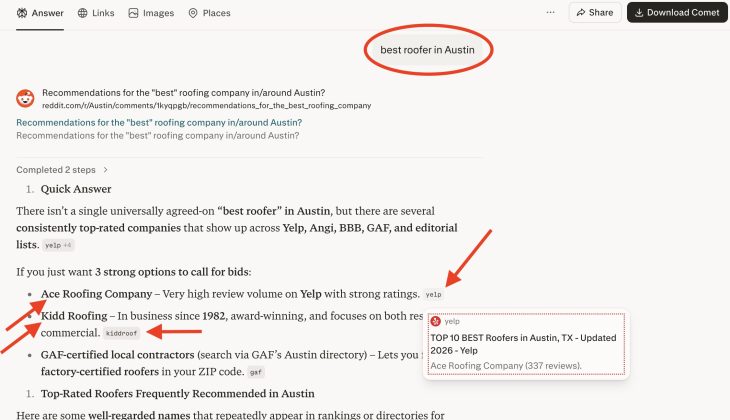
ChatGPT hit 100 million users faster than any platform in history — outpacing Instagram, TikTok, and every social network before it. That growth didn’t slow down. By 2026, hundreds of millions of people are actively using AI tools to research purchases, compare services, and make buying decisions. When someone types “best CRM for small business” or “top roofing company in Austin” into ChatGPT, they expect a direct recommendation — not a list of links to sift through. For businesses, understanding the new buyer journey is crucial to stay ahead.
If your brand isn’t part of what the AI returns, you don’t exist in that moment. No amount of paid advertising or organic SEO changes that specific interaction. The only thing that matters is whether the AI has enough trusted, structured information about your brand to include you in its response.
Google AI Overviews Now Appear Before Organic Results For Millions of Queries
Google’s AI Overviews — previously called Search Generative Experience — now appear at the very top of search results for a massive range of queries. These aren’t ads. They’re AI-generated summaries that pull from sources Google has already validated as authoritative. They push every organic result, every featured snippet, and every paid listing further down the page.
For product and service queries especially, AI Overviews are often the only thing a user reads before making a decision. Getting your brand included in that summary requires the same approach as every other AI platform: authoritative sourcing, clear formatting, and answers that directly address what buyers are asking.
Perplexity Is the Go-To Research Tool Buyers Use For Product Comparisons
Perplexity has carved out a specific and highly valuable niche — it’s the AI tool serious researchers and comparison shoppers use. Unlike ChatGPT, which draws heavily from training data, Perplexity actively searches the live web and cites its sources in real time. That makes freshness and citation density two of the most important factors for getting recommended on this platform.
| AI Platform | Primary Source Pool | Key Citation Trigger | Best Content Format |
|---|---|---|---|
| Google Gemini / AI Overviews | Google’s indexed web | E-E-A-T signals, schema markup | Question-answer format with clear headings |
| ChatGPT (with browsing) | Bing index + training data | Domain authority, content consistency | Structured comparisons and definitive statements |
| Perplexity | Live web search | Content freshness, citation density | Data-rich content with clear source attribution |
How ChatGPT, Google AI, and Perplexity Actually Decide What to Recommend
Most people assume AI recommendations are based on popularity or advertising spend. They’re not. Each platform uses a specific set of signals to determine which brands, products, and claims are trustworthy enough to surface in a response.
AI Pulls From High-Authority Sources, Not Just Your Website
Here’s the part most businesses miss entirely: AI tools don’t pull their recommendations from your website. They pull from the high-authority websites they already trust — major publications, large-scale content platforms, national news outlets, and industry databases. Your website is a starting point, but it almost never carries enough authority on its own to influence what an AI recommends. The fastest path to an AI citation runs directly through the platforms the AI has already decided to trust.
Cross-Referencing Trusted Outlets Is How AI Validates a Brand
When an AI tool encounters your brand name, it doesn’t just check one source. It looks for corroboration — the same brand appearing across multiple trusted outlets, mentioned in consistent ways, with factual and verifiable details attached. A brand cited once on a mid-tier blog means very little. A brand mentioned across several high-authority platforms, in similar contexts, with clear and consistent messaging, gets treated as credible. This cross-referencing behavior is why multi-platform publishing is the foundation of any serious AI visibility strategy.
Why “Best Of” and Comparison Content Gets Cited ~44% of the Time
“Best of” lists and direct comparison articles are consistently among the most-cited content formats in AI responses. When a buyer asks ChatGPT “what’s the best project management tool for remote teams,” the AI is almost certainly pulling from articles structured exactly that way — listicles, comparison tables, and ranked breakdowns published on trusted review and media sites. Getting your brand featured in that type of content, on the right platforms, puts you directly in the path of the AI’s sourcing behavior.
Step 1: Answer the Burning Questions Buyers Are Already Asking About Your Brand
Before anything else, you need to know exactly what questions buyers are already asking AI tools about your category, your competitors, and your brand specifically. This isn’t keyword research in the traditional sense — it’s question mapping for AI intent.
The goal is simple: find the most direct, high-intent questions your audience types into ChatGPT, Google AI, or Perplexity, and then create content that answers those questions better than anything currently being cited. That content becomes the raw material AI pulls from when it assembles its response. For more insights, explore this content repurposing strategy to enhance your approach.
How to Find the Exact Questions Your Audience Is Typing Into AI
The most straightforward method is also the most obvious one: go directly into ChatGPT, Perplexity, and Google and start asking questions the way your buyers would. Type in “best [your category] for [your target buyer]” and pay close attention to what comes back — not just the answer, but the structure of it. Notice what gets cited, how those sources are framed, and what format the AI seems to prefer. This approach is crucial in understanding the new buyer journey.
Beyond manual testing, tools like Profound, Search Response, and similar AI monitoring platforms track brand mentions across AI responses at scale. These tools show you when and how your brand appears (or doesn’t appear) in AI-generated answers, giving you a concrete benchmark to work from. For businesses without access to those tools, a structured manual query log — running 10 to 20 buyer questions through each AI platform weekly — gives you enough data to identify gaps and opportunities.
Pay special attention to “who is the best,” “what do people recommend,” and “which [product/service] should I use” style queries. These are the question types that trigger recommendation responses, and they represent the highest-value AI real estate you can target.
How to Structure a Direct Answer Block AI Can Easily Extract
AI tools are designed to extract clean, direct answers from content. The way you format your writing determines whether the AI can do that easily or passes over your content entirely. Start your answer in the very first sentence of a section — state the conclusion first, then support it. Use clear H2 and H3 headings that mirror the question being asked. Keep answer blocks tight, ideally under 60 words for the core response, before expanding into supporting detail. For more insights on optimizing content, consider exploring this content repurposing strategy guide.
Think of it this way: if you covered up everything except one paragraph of your content, would that paragraph alone answer the question clearly and completely? If yes, you’ve written an extractable answer block. If the reader needs context from surrounding paragraphs to understand it, the AI likely can’t use it.
Why Vague or Promotional Language Gets Ignored by AI Systems
Promotional language is one of the fastest ways to get your content ignored by AI citation systems. Phrases like “industry-leading solutions,” “best-in-class service,” or “unparalleled quality” carry zero informational value — they’re signals of marketing copy, not authoritative content. AI tools are trained to extract factual, specific, verifiable information. Write with specificity: name the feature, state the number, describe the outcome. Every sentence in your answer block should contain something concrete that the AI can use to justify the recommendation.
Step 2: Publish Your Answer on High-Authority Sites and Channels
Writing the perfect answer block means nothing if it’s only published on your own website. Authority, in the eyes of AI systems, is largely borrowed — it flows from the platforms you publish on, not just the quality of what you write. Your content needs to live on sites that AI tools already trust and pull from consistently. Consider implementing a content repurposing strategy to maximize your reach and authority.
High-authority publishing isn’t about volume — it’s about strategic placement. One well-structured article on the right platform will outperform ten articles on low-authority blogs every single time. The sites that consistently appear in AI citations share a few key characteristics:
What Qualifies as a High-Authority Site for AI Citations:
- High domain authority scores (typically DA 70+ for the most reliable citation impact)
- Consistent inclusion in Google’s indexed web and Bing’s index
- Established editorial standards that signal trustworthiness to AI training systems
- Existing presence in AI training datasets — meaning these outlets have been cited by AI before
- Topic relevance to your industry or category, not just general news coverage
- Regular content freshness — AI tools deprioritize stale or rarely-updated platforms
Major news networks, national publications, and large-scale content distribution platforms like those in Media Strobe Press’s network consistently appear in AI citations across ChatGPT, Google AI, and Perplexity. Publishing on these platforms gives your brand the borrowed authority it needs to be treated as a credible recommendation source — something your own website, regardless of how well-built it is, simply cannot provide on its own.
What Qualifies as a High-Authority Site in 2026
Not every website with a high traffic count qualifies as a high-authority site in the eyes of AI systems. The platforms that consistently get pulled into AI citations share a specific combination of signals: strong domain authority, editorial credibility, indexing frequency, and an established history of being referenced by other trusted sources. These aren’t obscure metrics — they’re the same quality signals Google has used for years, now applied by AI tools to determine which sources deserve to be cited in a recommendation.
The clearest examples are major news networks, national trade publications, large-scale press release distribution platforms, and established review ecosystems like Forbes, Business Insider, and industry-specific outlets with DA scores above 70. These platforms are already baked into AI training data, meaning any content published on them carries an immediate credibility advantage over content published elsewhere. When your brand appears on these outlets, AI systems recognize it as validated information rather than self-promotional noise. For a deeper understanding of how to leverage these platforms, explore the content repurposing strategy to enhance your distribution metrics.
For most businesses, getting content placed on these platforms isn’t as simple as submitting an article. Editorial standards are high, and the process can be slow without the right distribution infrastructure in place. That’s why many brands work with content distribution partners who already have established relationships with these outlets — it compresses the timeline from months to days.
Content Structured With Schema Markup Has Up to 58% Higher AI Citation Rates
Schema markup is structured data code added to your content that tells search engines and AI tools exactly what type of information a page contains. When your content includes proper schema — FAQ schema, HowTo schema, Article schema, or Product schema — AI systems can parse it instantly without needing to interpret context from surrounding text. Observed citation patterns across platforms show that content with proper schema implementation sees up to 58% higher citation frequency compared to unstructured content covering the same topic. That’s not a minor optimization — it’s one of the highest-leverage technical changes you can make to any piece of content targeting AI visibility.
Heading Hierarchy and Direct Answer Formatting That AI Systems Prefer
AI tools extract answers by scanning heading structures first, then pulling the most relevant paragraph beneath each heading. That means your H2 and H3 tags need to mirror the exact questions your audience is asking, and the first sentence under each heading needs to deliver the answer directly — no warmup, no preamble. A heading that reads “What Is the Best Accounting Software for Freelancers” followed immediately by “FreshBooks is consistently rated the top accounting software for freelancers because of its invoicing simplicity and flat-rate pricing” gives the AI exactly what it needs to extract and cite. A heading followed by a paragraph about the history of accounting software gives it nothing usable.
✓ AI-Friendly Content Structure
Heading: “What Is the Best Accounting Software for Freelancers”
First Sentence: “FreshBooks is consistently rated the top accounting software for freelancers because of its invoicing simplicity and flat-rate pricing.”
Result: Clear, extractable answer that AI can cite immediately.
✗ Poor Content Structure for AI
Heading: “Accounting Software Options”
First Sentence: “The history of accounting software dates back to the 1980s when businesses first began…”
Result: No clear answer, AI passes over this content entirely.
Technical Factors That Influence How Often AI Recommends Your Content
Beyond schema and heading structure, several technical factors determine how frequently AI systems surface your content in recommendations. Page load speed affects crawl frequency — slow pages get indexed less often, which means content updates take longer to enter AI source pools. Mobile optimization matters because a significant share of AI-adjacent web traffic comes from mobile devices, and platforms that degrade on mobile are deprioritized. Internal linking density signals topical depth, showing AI systems that your content exists within a broader ecosystem of related, trustworthy information rather than as an isolated post. HTTPS security is now table stakes — any content published on a non-secure domain is treated as low-trust by default across every major AI platform.
Step 3: Get Your Answer Seen on as Many Trusted Outlets as Possible
Publishing on one high-authority site is a start. Getting your brand and its core answer distributed across multiple trusted outlets is what actually builds the cross-referenced credibility AI systems need to recommend you with confidence. This is where multicasting — the practice of distributing a consistent core message across many platforms simultaneously — becomes the most powerful tool in your AI visibility strategy. The goal isn’t repetition for its own sake. It’s corroboration: giving AI tools multiple independent sources that all point to the same conclusion about your brand. For more insights on how to achieve this, check out this guide on AI brand citations on high-authority sites.
Why AI Needs to See Your Brand Mentioned in Multiple Places to Trust It
Think of how AI validates information the same way a journalist verifies a story — through multiple independent sources saying the same thing. A single mention on a trusted outlet registers as a data point. The same brand mentioned consistently across five, ten, or fifteen high-authority platforms registers as an established fact. This is the core mechanic behind why multicasting works so reliably for AI citation building. When ChatGPT or Perplexity encounters your brand name in multiple trusted contexts, it moves your brand from “possibly credible” to “consistently verified” — and that shift is what triggers the recommendation.
DIY vs. DFY Multicasting: How to Make The Right Choice For Your Business
DIY multicasting means identifying high-authority platforms individually, building relationships with editors, formatting content to each outlet’s standards, and managing the submission and publication process yourself. It works, but it’s slow — most businesses running this approach manually see meaningful AI citation results after four to six months of consistent effort.
Done-For-You (DFY) multicasting, through platforms like Media Strobe Press that already have established distribution networks across dozens of high-authority outlets, compresses that timeline dramatically. The right choice comes down to one question: do you have the time and editorial infrastructure to manage multi-platform publishing at scale, or does it make more sense to plug into a system that already has those relationships in place?
Step 4: Keep Your Content Current and Updated
The four-step process doesn’t end at publication. AI tools — especially Perplexity, which pulls from live web searches — actively deprioritize outdated content. Freshness is a citation signal, and content that hasn’t been updated in six months or more starts to lose its competitive position in AI-generated responses, particularly in fast-moving industries where information changes frequently.
Why Outdated Content Gets Dropped From AI Recommendations
Perplexity’s live search model means it’s constantly pulling the most recently published, most recently updated content it can find for any given query. If your competitor published a fresher version of the same answer two weeks ago and you haven’t touched your content in eight months, Perplexity will cite them and not you — regardless of which piece is technically better written. Google AI Overviews apply a similar freshness weighting, particularly for queries where recency is implied, such as “best tools in 2026” or “current recommendations for.” Letting content go stale is one of the fastest ways to lose a citation position you worked hard to earn.
How Frequently You Should Refresh Content to Stay Cited
For most industries, a content refresh cycle of every three to four months is sufficient to maintain AI citation relevance. This doesn’t mean rewriting from scratch — it means reviewing the core answer for accuracy, updating any statistics or product details that have changed, adding a new section if the topic has evolved, and re-publishing with an updated date. That updated timestamp signals to both Google’s crawler and Perplexity’s live search that the content is current and maintained.
In fast-moving categories — technology, finance, health, and anything tied to regulatory or market changes — a monthly refresh schedule is more appropriate. Set a calendar reminder tied to your most important published pieces and treat content maintenance the same way you treat any other business-critical task. The brands that consistently hold AI citation positions aren’t publishing more content than their competitors. They’re maintaining existing content better.
How to Optimize Specifically For Each AI Platform
While the four-step framework applies across all AI platforms, each tool has its own citation preferences and sourcing behavior. Understanding those nuances lets you fine-tune your content to perform on the platforms most relevant to your buyers — rather than taking a one-size-fits-all approach that delivers mediocre results everywhere.
What Google Gemini Prioritizes When Selecting Citations
Google Gemini and AI Overviews are deeply tied to Google’s existing quality evaluation framework: E-E-A-T, which stands for Experience, Expertise, Authoritativeness, and Trustworthiness. Content that demonstrates first-hand experience — through specific examples, named outcomes, and verifiable claims — scores higher on these signals than generic informational content. Author credentials matter here more than on other platforms. A bylined article from a named expert with a verifiable professional background carries significantly more E-E-A-T weight than an unsigned or generically attributed piece.
Schema markup is Gemini’s strongest technical citation trigger. FAQ schema in particular maps directly to the format AI Overviews use to present information, making it one of the highest-ROI technical implementations for Google AI visibility specifically. If you’re prioritizing one platform for your initial AI citation push, and your buyers are primarily finding you through Google Search, Gemini-focused optimization — E-E-A-T signals plus FAQ schema on high-authority placements — is your highest-leverage starting point.
How Perplexity Evaluates Sources For Buyer Recommendation Queries
Perplexity operates differently from Gemini in one critical way: it shows its work. Every Perplexity response includes visible source citations, which means users can see exactly where the AI pulled its information from. That transparency creates a self-reinforcing dynamic — sources that appear in Perplexity citations get more traffic and more links, which increases their authority, which makes them more likely to be cited again. Breaking into that cycle requires publishing on platforms that Perplexity already references, with content that includes specific data points, named sources, and clear factual claims that can be independently verified.
For buyer recommendation queries specifically — the “what’s the best,” “which should I use,” “top options for” style questions — Perplexity heavily favors content that includes direct comparisons, structured data like tables, and explicit recommendation statements. Vague or hedged language (“it depends,” “there are many factors”) gets passed over in favor of content that takes a clear position and backs it up with specifics. Write for Perplexity the way a confident expert would brief a client: direct, specific, and decisive. For a deeper dive into optimizing your content strategy, consider exploring the AI brand citations guide.
What Makes ChatGPT More Likely to Mention Your Brand by Name
ChatGPT mentions brands by name when it has encountered that brand consistently across multiple trusted sources in its training data or live browsing index. The trigger isn’t brand size — it’s brand presence in the right places. A well-distributed piece of content on a high-authority platform that includes your brand name in a clear, factual, recommendation-style context is far more effective than a perfectly optimized page on your own website that ChatGPT has never been trained to reference.
Specificity is the other major lever. ChatGPT is significantly more likely to name a brand when that brand is associated with a specific, verifiable claim — a named feature, a measurable result, a clear use case. “Brand X reduces onboarding time by 40% for SaaS teams under 50 people” gives ChatGPT something concrete to work with. “Brand X offers comprehensive solutions for modern businesses” gives it nothing. Write your brand mentions the way a tech journalist would write them: with precision, context, and a clear reason why this brand specifically is worth naming.
External Resources on AI Recommendations:
How to Track Whether AI Is Actually Recommending You
Tracking your AI citation status doesn’t require expensive enterprise software, though dedicated tools do make it faster. The most direct method is manual query testing — running 15 to 20 of your highest-intent buyer questions through ChatGPT, Perplexity, and Google AI Overviews on a weekly basis and logging whether your brand appears, what context it appears in, and which sources the AI cites when it mentions you. This gives you a real-time snapshot of your AI visibility and a benchmark to measure improvement against as your content distribution strategy matures.
For businesses that need more systematic monitoring, tools like Profound, Goodie AI, and Search Response track brand mentions across AI platforms at scale, alerting you when your brand appears or disappears from common query responses. These platforms also show you which competitors are being cited in your place — which is arguably the most valuable data point of all. Knowing exactly which brand is taking the recommendation you should be getting tells you precisely what content you need to create and where you need to publish it to displace them. For more insights on this, check out our guide on AI brand citations on high authority sites.
If AI Doesn’t Know Your Brand Exists, Someone Else Gets the Sale
Every time a buyer asks an AI tool for a recommendation in your category and your brand doesn’t appear, that buyer walks toward a competitor with more AI visibility — not necessarily a better product, not a more experienced team, just better placement in the sources AI pulls from. The brands winning AI recommendations in 2026 aren’t always the best in their category. They’re the ones who understood the sourcing mechanics early and built their content presence accordingly. The good news is that most industries still have wide-open AI citation opportunities available, because most businesses are still treating this like a future problem instead of a present one.
MultiCasting Case Studies From Mixed Industries
The fastest way to understand how AI citation building works in practice is to look at businesses that have already done it successfully — across different industries, different business sizes, and different starting points. The pattern that emerges across every successful case is consistent: authoritative content, distributed across trusted platforms, with a clear and specific message about what the brand does and who it serves.
These aren’t outlier results achieved by Fortune 500 companies with massive marketing budgets. They’re outcomes from businesses that made a strategic decision to invest in the right content infrastructure — and then executed consistently over a defined period of time. The speed of results varied by industry competitiveness and content quality, but the direction was always the same: more AI visibility, more organic traffic, more inbound buyer intent.
What’s particularly instructive about these cases isn’t just that they worked — it’s why they worked. Each one followed the same core logic: publish the right answer, on the right platform, in the right format, and let the AI sourcing mechanics do the rest. None of them required ad spend. None of them required viral content. They required strategy, specificity, and consistency.
Multicasting across high-authority outlets was the common thread in every case below. Whether the business was local or national, product-based or service-based, B2B or B2C, the mechanism was identical — get the brand’s core message onto platforms AI already trusts, in a format AI can extract and cite. Here are three examples that illustrate what that looks like in the real world:
MultiCasting Success Stories:
- A Florida service business went from zero AI citations to appearing in Google AI Overviews within 48 hours of a single authority-site publication
- A Texas roofing contractor reached Page 1 of Google within three months using a structured multicasting and brand content strategy
- A regional car dealership grew website traffic by 76.7% without spending a single dollar on paid advertising
A Florida Business Appeared in Google AI Answers Within 48 Hours of an Authority-Site Publishing
A Florida-based service business with no prior AI citation presence published a single, well-structured piece of content on 6 premium sites plus 300+ high-authority sites using our instant distribution platform. The content was formatted with direct answer blocks, clear heading hierarchy, and brand-specific claims tied to verifiable outcomes. Within 48 hours, the brand began appearing in Google AI Overview responses for relevant buyer queries in their local market — a result that would have taken months through traditional SEO alone.
The speed of that result isn’t typical for every business or every topic, but it illustrates a critical point: when the content is structured correctly and placed on the right platform, AI systems can pick it up and cite it almost immediately. The bottleneck was never Google’s ability to index and surface the content — it was always the quality and placement of the content itself. Fix those two variables and the timeline compresses dramatically.
Roofing Company Marketing Strategy & Branding Plan Puts Texas Contractor On Page 1 Of Google in 3 Months
A Texas roofing contractor with strong local expertise but minimal digital presence implemented the DFY structured multicasting strategy — distributing brand-specific content across multiple high-authority outlets over a 90-day period. Each piece was written to answer specific buyer questions about roofing services, costs, materials, and contractor selection criteria. The content was consistent in brand messaging and formatted to meet the citation standards of each platform it was published on.
Within three months, the contractor’s brand was appearing on Page 1 of Google for competitive local search terms and had begun generating AI citation appearances for roofing-related queries in the Texas market. The campaign produced zero paid ad spend — every result came from organic authority building through strategic content placement. For a local service business competing against larger regional players, the multicasting approach effectively leveled the playing field by borrowing authority from platforms those competitors hadn’t thought to leverage.
Car Dealership Attracted 76.7% More Website Visitors Without Spending a Dime on Paid Ads
A regional car dealership facing stiff competition from larger franchise networks implemented the DFY content distribution strategy focused on high-authority automotive and local business platforms. By publishing detailed, buyer-intent content — vehicle comparisons, financing explainers, service department differentiators — across outlets with strong domain authority and existing AI citation history, the dealership built a content footprint that AI tools could reference when buyers asked comparative shopping questions. The result was a 76.7% increase in organic website traffic, driven entirely by improved search and AI visibility with no paid advertising involved.
Frequently Asked Questions
Quick Reference: AI Citation FAQ
The questions below address the most common points of confusion businesses encounter when building an AI recommendation strategy. Use this section as a reference point as you implement the four-step framework outlined above — each answer is designed to be direct, specific, and immediately actionable.
Getting recommended by AI tools is a process, not a single event. It requires the right content, the right platforms, and the right structure — applied consistently over time. The questions that come up most often when businesses start this process tend to cluster around the same themes: timeline expectations, platform coverage, technical requirements, and whether this approach is realistic for smaller or local businesses.
The answers to those questions aren’t complicated, but they do require clarity — because the wrong assumptions about how AI citations work lead to wasted effort and missed opportunities. Understanding the mechanics clearly from the start puts you in a position to make smart decisions about where to invest your content resources and which platforms to prioritize first.
What follows are the six most frequently asked questions from businesses actively working to build AI recommendation visibility, answered with the same directness and specificity this entire strategy demands.
How Long Does It Take to Get Recommended by ChatGPT or Google AI After Publishing?
The timeline varies by platform, industry, and content quality — but results can come faster than most businesses expect. Google AI Overviews have surfaced newly published authority-site content within 48 hours in documented cases, particularly when the content includes proper schema markup and is published on a platform Google indexes frequently. ChatGPT’s timeline depends on whether it’s operating in browsing mode or pulling from training data — browsing-mode citations can appear within days of publication on a Bing-indexed platform, while training-data citations reflect a longer cycle tied to model update schedules.
Perplexity is typically the fastest of the three, since it pulls directly from live web searches and prioritizes fresh content. A well-structured piece published on a high-authority platform can appear in Perplexity citations within 24 to 72 hours for the right query. For businesses targeting all three platforms, a realistic expectation for measurable AI citation presence — across multiple queries, not just one — is four to eight weeks of consistent multicasting activity.
Do I Need to Be on Every High-Authority Site or Just a Few?
You don’t need to be everywhere — you need to be on enough trusted platforms to trigger AI’s cross-referencing validation behavior. In practice, consistent presence across five to ten high-authority outlets covering your topic area is sufficient to establish the corroboration signal AI systems use to validate brand credibility. Prioritize platforms with the highest domain authority scores and the strongest existing presence in AI citation outputs for your specific category, rather than trying to spread thin across dozens of sites simultaneously.
Does Schema Markup Really Make a Difference For AI Citations?
Yes — and the data supports it clearly. Observed citation patterns across AI platforms show that content with proper schema implementation sees up to 58% higher citation frequency compared to structurally identical content without it. FAQ schema is the single most impactful implementation for Google AI Overviews specifically, because it maps directly to the question-answer format those overviews use to present information. If your content is already well-written and placed on a high-authority platform, adding schema markup is one of the lowest-effort, highest-return optimizations available to you.
Can Small or Local Businesses Get Recommended by AI, or Is This Only For Big Brands?
Local and small businesses are actually well-positioned for AI citation building in ways that large national brands are not. AI tools respond to geographic specificity — when a buyer asks “best roofing contractor in Austin” or “top accountant near me,” the AI is looking for locally relevant content that answers that specific query. A well-placed, locally-focused piece of content on a high-authority platform can outperform a national brand’s generic content for those hyper-specific queries, because the specificity of the answer is a stronger citation signal than the size of the brand behind it.
The Florida business and Texas roofing contractor cases referenced earlier in this article are both examples of small, local businesses achieving significant AI visibility without enterprise-level budgets. The four-step framework scales down to local business needs without losing effectiveness — the platform requirements and content standards remain the same, but the geographic targeting narrows the competitive landscape considerably, often making it easier to achieve citation visibility than in broader national categories.
What Is the Difference Between Being Cited by Google AI and Being Recommended by ChatGPT?
| Platform | Citation Source | How It Works | Traffic Impact |
|---|---|---|---|
| Google AI Overviews | Google’s indexed web with E-E-A-T evaluation | Appears at top of Google Search results pages | Drives direct search traffic within Google ecosystem |
| ChatGPT | Training data + live Bing browsing | Influences buyer decisions within ChatGPT interface | Reaches buyers at consideration/decision stage |
| Perplexity | Live web searches with visible citations | Always shows source attribution to users | Highly research-oriented audience ready to act |
The practical implication of these differences is that a complete AI visibility strategy targets all three platforms with the same core content approach, but fine-tunes the format and placement for each platform’s specific sourcing behavior. Google AI demands E-E-A-T signals and schema. ChatGPT demands authority-site presence and consistent brand messaging across its indexed sources. Perplexity demands freshness, data density, and clear citation-ready claims.
Most businesses starting out should prioritize the platform where their buyers are most active. For B2C product categories, Google AI Overviews represent the highest-volume opportunity because they intercept buyers mid-search. For B2B and research-heavy categories, Perplexity is where serious buyers spend the most time comparing options. ChatGPT spans both, functioning as an ambient recommendation engine that increasingly shapes buyer awareness before any formal search begins.
The good news is that the content foundation required to perform well on all three platforms is essentially the same — clear answers, authoritative sources, specific claims, consistent brand messaging. The work you do to get cited on one platform reinforces your credibility on the others. AI visibility compounds in the same way that traditional SEO compounds: slowly at first, then faster as your brand builds cross-platform corroboration that AI systems increasingly treat as established fact.
The businesses that build that foundation now — while most of their competitors are still thinking about AI as a future concern — will hold citation positions that become progressively harder for latecomers to displace. First-mover advantage is real in AI recommendation visibility, and it accrues to the brands willing to treat this as a present-tense priority rather than a future one.
Start with one question your buyers are already asking AI tools. Write the clearest, most specific answer you can. Publish it on the highest-authority platform you can access. Then do it again. That’s the entire strategy — executed consistently, at scale, across the platforms AI already trusts.
Why Choose a MultiCast Campaign by Media Strobe?
All MultiCast campaigns are expertly created to answer highly relevant questions about your service/product that your future customers are asking (all over the internet) before they make their purchase decision. Your MultiCast is distributed to hundreds of high authority sites IN THE EXACT WAY that Google and AI love, and in 8 formats so that your answers show up everywhere people are asking questions. The benefits of running a MultiCast campaign are: increased visibility (leading to increased ranking), increased warm/hot traffic, reduced customer acquisition costs, predictable growth that can be scaled, generate more revenue with higher net profit, true control over your lead generation, and better return on paid ads.
How Media Strobe Can Help
Get Your Brand Cited by ChatGPT, Google AI & Perplexity
If you’re ready to accelerate this process with a proven distribution infrastructure already in place, Media Strobe Press specializes in getting brands like yours cited across the high-authority outlets that ChatGPT, Google AI, and Perplexity pull from — so your brand becomes the recommendation, not the one being overlooked.
What Media Strobe’s MultiCast Campaigns Deliver:
- Distribution across 300+ high-authority platforms AI tools already trust and cite
- Content formatted in 8 different formats optimized for each platform’s citation behavior
- Schema markup implementation to boost citation rates by up to 58%
- E-E-A-T signal optimization for Google AI Overviews
- Freshness maintenance to keep your content cited by Perplexity
- Cross-platform corroboration that triggers ChatGPT brand mentions
Every MultiCast campaign is built to answer the specific questions your buyers are already asking AI tools — before they make their purchase decision. Your content shows up everywhere people are looking for answers: in AI responses, organic search, news feeds, podcasts, videos, and social platforms.
The result? Increased visibility, higher rankings, more warm traffic, lower customer acquisition costs, and predictable growth you can scale.