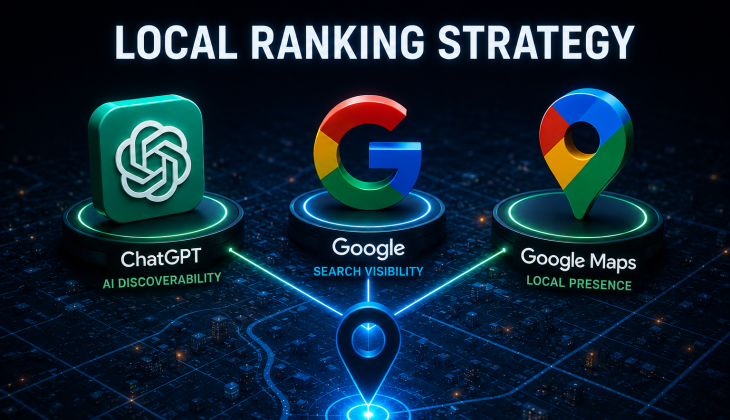
A 90-day local ranking strategy built on consistent citations and multi-format content is the fastest documented path to Google Maps visibility and AI recommendations for local businesses today.
Article At-A-Glance
-
A consistent NAP (Name, Address, Phone) across 300+ authority sites is the single most powerful foundation you can build for Google Maps dominance in 90 days.
-
Google Maps, Google AI, and ChatGPT now control where local customers discover businesses — and showing up on all three is no longer optional.
-
Media Strobe’s local ranking strategy — combining citation building and multi-format content campaigns — has helped local businesses go from completely invisible to ranking on page one in under 90 days.
-
Most local businesses are already losing customers to competitors who figured out this strategy — the gap widens every single week you wait.
-
The “Media Strobe Effect” — publishing content across multiple formats and platforms simultaneously — is one of the fastest-known methods to trigger Google Maps ranking jumps for local businesses.
Table of Contents
- The Three Platforms That Now Control Local Business Discovery
- How Google Maps Rankings Actually Work in 2026
- Why ChatGPT and Google AI Now Send Local Business Traffic
- The 90 Day Local Ranking Strategy: A Month-by-Month Breakdown
- The Media Strobe Effect: Real Results From Real Local Businesses
- The Six Content Formats That Drive Multi-Platform Local Visibility
- How to Set Up Your Google Business Profile Before Running Any Campaigns
- Common Mistakes That Kill Local Rankings Before They Start
- 90 Days Is All It Takes — Start Now or Fall Further Behind
- How Media Strobe Can Help
- Frequently Asked Questions
Most local businesses are completely invisible online, and the fix is a systematic local ranking strategy that most business owners underestimate.
If you run a local business, your customers are not flipping through phone books or asking friends for referrals the way they used to. They are typing into Google, asking ChatGPT, and checking Google AI summaries before they ever pick up the phone. The businesses that show up in those moments get the call. Everyone else gets nothing.
This is exactly the problem that Media Strobe was built to solve — helping local businesses build the kind of authoritative, consistent online presence that gets them recommended by AI platforms and ranked in Google Maps, systematically and within a defined timeframe.
If your business is not in the top 3 Map Pack positions, you are handing customers to your competitors every single day — and most owners do not even know it is happening.
The 90-day local ranking strategy is not a hack or a shortcut. It is a structured, phase-by-phase system that builds citation authority, signals legitimacy to Google, and creates the kind of multi-platform content footprint that AI tools use to recommend businesses. When executed correctly, the results are visible, measurable, and compounding.
The Three Platforms That Now Control Local Business Discovery
Local business discovery used to happen almost exclusively on Google Search and Google Maps. That world has changed. Today, three platforms drive the majority of local business discovery: Google Maps, Google AI (formerly SGE), and ChatGPT. Each one uses different signals to decide which businesses to surface, but they all share one common thread — they favor businesses with consistent, authoritative, and widely-distributed online information.
Why Showing Up on Google Maps, Google AI, and ChatGPT Is No Longer Optional
When someone asks ChatGPT “What’s the best plumber near downtown Austin?” or asks Google AI to recommend a local accountant, those platforms pull from indexed content, citation data, and authority signals spread across the web. A business with thin online presence simply does not get mentioned. A business with hundreds of consistent citations, published news articles, blog placements, and video content? That business gets recommended by name.
This is why the 90-day strategy is built around volume, consistency, and multi-format distribution — not just one or two directory listings. The goal is to become the most credible, most mentioned, most documented local business in your niche and geography, so that every platform — human-operated or AI-driven — has no choice but to recommend you.
The Local Ranking Strategy By The Numbers
How Google Maps Rankings Actually Work in 2026: The Foundation of a Local Ranking Strategy
Google Maps rankings are driven by three core factors: relevance, distance, and prominence. You cannot control distance, and relevance is largely determined by your Google Business Profile categories. But prominence? That is entirely within your control — and citations are the primary lever.
Prominence refers to how well-known and established Google believes your business to be. Google measures this by crawling the web for mentions of your business name, address, and phone number across directories, news sites, blogs, and social platforms. The more consistent and widespread those mentions are, the more prominent — and therefore rankable — your business becomes in the local Map Pack.
NAP Consistency: The Non-Negotiable Foundation
NAP stands for Name, Address, and Phone number. Every single online mention of your business needs to use exactly the same format. Not “St.” on one site and “Street” on another. Not a local number on Google and an 800 number on Yelp. Inconsistency confuses Google’s crawlers and signals that your business information may not be trustworthy — which directly suppresses your Maps ranking.
What Citations Are and Why They Matter More Than Backlinks for Local SEO
For insights on how AI can enhance your online presence, check out this resource. A citation is any online reference to your business’s NAP information — whether it includes a link or not. Citations appear on general directories like Yelp and Yellow Pages, industry-specific platforms, news sites, blog posts, podcast show notes, and video descriptions. For local SEO specifically, citations carry more immediate ranking weight than traditional backlinks because they directly feed the prominence signals Google uses for Maps rankings.
Building citations is not about quantity alone, though volume matters. It is about building citations on high-authority, trusted platforms that Google already respects. A citation on a domain that Google trusts passes more prominence signal than ten citations on low-quality directories.
How Google Uses Citations to Decide Who Ranks in the Map Pack
Think of each citation as a vote of confidence for your business. When Google sees your NAP information consistently referenced across hundreds of reputable sites, it interprets that as a strong signal that your business is legitimate, established, and relevant to local searches. The more votes you have — and the more consistent those votes are — the higher you climb in the Map Pack.
Google cross-references citation data with your Google Business Profile to confirm that the information matches. If there are discrepancies — wrong phone number, old address, misspelled business name — Google essentially discounts those citations. This is why the foundation of any 90-day local ranking strategy starts with a full citation audit and cleanup before any new citations are built.
The businesses that dominate the Map Pack in competitive local markets are not necessarily the ones with the best products or the most reviews. They are the ones with the most consistent, widespread, and authoritative citation footprint. That is a system — and systems can be replicated.
| Citation Type | Examples | Impact on Rankings |
|---|---|---|
| Tier 1 Authority Directories | Google Business Profile, Yelp, Facebook, Apple Maps | Very High |
| Industry-Specific Directories | Houzz (home services), Avvo (legal), Healthgrades (medical) | High |
| News & Media Site Mentions | Local news outlets, PR distribution networks | High |
| General Web Directories | Yellow Pages, Foursquare, Manta | Moderate |
| Blog & Content Mentions | Guest posts, niche blogs, sponsored content | Moderate to High |
Why ChatGPT and Google AI Now Send Local Business Traffic
AI-powered search is no longer a future trend — it is already reshaping how local customers find businesses right now. Google’s AI Overviews appear at the top of search results for millions of local queries, often before the traditional Map Pack. ChatGPT, with its browsing capabilities and integrated search features, is actively recommending specific local businesses to users who ask for them by category and location.
The businesses that get recommended are not chosen at random. AI models are trained on indexed web content and they surface businesses that have a strong, consistent, and well-documented online footprint. If your business has minimal online presence, AI tools simply cannot confidently recommend you — and they will default to competitors who have the content volume and authority signals to back them up.
How AI Models Decide Which Local Businesses to Recommend
Both ChatGPT and Google AI pull from publicly indexed web content to formulate their recommendations. When a user asks for a local business recommendation, these models look for businesses that appear across multiple credible sources — news articles, directories, review platforms, blog mentions, and social media. The more a business appears across diverse and trustworthy sources, the more likely it is to be surfaced in an AI recommendation.
This is not SEO in the traditional sense. It is AI presence optimization — building the kind of distributed online authority that makes your business the obvious answer when an AI model is asked about your category and location. The core mechanism is identical to what drives citation-based Maps rankings, which is why the 90-day strategy addresses both simultaneously.
| Signal | Why It Matters to AI |
|---|---|
| Consistent NAP across multiple platforms | Confirms business legitimacy and location accuracy |
| News and media mentions | Treated as high-credibility third-party validation |
| Review volume and sentiment | Social proof that the business delivers on its promises |
| Content diversity (video, audio, blog, news) | Signals authority and broad industry presence |
| Geographic relevance in content | Helps AI confirm the business serves the stated location |
The key insight here is that AI platforms weight media mentions heavily. A business that has been featured in online news articles — even through content distribution networks — carries significantly more AI recommendation weight than a business that only has directory listings. This is one of the reasons why the 90-day strategy includes news article distribution as a core component, not an optional add-on.
The Role of Online Authority and Content Volume in AI Recommendations
Content volume is a direct proxy for authority in the eyes of AI models. A business with 15 published news articles, 10 blog posts, video content, and 400+ directory citations looks dramatically more established than a competitor with a single Google Business Profile and a few Yelp reviews. AI models are essentially making trust decisions — and they trust the business with the larger, more consistent footprint every single time.
The 90 Day Local Ranking Strategy: A Month-by-Month Breakdown
The 90-day local ranking strategy is built in three distinct phases, each one building on the last. Skip a phase or rush through it, and you undermine the entire system. Follow the sequence, and you create a compounding momentum that gets stronger with every passing week.
Days 1–30: Build Your Citation Foundation Across 300+ Authority Sites
The first 30 days are entirely about establishing your citation foundation. This means auditing your existing NAP information across all platforms, correcting any inconsistencies, and then systematically building new citations across 300 or more authority directories, industry platforms, and web properties. Every citation must use identical NAP formatting — down to punctuation, suite numbers, and phone number format.
During this phase, the focus is on breadth and consistency, not content creation. You are essentially telling Google — through hundreds of independent third-party sources — that your business is exactly where you say it is, doing exactly what you say you do. This foundational layer is what makes everything in months two and three actually work. Without it, content campaigns and media placements land on shaky ground and produce inconsistent results.
Days 31–60: Publish Multi-Format Content to Signal Authority to Google and AI Platforms
Once your citation foundation is in place, the second phase shifts gears entirely. Days 31 through 60 are about content volume and format diversity — publishing across news sites, blogs, video platforms, podcast directories, and infographic networks simultaneously. This is where the “Media Strobe Effect” kicks in. When Google’s crawlers detect your business being mentioned across multiple content formats and high-authority domains in a concentrated period, it triggers a prominence signal that citation building alone cannot produce.
The goal during this phase is to publish a minimum of one content campaign per week, each one distributed across at least six different content formats. Each piece of content should mention your business name, location, and service category naturally within the copy — reinforcing both the NAP signals from month one and the topical relevance Google needs to confidently rank you for local search queries. Think of this phase as turning up the volume on everything you built in month one.
Days 61–90: Amplify, Monitor, and Dominate Your Local Map Pack
The final 30 days are about amplification and tracking. By this point, your citation foundation is indexed, your content is live across dozens of platforms, and Google has had time to process those authority signals. Now you double down on what is working. Run additional content campaigns targeting your highest-value service keywords and local neighborhoods. Push more news article distributions. Respond to and solicit Google reviews to boost your profile’s engagement signals.
Monitoring during this phase is not optional — it is essential. Track your Google Maps ranking position for your core keywords weekly. Check which content pieces have been indexed. Identify any citation inconsistencies that may have surfaced and correct them immediately. The businesses that see the biggest jumps in the final 30 days are the ones that stay aggressive and attentive rather than sitting back and waiting.
| Phase | Timeframe | Primary Focus | Key Deliverables |
|---|---|---|---|
| Phase 1: Foundation | Days 1–30 | NAP consistency & citation building | 300+ authority citations, full NAP audit, Google Business Profile optimization |
| Phase 2: Authority | Days 31–60 | Multi-format content distribution | Weekly content campaigns across 6 formats, news article placements, blog & video publishing |
| Phase 3: Domination | Days 61–90 | Amplification & ranking consolidation | Additional campaigns, review generation, Map Pack position tracking, citation cleanup |
By day 90, a business that has executed all three phases consistently will have hundreds of citations indexed, dozens of content pieces live across the web, and a Google Business Profile that Google views as one of the most prominent and credible options in its local market. That is not a theory — it is the documented outcome of businesses that have followed this exact framework.
The Media Strobe Effect: Real Results From Real Local Businesses
The “Media Strobe Effect” is what happens when a local business publishes content across multiple formats and platforms in rapid succession — and Google notices. Instead of a single content piece trickling into the index over weeks, the strobe effect creates a burst of simultaneous authority signals that Google interprets as a sudden spike in business prominence. For local businesses, this spike often translates directly into Google Maps ranking jumps that would otherwise take months to achieve organically.
The effect is particularly powerful because it mimics what happens naturally when a legitimate, established business gets media coverage. A business featured in a news article, discussed on a podcast, mentioned in a blog, and showcased in a video — all within the same week — looks, from Google’s perspective, like a business that the world is suddenly paying attention to. And Google responds by paying attention too.
How a Roofing Company Went From Zero Google Visibility to Page One Rankings
One documented example involves a roofing company that had virtually no online visibility before running a MultiCast content campaign. The business had a Google Business Profile but minimal citations and no published content. After a structured campaign that distributed news articles, blog posts, and video content across authority platforms — all with consistent NAP information and location-specific copy — the business went from having no page one presence to securing multiple rankings on page one within the campaign window. The local visibility report shifted from entirely red (no rankings) to green (multiple page one positions), a transformation driven entirely by citation building and content distribution working in tandem.
How MultiCasting Scaled Multiple Rank-and-Rent Contractor Sites With Content Campaigns
Media Strobe used its MultiCast content distribution campaign to build and rank multiple rank-and-rent contractor websites — a business model where you rank a local service site and rent the leads to contractors. By running consistent content campaigns across multiple formats for each site, Media Strobe was able to establish enough authority and citation volume to rank contractor sites in competitive local markets without relying on traditional link building. These results demonstrated that the multi-format content approach works not just for established businesses but for brand-new web properties targeting local keywords from a standing start.
Why the MultiCasting Effect Hits Faster in Low-Competition Local Markets
In smaller cities, regional towns, and niche local markets, the competitive bar for Google Maps dominance is dramatically lower than in major metropolitan areas. Most local competitors have inconsistent citations, thin content, and neglected Google Business Profiles. This means a well-executed 90-day strategy can produce Map Pack rankings in as little as 30 to 45 days in these markets, rather than the full 90. The MultiCast effect accelerates in these environments because the authority threshold needed to outrank competitors is simply lower — and the content campaigns hit with disproportionate force when the competition has done almost nothing to build online prominence.
The Six Content Formats That Drive Multi-Platform Local Visibility
Not all content is created equal when it comes to local SEO. The formats that move the needle for Google Maps rankings and AI recommendations are the ones that get indexed on high-authority domains, distributed across diverse platform types, and reference your business NAP information in a natural, credible context. For a deeper dive into optimizing for AI, explore this guide on AI recommendations.
The 90-day strategy uses six specific content formats, each one serving a distinct purpose in the overall authority-building ecosystem. Used together, they create the multi-platform presence that triggers both the Media Strobe Effect and the AI recommendation signals discussed earlier.
1. News Articles
News articles distributed through content networks are the highest-authority content format for local SEO. When your business is mentioned in an article published on a news site — even through a content distribution network rather than an editorial placement — Google treats that mention as a high-credibility third-party reference. News articles also carry significant weight with AI platforms like ChatGPT and Google AI, which prioritize media mentions as trust signals when formulating local business recommendations. Each news article should naturally include your business name, location, and service category alongside genuinely useful information relevant to your local market.
2. Blog Posts
Blog posts placed on established blogging platforms serve a dual purpose in the 90-day strategy. First, they create additional indexed content that references your business NAP information, reinforcing citation signals across a broader range of domains. Second, well-written blog posts targeting location-specific keywords contribute to your topical authority in Google’s eyes — signaling that your business is not just mentioned online, but genuinely associated with expertise in your service area.
A blog post titled “Best HVAC Maintenance Tips for Homeowners in Scottsdale, Arizona” does more for local ranking than a generic industry article.
The geographic specificity mirrors what local searchers actually type into Google, and it gives the content a much higher chance of ranking for long-tail local queries that feed directly into Map Pack visibility.
3. Videos
Video content published to video-sharing platforms creates citation-equivalent signals through video titles, descriptions, and tags that include your business NAP information. Beyond the citation value, videos are increasingly being surfaced in Google Search results for local queries — meaning a well-optimized video about your business and service area can appear on page one of Google independently of your Maps ranking, giving you multiple entry points on the same search results page.
4. Infographics
Infographics distributed across image-sharing and content platforms add a visual layer to your authority footprint. They are particularly effective for industries where process, data, or comparisons are naturally visualized — home services, healthcare, legal, and financial services all benefit from infographic content that gets shared and embedded across multiple sites.
Each infographic distribution creates additional indexed pages that reference your business, contributing to the overall content volume that Google and AI platforms use to assess your prominence. Even a modest infographic campaign — five to ten placements — can meaningfully expand the number of domains that reference your business within the 90-day window.
5. Audio Placements
Audio content placements — typically in the form of podcast show notes, audio article directories, and spoken-word content platforms — extend your business’s presence into a content format that most local competitors completely ignore. Podcast directories and audio platforms are indexed by Google, and show notes that include your business NAP information function identically to text-based citations in terms of the prominence signals they generate. Being present in audio content formats also positions your business favorably for voice search queries, which remain a significant source of local business discovery.
6. Standard Articles
Standard articles — informational pieces published on general content platforms and article directories — round out the six-format system by adding additional indexed content across a broad range of domain types. While standard articles carry less individual authority than news placements, they contribute meaningfully to the overall volume of web content that references your business. In the context of the Media Strobe Effect, these articles function as supporting signals that reinforce the higher-authority content placements happening simultaneously.
When all six formats are deployed in the same campaign window, the combined effect is dramatically greater than any single format used in isolation. Google sees your business referenced across news sites, blogs, video platforms, image networks, audio directories, and article platforms — all within days of each other — and interprets that pattern as the hallmark of a prominent, credible, and widely-recognized local business.
How to Set Up Your Google Business Profile Before Running Any Campaigns
Your Google Business Profile (GBP) is the command center of your entire local ranking strategy — and if it is not set up correctly before you start building citations and running content campaigns, you are essentially building on a cracked foundation. Every citation you create, every article you publish, and every piece of content you distribute will cross-reference back to the information in your GBP. If that information is wrong, outdated, or incomplete, the entire system underperforms.
Before launching any campaign, work through this GBP setup checklist:
-
Business Name: Use your exact legal business name — no keyword stuffing, no location modifiers added artificially.
-
Address: Must match exactly what will appear across all citations — same abbreviations, same suite number format, same everything.
-
Phone Number: Use a local area code number, not a toll-free or tracking number as your primary listing.
-
Primary Category: Choose the most specific category that accurately describes your core service — this is one of the most impactful ranking factors on the entire profile.
-
Secondary Categories: Add all relevant secondary categories to capture additional search queries without diluting your primary relevance signal.
-
Business Description: Write a 750-character description that naturally includes your primary service keyword and city — do not keyword stuff, but do be specific.
-
Photos: Upload a minimum of ten high-quality photos including your storefront, interior, team, and work examples — profiles with photos receive significantly more clicks than those without.
-
Hours: Keep hours accurate and updated — incorrect hours are one of the fastest ways to accumulate negative reviews and signal unreliability to Google.
-
Services and Products: Fill out every applicable service and product listing with descriptions that include location-relevant language.
-
Website Link: Connect your GBP to your primary website and confirm that the NAP information on your website’s contact page matches your GBP exactly.
Once your GBP is fully optimized and verified, it becomes the anchor point that makes every citation and content campaign you run in the next 90 days dramatically more effective. Do not skip this step or treat it as an afterthought — it is the single most important setup task in the entire strategy.
Common Mistakes That Kill Local Rankings Before They Start
The 90-day local ranking strategy works — but it only works if you avoid the mistakes that quietly sabotage the entire system before results ever have a chance to materialize. These are not obscure edge cases. They are the most common reasons local businesses invest in citation building and content campaigns and see little to no improvement in their Maps rankings.
Inconsistent Business Name, Address, and Phone Number Across Directories
This is the single most damaging mistake in local SEO, and it is shockingly common. A business lists itself as “Smith’s Plumbing LLC” on Google, “Smiths Plumbing” on Yelp, and “Smith Plumbing Services” on a contractor directory. To a human, these all look like the same company. To Google’s crawlers, they look like three different businesses — and none of them get the full benefit of the citation signals. Every variation in your business name, every address format discrepancy, and every phone number mismatch dilutes the prominence signal that citation building is designed to create. Audit every existing citation before building new ones, and standardize your NAP format in a document that you reference for every new submission going forward.
Neglecting Google Business Profile Before Running Content Campaigns
Running a content campaign before your Google Business Profile is fully optimized is one of the most common sequencing errors in local SEO. The content and citations you build during a campaign will drive traffic and authority signals back to your GBP — but if that profile is incomplete, unclaimed, or populated with incorrect information, those signals land on a profile that Google does not fully trust. The result is a campaign that generates activity but produces minimal ranking movement because the anchor point of the entire strategy is not solid.
Always complete the full GBP setup process outlined in the previous section before submitting a single citation or publishing a single piece of content. The 48 to 72 hours it takes to properly optimize your profile is an investment that multiplies the return on every campaign activity that follows.
Targeting Too Many Niches or Regions Too Quickly
Local businesses with multiple service categories or multi-location footprints often make the mistake of trying to rank for everything at once. Spreading your citation building and content campaigns across five service categories and three cities in the first 30 days dilutes your authority signals across too many targets and prevents you from building the concentrated prominence that Google needs to confidently rank you for any single query. Start with your highest-value service category and your primary location. Dominate that combination first. Then expand methodically once your core rankings are established and stable.
90 Days Is All It Takes — Start Now or Fall Further Behind
The local search landscape is not static. Every week that passes, your competitors are either building their online presence or falling behind — and the businesses that move first in any local market establish an authority advantage that becomes increasingly difficult for late movers to overcome. Google Maps rankings compound over time. A business with 400 consistent citations and 20 published content pieces today will be dramatically harder to displace in six months than it is right now. Learn more about how customers conduct online research to stay ahead.
The 90-day local ranking strategy is not complicated, but it is systematic. Build your citation foundation in the first 30 days. Publish multi-format content campaigns in the middle 30 days. Amplify and consolidate in the final 30 days. Execute each phase with consistency and precision, and by day 90 you will have built an online presence that Google trusts, AI platforms recommend, and local customers find — every single time they search for what you offer. The businesses that win local search are not the ones with the best products or the longest history. They are the ones that show up. Media Strobe helps local businesses show up everywhere that matters, faster than any other approach available today.
How Media Strobe Can Help
A local ranking strategy is only as strong as the content engine behind it, and that is exactly what Media Strobe’s MultiCast campaign was built to deliver. A MultiCast campaign takes a single piece of content and distributes it across all six of the high-authority formats covered in this article: news articles, blog posts, videos, infographics, audio placements, and standard articles, in a single, concentrated push. Instead of publishing one format at a time over months, a MultiCast campaign creates the simultaneous, multi-platform footprint that triggers the Media Strobe Effect described earlier in this guide, giving your business the kind of rapid, compounding authority signal that a scattered content calendar simply cannot match.
Each MultiCast campaign is built around your business’s exact NAP information, service categories, and target geography, so every placement reinforces the citation and prominence signals Google and AI platforms use to decide who ranks and who gets recommended. Learn more and get started at https://mediastrobe.clientcabin.com/app/info.
A local ranking strategy is only as strong as the content engine behind it — and that is exactly what Media Strobe’s MultiCast campaign was built to deliver. A MultiCast campaign takes a single piece of content and distributes it across all six of the high-authority formats covered in this article — news articles, blog posts, videos, infographics, audio placements, and standard articles — in a single, concentrated push. Instead of publishing one format at a time over months, a MultiCast campaign creates the simultaneous, multi-platform footprint that triggers the Media Strobe Effect described earlier in this guide, giving your business the kind of rapid, compounding authority signal that a scattered content calendar simply cannot match.
Each MultiCast campaign is built around your business’s exact NAP information, service categories, and target geography, so every placement reinforces the citation and prominence signals Google and AI platforms use to decide who ranks and who gets recommended. Learn more and get started at https://mediastrobe.clientcabin.com/app/info.
Frequently Asked Questions
Here are the most common questions local business owners ask when they first encounter the 90-day local ranking strategy — answered directly and without the fluff.
How Long Does It Take to See Results From a Local Citation Building Campaign?
Most local businesses begin to see measurable ranking movement within 30 to 60 days of launching a citation building campaign, depending on market competitiveness and the starting state of their online presence. In low-competition local markets — smaller cities, niche service categories, regional towns — ranking improvements can appear within the first 30 days. In highly competitive markets like major metropolitan areas or saturated service categories, the full 90-day window is typically needed before consistent Map Pack rankings begin to stabilize.
The important thing to understand is that citation signals are cumulative. Each new citation that gets indexed adds to the prominence score Google assigns to your business. The effect accelerates as more citations are indexed, which is why the final 30 days of the strategy often produce the most dramatic ranking jumps — even though the foundational work was done in the first 30 days.
Does NAP Consistency Really Make That Much of a Difference for Google Maps Rankings?
Yes — and the impact is both positive and negative. Consistent NAP across 300+ authority sites can be the difference between ranking in the Map Pack and not appearing on page one at all. But inconsistent NAP — even minor variations — can actively suppress rankings that would otherwise be achievable. Google’s local algorithm is designed to surface businesses it can confidently verify as legitimate and accurately located. Inconsistency creates doubt, and doubt suppresses rankings. NAP consistency is not one factor among many — it is the prerequisite that makes every other factor work.
Can Small Local Businesses Actually Get Recommended by ChatGPT and Google AI?
Yes — and in many cases, small local businesses have an easier time getting AI recommendations than large national chains, because AI platforms are specifically asked about local providers by category and geography. When someone asks ChatGPT to recommend a local electrician in Boise, Idaho, the AI is not going to recommend a national brand — it is going to recommend whatever local business has the strongest, most consistent, and most widely-documented online presence for that category and location.
The businesses that get recommended are the ones that have built the kind of multi-platform content footprint that gives AI models enough data to confidently surface them by name. A small HVAC company with 15 published news articles, 400 citations, and consistent NAP across the web will get recommended over a larger competitor with minimal online documentation every single time.
The key factors that influence AI recommendations for local businesses include:
-
Number and consistency of NAP citations across trusted directories and platforms
-
Volume of published content — news articles, blog posts, and videos — that reference the business by name and location
-
Review volume and sentiment on Google, Yelp, and industry-specific review platforms
-
Geographic specificity in published content that confirms the business serves the stated service area
-
Domain diversity — how many different websites and platform types reference the business
-
Recency of content — AI platforms favor businesses with recently published, actively maintained online presence over businesses with stale or outdated information
How Many Citations Does a Business Need to Rank in the Google Map Pack?
There is no universal citation threshold that guarantees Map Pack rankings — but research and practical experience consistently point to 300 or more high-quality, consistent citations as the volume needed to build meaningful prominence in most local markets. In less competitive markets, businesses have ranked in the Map Pack with fewer citations. In highly competitive urban markets, 400 to 500 citations may be needed to match the authority levels of established competitors. The more important metric is not raw citation count but citation quality and consistency — 300 perfectly consistent citations on authority domains will outperform 1,000 inconsistent citations on low-quality directories every time.
What Is the Media Strobe Effect and How Does It Impact Local SEO?
The Media Strobe Effect is the phenomenon that occurs when a local business publishes content simultaneously across multiple formats and platforms — news articles, blog posts, videos, infographics, audio content, and standard articles — within a concentrated timeframe. The term describes the pattern that Google’s crawlers detect: instead of a single content piece appearing across the web gradually, the business appears everywhere at once, across diverse platform types and authority domains.
From Google’s perspective, this pattern mimics what happens when a legitimate business receives a sudden wave of media attention. Google’s response is to re-evaluate the business’s prominence score — often resulting in a rapid ranking jump in the local Map Pack that would otherwise take months of gradual citation building to achieve. The strobe effect is most powerful when the content is distributed within a seven to fourteen day window, giving Google’s crawlers enough time to index everything before the algorithm reassesses the business’s local prominence.
The practical implication for local businesses is that content distribution campaigns are most effective when they are concentrated rather than spread out. Running one content piece per month produces slow, incremental results. Running six content formats simultaneously — with consistent NAP information and location-specific copy — produces the kind of rapid authority spike that translates into visible Map Pack ranking movement within weeks rather than months.
Why Choose a MultiCast Campaign by Media Strobe?
All MultiCast campaigns are expertly created to answer highly relevant questions about your service/product that your future customers are asking (all over the internet) before they make their purchase decision. Your MultiCast is distributed to hundreds of high authority sites IN THE EXACT WAY that Google and AI love, and in 8 formats so that your answers show up everywhere people are asking questions. The benefits of running a MultiCast campaign are increased visibility (leading to increased ranking), increased warm/hot traffic, reduced customer acquisition costs, predictable growth that can be scaled, generating more revenue with higher net profit, true control over your lead generation, and better return on paid ads.