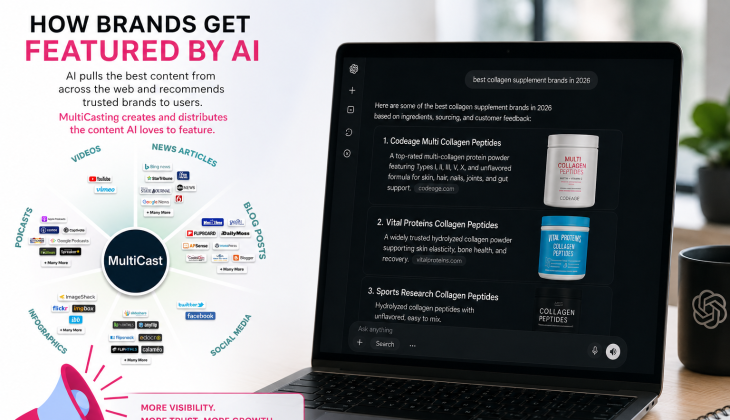
Yes, Multicast Marketing is one of the fastest ways to get recommended by AI, because it puts your brand’s answers on the high-authority sites that ChatGPT, Google AI, and Perplexity already trust, instead of waiting years to build that trust on your own website alone.
Article at a Glance
- • Multicast Marketing means turning one topic into multiple content formats, like videos, podcasts, blogs, news articles, and infographics, and publishing them across hundreds of high-authority platforms simultaneously.
- • AI tools like ChatGPT, Google AI, and Perplexity don’t recommend brands randomly, they pull from high-authority sites they already trust, making platform selection critical.
- • Three technical signals directly influence how often AI cites your brand: schema markup, content freshness, and multi-platform publishing volume.
- • The MultiCasting effect creates cross-referencing signals that AI uses to validate a brand as credible, the same answer repeated across trusted sources becomes consensus truth.
- • Keep reading to find out which specific platforms carry the most weight with AI tools and exactly how to start appearing in AI recommendations faster than you’d expect.
Table of Contents
- AI Is Already Recommending Brands, Just Not Yours Yet
- What Multicast Marketing Actually Is
- Why AI Tools Recommend Some Brands and Ignore Others
- The Three Technical Signals That Drive AI Citations
- Why Big Authority Sites Get More Trust From Google & AI
- How the MultiCasting Effect Creates AI Credibility
- How to Start Getting Recommended by AI With Multicast Marketing
- How Media Strobe Can Help
- Multicast Marketing Is the Fastest Path to AI Visibility
- Frequently Asked Questions
Most brands are invisible to AI, not because their product is bad, but because AI has never seen them anywhere it trusts.
Right now, when someone asks ChatGPT, Google AI, or Perplexity which brand to buy, use, or trust in your niche, AI is pulling from a shortlist of sources it considers credible. If your brand isn’t showing up on those sources, you’re not in the conversation, no matter how good your website looks or how many followers you have. Media Strobe has been tracking this shift closely, and the brands gaining ground in AI recommendations all share one common strategy: they’re everywhere at once.
AI Is Already Recommending Brands, Just Not Yours Yet
Here’s the uncomfortable truth: 93% of buyers research across multiple platforms before purchasing. They’re checking Google, ChatGPT, YouTube, social media, podcasts, and review sites, all before they buy. AI tools are increasingly the first stop in that journey. And when AI makes a recommendation, most users take it seriously.
The brands getting recommended aren’t necessarily the biggest or oldest. They’re the ones that have made themselves visible across the platforms AI already trusts. That’s the entire game right now, and Multicast Marketing is how you play it.
What Multicast Marketing Actually Is
Multicast Marketing is the practice of taking a single core topic and transforming it into multiple distinct content formats, then distributing all of them across high-authority platforms at the same time. It’s not about creating more content, it’s about making one piece of content work in every environment where your buyers and AI tools are paying attention.
One Topic, Eight Formats, Hundreds of Platforms
A single MultiCast typically covers eight content formats from one topic:
- News articles
- Blog posts
- Interview-style podcasts
- Videos
- Reels and Shorts
- Infographics
- Flipbooks
- Social media posts
Each format is then published across 300+ platforms, including Google News, YouTube, Spotify, and major news networks like USA Today and Business Insider. That’s not cross-posting the same caption everywhere. That’s a full content ecosystem built around one idea, designed to signal authority to both humans and AI systems.
Why This Is Different From Cross-Posting
Cross-posting means sharing the same content in the same format across multiple channels. Multicast Marketing is fundamentally different. Each format is adapted for its platform, a podcast is not a repurposed blog post read aloud, and an infographic is not a screenshot of a tweet. The formats are distinct, the platforms are authoritative, and the cumulative effect is what changes how AI perceives your brand.
Why AI Tools Recommend Some Brands and Ignore Others
AI recommendations are not random, and they’re definitely not based on which brand has the nicest website. These systems are built to surface information from sources they already consider trustworthy. Understanding that logic is the first step to working with it.
How ChatGPT, Google AI, and Perplexity Decide What to Cite
When making recommendations, AI agents check sources like YouTube videos reviewing or demonstrating products, blog content on high domain authority sites, news coverage from established publications, and mentions across multiple independent platforms. They’re looking for consensus, the same answer showing up across trusted, independent sources. A brand that appears in only one or two places looks less authoritative than one with relevant content across dozens of platforms.
The Role High-Authority Sites Play in AI Recommendations
Google AI Overviews are more likely to cite brand blogs, but only at moderate to high domain authority levels. ChatGPT also cites brand blogs but appears to have a higher DA threshold before trusting vendor content. Both platforms weight sites like YouTube and LinkedIn heavily. Publishing on established news networks and media platforms isn’t just a PR move, it’s the most direct path to getting your brand into the pool of sources AI draws from.
Why Your Own Website Alone Is Not Enough
A brand with a well-built website but no external authority presence is essentially invisible to AI. Your own site can contribute to citations, especially if the domain authority is strong and content is fresh. But AI tools cross-reference. They look for your brand to appear on sites they already trust, independently of your own domain. That’s the gap Multicast Marketing is designed to close.
The Three Technical Signals That Drive AI Citations
Schema markup, content freshness, and multi-platform publishing volume are the three technical levers that most directly influence how often AI cites your brand. Each one matters independently, but together they create the kind of signal footprint that gets brands recommended consistently.
1. Schema Markup
Schema markup is structured data you add to your content that tells AI and search engines exactly what your content is about, who wrote it, what it covers, what type of content it is, and how it connects to your brand. Without it, AI has to guess. With it, your content is immediately interpretable. Brands that consistently use schema markup across their published content give AI a clean, unambiguous signal that their information is organized, intentional, and trustworthy.
2. Content Freshness
AI systems actively favor content that has been recently published or updated. A blog post from three years ago with no updates carries significantly less weight than one published or refreshed in the last few weeks. This is why brands that publish consistently, not just once and wait, show up in AI recommendations more often. Freshness signals that a brand is active, relevant, and still a credible voice in its space.
The practical implication here is that publishing frequency matters as much as publishing quality. A steady stream of fresh, relevant content across multiple platforms compounds over time, building the kind of ongoing presence AI tools treat as authoritative rather than historical.
3. Multi-Platform Publishing Volume
Volume without strategy is noise. But volume with the right platform selection is one of the fastest ways to build AI visibility. When your brand’s content appears across dozens of independent, high-authority platforms covering the same topic from different angles, AI interprets that pattern as consensus. You’re not just one source making a claim, you’re a brand that multiple trusted platforms have independently covered.
“Each new platform adds another data point for AI to cross-reference, and the cumulative effect is a brand footprint that’s hard to ignore.”
This is precisely why distributing across 300+ platforms through a structured MultiCast campaign creates compounding results.
Why Big Authority Sites Get More Trust From Google & AI
Domain authority is essentially a trust score, and AI tools use it the same way Google does. High-DA sites have earned their credibility through years of quality content, inbound links, and consistent publishing. When your brand appears on those sites, some of that trust transfers to you by association. It’s one of the most powerful shortcuts available in modern digital marketing.
| Platform | Why AI Trusts It |
|---|---|
| USA Today | Nationally recognized news source with massive AI indexing weight |
| Business Insider | High-trust financial and business coverage cited frequently by AI tools |
| YouTube | Google-owned platform weighted heavily by both Google AI and ChatGPT |
| Treated as an authoritative professional source across all major AI platforms | |
| Spotify | Growing importance as AI increasingly indexes audio content and podcasts |
| Google News | Direct pipeline into Google AI Overviews and news-based citations |
Getting featured on even a handful of these platforms creates a trust signal that your own website simply cannot replicate on its own. The authority these sites carry is the result of decades of credibility-building, and publishing on them lets your brand borrow that credibility immediately.
Which Platforms Carry the Most Weight With AI
Based on observed AI citation behavior, Google AI Overviews lean heavily on Google News, YouTube, and brand blogs with sufficient domain authority. ChatGPT draws from a broader mix, including news publications, LinkedIn, and high-DA blogs, but with a notably higher trust threshold for vendor-owned content. Perplexity tends to pull from news sites and authoritative reference pages. The overlap across all three is clear: news publications, YouTube, and LinkedIn consistently appear as trusted sources regardless of which AI tool your buyer is using.
Why Publishing on USA Today or Business Insider Beats Building Your Own DA
Building domain authority for your own website is a long game, typically measured in years, not weeks. A new or mid-sized brand targeting AI citations doesn’t have the luxury of waiting that long, especially as AI adoption accelerates and early-mover advantage becomes a real competitive edge.
Publishing on an established platform like USA Today or Business Insider gives your brand instant access to decades of accumulated trust. AI tools already pull from these sources regularly. When your brand’s name, product, or expertise appears in that content, you’re not just reaching human readers, you’re entering the citation pool AI tools draw from every day.
How the MultiCasting Effect Creates AI Credibility
The MultiCasting effect is what happens when AI encounters the same core information about your brand across multiple independent, high-authority sources. Instead of seeing one brand making one claim, AI sees a pattern, multiple trusted platforms all pointing to the same answer. That pattern is interpreted as consensus truth, and consensus truth is what AI recommends.
This is not a loophole or a hack. It mirrors exactly how human credibility works, a person mentioned once by a stranger carries little weight, but a person consistently referenced across multiple trusted sources becomes someone worth paying attention to. AI is simply doing the same thing at scale and at speed.
Cross-Referencing Signals AI Uses to Validate a Brand
AI tools don’t cite brands based on a single data point. They look for corroborating signals across multiple sources before treating a brand as a credible recommendation. Those signals include mentions in news articles, appearances in video content, podcast discussions, social media engagement on authoritative profiles, and blog coverage across independent domains. The more of these signals your brand generates around a specific topic, the more likely AI is to surface your brand when that topic is queried.
Consistency of information matters just as much as volume. If your brand’s messaging is slightly different across platforms, different claims, different positioning, different answers to the same buyer question, AI treats that as inconsistency, which reduces citation confidence. A MultiCast campaign solves this by ensuring every format and every platform carries the same core answer, just adapted for the medium.
Why Repetition Across Formats Makes AI Treat Your Brand as Factual
When AI sees the same answer repeated across a news article, a YouTube video, a podcast, a LinkedIn post, and a blog, all from different publishers, it processes that repetition as verification. Your brand stops being an opinion and starts being a fact. That’s the real power of Multicast Marketing: it doesn’t just get you seen, it gets you believed.
How to Start Getting Recommended by AI With Multicast Marketing
The good news is that brands that publish strategically can start appearing in AI answers within days, not months. The process is straightforward, but the execution has to be intentional, the right questions, the right formats, and the right platforms.
1. Identify the Buyer Questions Your Content Must Answer
AI tools are answer engines. They get asked specific questions and they return specific answers. Your content strategy has to start from the questions your buyers are actually typing into ChatGPT, Google, and Perplexity before they make a purchase decision. These aren’t broad topics, they’re specific, intent-driven queries like “what’s the best project management tool for remote teams” or “is [your product category] worth it for small businesses.” Map out those questions first, because they become the foundation of every MultiCast you publish.
2. Publish on High-Authority Platforms First
Before you think about volume, think about where you’re publishing. A hundred posts on low-authority sites will do less for your AI visibility than five pieces on platforms that AI tools already trust. Start with the platforms that carry real weight, news publications, YouTube, LinkedIn, Google News, and podcast directories like Spotify.
The logic is simple: AI tools have a shortlist of sources they draw from when generating recommendations. Your goal in the early stages of a Multicast strategy is to get your brand’s name, expertise, and answers onto that shortlist. That happens through authority-site publishing first, not through social media volume or blog frequency alone.
Think of it as borrowing credibility. When Business Insider or USA Today publishes content featuring your brand, AI tools that already trust those outlets extend a portion of that trust to you. Your own website might take years to earn that level of domain authority organically, authority-site publishing shortcuts that timeline significantly.
Prioritize platforms in this order when starting out:
- Google News-indexed publications, direct pipeline into Google AI Overviews
- YouTube, weighted heavily by both Google AI and ChatGPT for video citations
- LinkedIn, treated as a professional authority source across all major AI platforms
- Major news networks (USA Today, Business Insider), instantly recognized as high-trust by AI systems
- Spotify and podcast directories, growing in AI indexing weight as audio content gains citation relevance
3. Distribute Across Formats Using Media Strobe or Manual Multicasting
Once you know your buyer questions and have identified your target platforms, the next step is execution. Tools like Media Strobe automate this by turning one topic into eight distinct content formats, news articles, blog posts, interview podcasts, videos, reels and shorts, infographics, flipbooks, and social posts, and distributing them across 300+ platforms simultaneously. For brands doing this manually, the process is the same but slower: adapt your core answer into each format, then publish sequentially across your priority platforms. Either way, the goal is the same, one topic, maximum format diversity, maximum platform reach.
4. Track Which Platforms Drive AI Citations for Your Brand
Once your MultiCasts are live, start tracking where AI tools are pulling your brand from. Query ChatGPT, Google AI, and Perplexity with the exact buyer questions your content answers and see which sources come up. Note which platforms are appearing in citations and double down on those. This feedback loop is how you refine your Multicast strategy over time, moving from broad distribution to targeted, high-yield platform publishing that consistently puts your brand in front of AI recommendations.
How Media Strobe Can Help
Media Strobe’s MultiCast campaign takes everything covered in this guide and executes it end-to-end. A single MultiCast turns one topic into eight distinct content formats, news articles, blog posts, interview-style podcasts, videos, reels and shorts, infographics, flipbooks, and social media posts, then distributes all of it across 300+ high-authority platforms, including Google News, YouTube, Spotify, USA Today, and Business Insider.
Instead of spending weeks building each format separately and chasing down publishing relationships on your own, a MultiCast campaign compresses that entire workload into a single managed process, built around the exact buyer questions your future customers are already asking AI tools and search engines.
Ready to see how a MultiCast campaign could work for your brand? Learn more about Media Strobe’s MultiCast campaigns here.
Multicast Marketing Is the Fastest Path to AI Visibility
The window to establish early AI visibility is open right now, but it won’t stay open indefinitely. Brands that build their MultiCasting footprint today are positioning themselves as the default recommendations AI tools serve tomorrow. One topic, eight formats, hundreds of platforms, and three technical signals working together: that’s not just a marketing strategy. That’s how you become the answer.
Frequently Asked Questions
If you’re new to Multicast Marketing or just starting to think seriously about AI visibility, these are the questions that come up most often, and the answers that will save you time.
Here’s a quick-reference breakdown of how the key elements of a Multicast strategy connect to AI citation outcomes:
| Strategy Element | What It Does | AI Impact |
|---|---|---|
| Schema Markup | Structures your content for machine readability | Makes content easier for AI to interpret and cite |
| Authority Site Publishing | Places your brand on high-DA platforms AI already trusts | Directly increases citation probability |
| Multi-Format Distribution | Covers video, audio, text, and visual formats | Creates cross-referencing signals AI uses for validation |
| Content Freshness | Keeps your published content recently updated | Signals active relevance to AI recommendation systems |
| Publishing Volume | Increases platform footprint across trusted sources | Builds consensus signals that AI interprets as credibility |
Use this as a checklist when auditing your current content strategy. If you’re missing more than two of these elements, your AI visibility is likely lower than it could be.
What is Multicast Marketing and how does it work?
Multicast Marketing is the practice of transforming a single topic into multiple content formats, such as news articles, blog posts, videos, podcasts, infographics, and social posts, and distributing all of them across hundreds of high-authority platforms simultaneously. The goal is to create a consistent, multi-format brand presence across the platforms that AI tools like ChatGPT, Google AI, and Perplexity already trust, triggering the cross-referencing signals those systems use to validate and recommend brands.
Why do AI tools like ChatGPT recommend some brands and not others?
AI tools recommend brands that appear consistently across sources they already consider authoritative. They look for corroborating signals, the same brand mentioned across news publications, YouTube, LinkedIn, podcasts, and blogs, and interpret that pattern as consensus credibility. Brands that only exist in one or two places, or only on their own website, rarely make it into AI recommendations regardless of how good their product or service actually is.
Do I need a high domain authority website to get cited by AI?
Not necessarily, but your content does need to appear on high-DA platforms somewhere. Your own website contributes to AI citations, especially if its domain authority is strong and content is regularly updated. However, AI tools cross-reference across multiple independent sources, which means even a brand with a modest website can gain AI visibility by publishing on established authority sites like Google News publications, YouTube, or major news networks.
Key distinction: Google AI Overviews tend to cite brand blogs at moderate DA levels, while ChatGPT applies a higher trust threshold to vendor-owned content. Publishing on third-party authority sites bypasses that threshold entirely, making external platform publishing the most reliable path to AI citation regardless of your own site’s DA score.
The practical takeaway is that you don’t need to wait years to build domain authority before pursuing AI visibility. Authority-site publishing lets you access credibility that already exists on platforms AI tools trust today.
Focus first on getting your brand’s answers published on platforms like USA Today, Business Insider, YouTube, and Google News-indexed outlets. Your own website’s authority can grow in parallel, but the fastest path to AI recommendations runs through platforms that already have the trust you’re working to build.
As your external authority-site presence grows and your own domain authority improves over time, the two reinforce each other, creating a compounding AI visibility effect that becomes increasingly difficult for competitors to replicate.
How many platforms do I need to publish on for Multicast Marketing to work?
There’s no fixed minimum, but the principle is clear: more high-authority platforms create more cross-referencing signals, and more cross-referencing signals increase the likelihood of AI citation. Brands publishing across 300+ platforms through structured MultiCast campaigns create a footprint that’s difficult for AI to overlook. Starting with even 10 to 15 high-authority platforms is meaningfully better than publishing in only one or two places, and each additional platform compounds the effect.
How can Media Strobe help your business grow with Multicast Marketing?
MultiCast Marketing is a campaign built by Media Strobe that automates the MultiCasting process end-to-end. It takes a single topic and transforms it into eight distinct content formats, news articles, blog posts, interview-style podcasts, videos, reels and shorts, infographics, flipbooks, and social media posts, then publishes them across 300+ platforms, including Google News, YouTube, Spotify, USA Today, and Business Insider.
The resources required to create and manage eight different content formats across hundreds of platforms manually are out of reach for most businesses. One MultiCast campaign would typically cost the average business 30-40 hours of work and well over $10k to produce what will be a substandard campaign. This is because it is not possible to access our distribution network or duplicate our expertly curated content in a reasonable amount of time. Media Strobe takes care of everything for a very fair investment, allowing the business owner to focus on their area of expertise. In essence, MultiCast marketing compresses that workload into a single workflow. The result is the kind of multi-channel presence that AI tools need to see before they recommend a brand, built faster and more consistently than manual multicasting allows.
Media Strobe helps brands build the multi-platform authority that gets them recommended by AI, if consistent AI visibility is your goal, it’s a tool worth exploring.
Why Choose a MultiCast campaign by Media Strobe?
All MultiCast campaigns are expertly created to answer highly relevant questions about your service/product that your future customers are asking (all over the internet) before they make their purchase decision. Your MultiCast is distributed to hundreds of high authority sites IN THE EXACT WAY that Google and AI love, and in 8 formats so that your answers show up everywhere people are asking questions. The benefits of running a MultiCast campaign are:
- Increased visibility (leading to increased ranking)
- Increased warm/hot traffic
- Reduced customer acquisition costs
- Predictable growth that can be scaled
- Generate more revenue with higher net profit
- True control over your lead generation
- Better return on paid ads