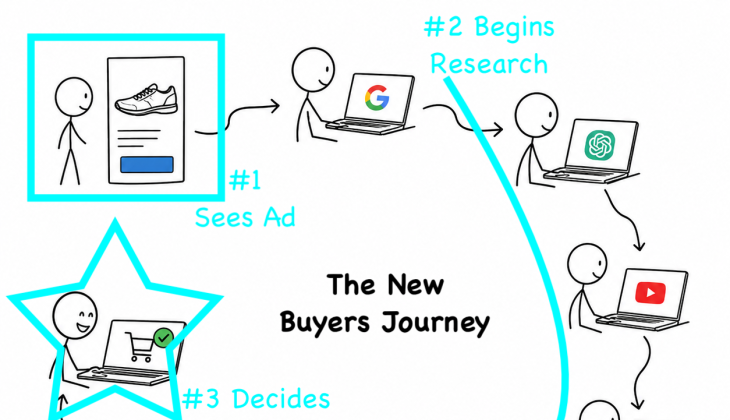
Your Facebook ads are generating clicks, but when curious buyers Google your brand to research before purchasing, they’re finding your competitors instead. The modern buyer journey spans 6-8 touchpoints across multiple platforms—and retailers invisible on most of them are losing sales they don’t even realize they’re missing.
Key Takeaways
- Modern buyers interact with 6-8 touchpoints across multiple platforms before making a purchase – meaning your brand needs to show up everywhere they look, not just on Google
- Over 80% of shoppers conduct online research before buying – even for items they plan to purchase in-store, making your research presence critical to conversion
- Brands optimized for AI-powered search and multi-platform discovery see conversion rates up to 4 times higher than those relying solely on traditional search traffic
- A strategic multi-platform content system can transform paid ad performance – one brand saw significant conversion rate improvements without changing a single ad
- 73% of retail consumers use multiple channels for research – yet most eCommerce brands only optimize for one platform, leaving massive gaps in their buyer journey
Article at a Glance: The modern buyer journey spans multiple platforms and touchpoints. Retailers optimized for this multi-platform discovery see dramatically higher conversion rates, while those invisible during the research phase lose sales to competitors. Learn why your ad spend is funding competitor sales—and how to fix it.
Table of Contents
- Your Ad Spend Is Funding Competitor Sales
- Where 73% of Retail Consumers Use Multiple Channels for Research
- Why Your Product Titles Are Invisible to Buyers
- Time-Efficient Image SEO Strategies That Drive Traffic
- How AI Agents Choose Which Brands to Recommend
- The MultiCasting System: 6 Formats From 1 Topic
- Case Study: Dramatic Conversion Boost Through Brand Authority
- Start Building Your Multi-Platform Presence Today
- How Media Strobe Can Help
- Frequently Asked Questions
Your Ad Spend Is Funding Competitor Sales
Every month, thousands of eCommerce sellers pour money into ads that create interest but fail to convert. The problem isn’t the ad creative, targeting, or landing pages. It’s what happens after the click – when buyers go to research the brand and find nothing compelling enough to build trust.
Here’s the brutal reality: When buyers see an ad and get curious, they don’t immediately purchase. They research. They Google the brand name, search for reviews on YouTube, check Reddit threads, and look for third-party validation. If they find your competitor’s content instead of yours during this research phase, your ad spend just funded someone else’s sale.
Media Strobe has documented this pattern across dozens of eCommerce brands, revealing how the research gap between paid ads and purchase decisions is where most conversions are actually lost.
The brands winning today aren’t just running better ads – they’re building content ecosystems that support every stage of the buyer journey. When a potential customer researches them, they find reinforcing signals across multiple platforms, not empty search results that send buyers straight to competitors.
Where 73% of Retail Consumers Use Multiple Channels for Research
While Google maintains its dominant position in search, buyers conduct research across numerous platforms that many sellers treat as afterthoughts – if they consider them at all. This massive research blind spot is costing brands millions in missed opportunities.
Where Buyers Research Before Purchasing
YouTube
High-intent visual validation and unboxing reviews
Unfiltered peer reviews and community discussions
TikTok
Discovery-driven product introductions and trends
Podcasts
Third-party authority signals and host endorsements
1. YouTube: High-Intent Visual Validation
Buyers don’t just want to read about products – they want to see them in action. YouTube has become the go-to platform for unboxing videos, product comparisons, and real-world demonstrations. When someone searches “best espresso machine under $500 review,” they’re not browsing casually. They’re in active purchase mode, looking for visual proof that validates their buying decision. Brands with strong YouTube presence capture these high-intent moments, while those without it watch potential customers validate competitors instead.
2. Reddit: Unfiltered Peer Reviews
Reddit threads often rank higher in Google results than brand websites because buyers trust peer recommendations over marketing messages. When someone asks “which wireless headphones are actually worth it?” in a relevant subreddit, the responses carry more weight than any product description. Smart brands monitor these conversations and ensure their products get mentioned by satisfied customers, creating authentic word-of-mouth that influences purchase decisions.
3. TikTok: Discovery-Driven Purchase Decisions
The “TikTok made me buy it” phenomenon represents a fundamental shift in product discovery. Unlike traditional research paths, TikTok often introduces buyers to products they didn’t know they needed. However, discovery on TikTok still leads to validation elsewhere – buyers see a product on TikTok, then research it on Google, YouTube, and other platforms before purchasing. Brands need presence across this entire journey, not just at the discovery moment.
4. Podcasts: Third-Party Authority Signals
Podcast mentions carry unique authority because they feel like personal recommendations from trusted hosts. When a fitness podcaster mentions a specific protein powder or a tech show reviews wireless earbuds, listeners perceive it as genuine endorsement rather than advertising. These mentions create powerful trust signals that influence buying decisions, especially for higher-priced products where buyers need more convincing.
Why Your Product Titles Are Invisible to Buyers
Most eCommerce sellers obsess over ad creative while ignoring the words buyers actually type into search bars. This disconnect quietly costs thousands in lost organic traffic every month. Product titles built around internal brand naming conventions instead of buyer language are essentially invisible to purchase-ready searches.
Replace Brand Names With Buyer Search Terms
Product Title Transformation
Before (Brand-Focused): “BrewMaster Pro 3000”
After (Buyer-Focused): “Programmable Drip Coffee Maker with Thermal Carafe, 12-Cup, Stainless Steel”
The rewritten version captures searches across multiple buyer intentions—coffee makers, programmable machines, thermal carafes, and capacity specs—while the brand name captures zero relevant searches.
Nobody wakes up searching for “BrewMaster Pro 3000.” They search for “programmable drip coffee maker with thermal carafe 12-cup.” That specific, descriptive phrase matches real buyer language and triggers high-intent traffic. The gap between creative product names and actual search behavior is where organic discovery dies.
Successful product title rewrites follow buyer psychology: lead with the product type, include the most-searched specifications, and add use cases where relevant. “VeloRide X2” becomes “Folding Electric Bike for Adults, 26-Inch, 500W Motor, 25 MPH.” The rewritten version captures searches across multiple buyer intentions – folding bikes, electric bikes, adult bikes, and specific performance specs.
Time-Efficient Image SEO Strategies That Drive Traffic
Search engines can’t see images – they read file names and alt text. An image saved as “IMG_4872.jpg” with blank alt text wastes a valuable SEO opportunity. The same image renamed “cooling-memory-foam-mattress-topper-queen-gel-infused.jpg” with descriptive alt text becomes a searchable asset driving image search traffic.
This represents a one-afternoon fix that most eCommerce sellers have never implemented. Rename your top 20 product images using descriptive, keyword-rich phrases with hyphens between words. Write alt text that describes both the image content and connects to buyer search intent. Combined with optimized product titles, these changes create a completely different organic footprint for your store.
How AI Agents Choose Which Brands to Recommend
AI-powered search tools don’t just crawl Google – they synthesize information from YouTube transcripts, podcast show notes, news articles, Reddit threads, and social content. When buyers ask ChatGPT or Google’s AI Overview “what’s the best home espresso machine under $500,” the AI recommendation pulls signals from every platform where that question has been answered.
Multi-Platform Signals Create AI Authority
AI systems evaluate trust by triangulating product data, expert validation from media and reviews, and authentic user sentiment across various platforms. A brand mentioned positively in a YouTube video, featured in a news article, discussed on Reddit, and reviewed on multiple sites creates strong authority signals that AI algorithms recognize and prioritize in recommendations.
This triangulation process means single-platform brands face a structural disadvantage in AI-powered search results. Even excellent products with strong Amazon reviews struggle to get AI recommendations if they lack broader presence. The brands that consistently appear in AI-generated suggestions have built content footprints across multiple platforms that reinforce their authority and credibility.
Single-Channel Brands Become Invisible to AI Search
Brands existing only on their product pages or single platforms essentially don’t exist to AI agents making purchase recommendations. AI systems need multiple data points to validate credibility, and single-channel presence provides insufficient signal strength. As AI-powered search becomes more prevalent – with 45% of consumers now shopping with AI assistance – this invisibility becomes a critical competitive disadvantage.
The solution involves systematic content distribution across platforms where AI agents gather information. This doesn’t require massive content creation – it requires taking existing expertise and deploying it in multiple formats across multiple channels where both buyers and AI systems look for answers.
The MultiCasting System: 6 Formats From 1 Topic
Creating separate content for each platform is the old model that exhausts resources and limits reach. The new approach – MultiCasting – takes one buyer topic and transforms it into multiple formats optimized for different platforms. A single campaign about “best elliptical for small apartments” becomes six distinct content pieces, each native to its platform while maintaining the same core message.
MultiCasting Format Strategy
| Format | Purpose | Buyer Stage |
|---|---|---|
| 1. Long-Form Article | Google Authority & SEO | Research & Education |
| 2. YouTube Video | Visual Proof & Demonstrations | High-Intent Validation |
| 3. Podcast Episode | Authority & Trust Building | Deep Research & Consideration |
| 4. Short-Form Video | Discovery & Awareness | Initial Interest |
| 5. News Article | Third-Party Credibility | Credibility & Authority |
| 6. Social Posts | Engagement & Awareness | Ongoing Touchpoints |
1. Long-Form Article for Google Authority
Detailed articles targeting buyer questions build domain authority and capture organic search traffic. A 2,000-word piece comparing elliptical machines for apartments ranks for dozens of related search terms, from “compact elliptical reviews” to “apartment-friendly cardio equipment.” These articles serve as the foundation content that other formats reference and link back to, creating a hub of authority around specific buyer topics.
2. YouTube Video for Visual Proof
Video content transforms article insights into visual demonstrations that buyers need for confidence. The apartment elliptical article becomes a YouTube video showing actual space requirements, noise levels, and setup processes. Video format captures buyers who prefer visual validation and creates additional discovery paths through YouTube’s search and recommendation algorithms.
3. Podcast Episode for Trust Building
Audio format builds deeper relationships through extended, conversational content. The elliptical topic becomes a podcast episode featuring expert interviews, buyer stories, and detailed comparisons. Podcast mentions carry unique authority because they feel like personal recommendations, making them particularly effective for higher-consideration purchases where trust is required.
4. Short-Form Video for Discovery
TikTok and YouTube Shorts capture attention and drive awareness for buyers who find products through social browsing. The apartment elliptical content becomes quick comparison videos, space-saving tips, or before-and-after transformation clips. Short-form content often introduces buyers to products they didn’t know they needed, starting research journeys that convert through other formats.
5. News Article for Credibility Signals
News coverage provides third-party validation that builds brand credibility. The elliptical expertise becomes a news article about fitness trends in small spaces or equipment recommendations for apartment living. News mentions create legitimacy signals that influence buyers who need external validation before trusting a brand with their purchase.
6. Social Posts for Engagement
Social content maintains ongoing engagement and provides multiple entry points into the brand ecosystem. The elliptical campaign becomes Instagram posts showing apartment gym setups, Facebook discussions about space-saving fitness solutions, and LinkedIn articles about home fitness trends. Social presence ensures the brand stays visible throughout the extended research process that characterizes modern buyer journeys.
Case Study: Dramatic Conversion Boost Through Brand Authority
One eCommerce client running $30,000 monthly on Facebook ads was stuck at low conversion rates despite optimized targeting, tested creative, and refined landing pages. The fundamental issue wasn’t the ads themselves – it was the research environment buyers encountered after clicking those ads.
The Research Gap That Kills Conversions
When potential customers clicked the ads and searched for brand validation, they found minimal supporting content. No YouTube presence, no news coverage, no third-party mentions – just a website and product pages. This created doubt during the research phase, causing interested buyers to abandon their purchase journey or choose competitors with stronger online presence.
The research gap represents the distance between what buyers find when validating a brand and what they need to find to feel confident purchasing. Wide research gaps mean buyers arrive at product pages already skeptical, looking for reasons to leave. Narrow gaps mean they arrive already convinced, looking for confirmation to buy.
Building Brand Authority Across Key Platforms
The solution involved systematic brand authority building through MultiCasting campaigns. Over three months, the brand deployed content across YouTube, Google, news sites, podcasts, and social platforms – creating the research environment that converts interest into sales.
The same Facebook ads that previously underperformed jumped to significantly higher conversion rates without any changes to targeting, creative, or landing pages. The ads didn’t improve – the research environment supporting those ads transformed completely. Additionally, the brand authority content generated substantial attributed organic sales, creating an independent revenue stream that continued growing long after the initial campaigns.
This demonstrates the point most eCommerce sellers miss entirely: fixing the research environment doesn’t just improve paid ads – it builds permanent assets that generate ongoing revenue without additional advertising spend.
Start Building Your Multi-Platform Presence Today
The new buyer journey isn’t a future trend – it’s current reality affecting conversion rates right now. Buyers research across multiple platforms before purchasing, and brands without wide presence lose those sales to competitors who show up everywhere buyers look. The solution isn’t more ad spend or better creative – it’s building the content ecosystem that supports and amplifies existing marketing efforts.
Start with buyer questions your customers ask most frequently, then create content that answers those questions across multiple formats and platforms. Focus on being helpful rather than promotional, and ensure your brand becomes the authority buyers find during their research process. The investment in multi-platform presence compounds over time, creating sustainable competitive advantages that paid advertising alone cannot replicate.
How Media Strobe Can Help
Media Strobe MultiCast Campaigns: Transform One Strategic Topic Into Maximum Visibility
Media Strobe’s MultiCast campaigns are expertly created to answer the highly relevant questions about your products and services that your future customers are asking all over the internet before they make their purchase decision. Instead of creating separate content for each platform, MultiCast campaigns take one strategically significant topic and transform it into 8 different formats distributed across hundreds of high-authority sites.
Key Benefits of Media Strobe MultiCast Campaigns:
- Increased Visibility — Leading to increased ranking and brand authority
- Increased Warm & Hot Traffic — Customers finding you when they’re actively seeking solutions
- Reduced Customer Acquisition Costs — Organic reach reduces paid advertising dependency
- Predictable Growth — Scalable systems that compound over time
- Higher Net Profit — More revenue with less ad spend
- True Control Over Lead Generation — Your message, your positioning, your audience
- Better ROI on Paid Ads — Warmer audiences convert at higher rates
Ready to fix your research gap? Learn how Media Strobe MultiCast campaigns work and start building multi-platform visibility for your eCommerce business.
Frequently Asked Questions
How many touchpoints should my buyer journey include?
Modern buyers interact with 6-8 touchpoints across multiple platforms before purchasing. Your goal is to show up on as many of these touchpoints as possible – not with the same content, but with format-optimized versions of the same strategic message. The brands seeing conversion rates up to 4 times higher than single-channel competitors have built presence across at least 5-6 key platforms where their buyers actively research.
What’s the difference between MultiCasting and just spreading content thin across platforms?
Spreading thin means taking existing content and posting it everywhere, usually in formats that don’t match the platform. MultiCasting means strategically creating content designed specifically for each platform while maintaining the same core message. A YouTube video isn’t just a narrated blog post – it’s shot, edited, and formatted for YouTube’s specific audience and algorithms. Each format respects its platform’s native format and audience expectations.
How does this affect my paid advertising performance?
Improving your research environment directly improves your paid ad ROI. When buyers click your ads and search for brand validation, finding strong supporting content across multiple platforms increases their confidence and purchase likelihood. The case study in this article shows a brand achieving significantly higher conversion rates from the exact same ad spend, simply because the research environment improved. Your paid ads create interest – your content ecosystem converts that interest into sales.
How long does it take to see results from multi-platform content?
You’ll see improved ad performance within weeks as research results improve for existing campaigns. Organic traffic from long-form content and YouTube typically takes 2-3 months to show meaningful results, while podcast and news mentions can have more immediate impact. The case study in this article showed significant improvements over three months. The key is that results compound over time – the longer you maintain presence across platforms, the stronger your authority signals become to both buyers and AI systems.
Why Choose a MultiCast campaign by Media Strobe?
All MultiCast campaigns are expertly created to answer highly relevant questions about your service and product that your future customers are asking all over the internet before they make their purchase decision. Your MultiCast is distributed to hundreds of high authority sites in the exact way that Google and AI love, and in 8 formats so that your answers show up everywhere people are asking questions. The benefits of running a MultiCast campaign include increased visibility (leading to increased ranking), increased warm and hot traffic, reduced customer acquisition costs, predictable growth that can be scaled, generate more revenue with higher net profit, true control over your lead generation, and better return on paid ads. Learn more about Media Strobe MultiCast campaigns.
For more insights on the evolving buyer journey and how to adapt your strategy, read our previous article: The New Buyer Journey: Wake Up Before It’s Too Late.