eCommerce Strategy · Marketing Channels · Influencer Partnerships · Performance Marketing
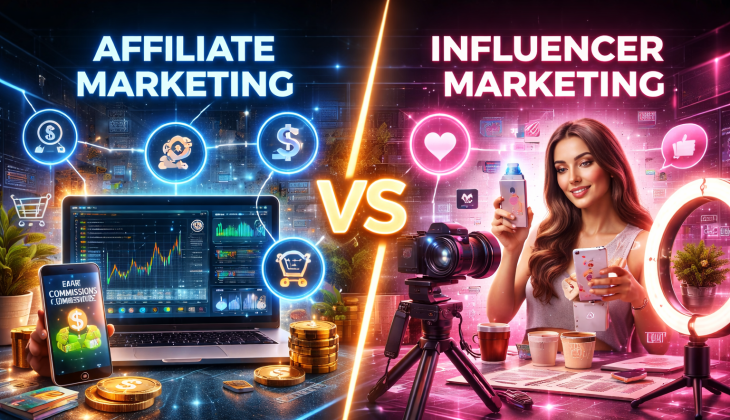
Affiliate Marketing vs Influencer Marketing: Which Builds Better ROI for Ecommerce Brands?
Pay for a post or pay for a sale — the complete breakdown of payment models, risk levels, and proven results to help you choose the right growth strategy.
Media Strobe Strategy Team · Updated March 2026 · 26 min read
Article-At-A-Glance
• Affiliate marketing pays only for results — commissions are earned when a sale, lead, or click is confirmed, making it one of the lowest financial risk strategies in ecommerce.
• Influencer marketing builds brand trust at scale — the right creator partnership can shift consumer perception faster than almost any other channel.
• The hybrid approach is where real growth happens — turning influencers into affiliates creates a funnel that combines awareness with measurable ROI.
• Attribution is the hidden challenge — measuring influencer marketing ROI requires a different toolkit than affiliate tracking, and most brands get this wrong.
• Your budget and business goal determine the winner — neither strategy is universally superior, but one will almost always fit your current growth stage better than the other.
Table of Contents
- Two Strategies, One Goal: More Revenue
- What is Affiliate Marketing?
- What is Influencer Marketing?
- Affiliate Marketing vs Influencer Marketing: 6 Key Differences
- When Affiliate Marketing Wins
- When Influencer Marketing Wins
- Why Most Brands Should Use Both
- How to Measure Results From Both Strategies
- Affiliate Marketing vs Influencer Marketing: Which is Right For Your Brand?
- How Media Strobe Can Help
- Frequently Asked Questions
Two Strategies, One Goal: More Revenue
Pay for a post or pay for a sale — that single decision defines the entire relationship between your brand and the people promoting it.
Affiliate marketing vs influencer marketing are two of the most talked-about growth channels in ecommerce right now, and for good reason. Both leverage third-party voices to drive purchasing decisions. Both put your product in front of audiences that already have some level of trust built in. But beyond that surface-level similarity, they operate in completely different ways — with different costs, different risks, and very different results depending on where your brand is in its growth journey.
Media Strobe works with ecommerce brands navigating exactly these kinds of decisions, helping businesses cut through the noise and build marketing strategies that actually move revenue. Understanding the distinction between these two channels is a foundational part of that work.
This breakdown covers everything you need to make a smart, informed decision — from how each model is structured and paid, to which industries they suit best, and how to combine them into a single high-performance funnel.
What is Affiliate Marketing?
Affiliate marketing is a performance-based partnership where individuals or companies — called affiliates — promote your products in exchange for a commission on every confirmed result. That result is typically a sale, but depending on your setup, it can also be a lead, a click, or a free trial signup. You don’t pay unless something happens. That’s the core value proposition. For more context on affiliate marketing fundamentals, check out BigCommerce’s affiliate marketing guide.
It’s one of the oldest digital marketing models still running at full speed, and ecommerce brands have been using it effectively since the late 1990s. Amazon’s Associates program, launched in 1996, essentially built the blueprint that most programs still follow today.
How Affiliate Tracking Works
Every affiliate gets a unique tracking link. When a customer clicks that link and completes the desired action — usually a purchase — the affiliate’s ID is recorded and a commission is credited. Most programs use cookie-based tracking, where a small file is stored in the customer’s browser to attribute the sale even if they don’t buy immediately. For more insights on how digital strategies are evolving, check out how AI is reshaping digital marketing strategies.
Cookie windows vary by program. A 30-day cookie window means the affiliate earns a commission on any purchase made within 30 days of the original click. Longer windows generally attract higher-quality affiliates because they account for longer buyer decision cycles — which is especially relevant in higher-ticket ecommerce categories.
Beyond cookies, more advanced programs now use:
- Server-side tracking — more accurate and not affected by browser privacy restrictions or ad blockers
- Coupon code tracking — affiliates are assigned unique discount codes, ideal for influencer-affiliate hybrids
- Postback URLs (server-to-server tracking) — the most reliable attribution method for high-volume programs
- First-party data tracking — increasingly important as third-party cookies phase out across browsers
The tracking infrastructure you build matters enormously. Brands running affiliate programs without solid attribution end up either overpaying on commissions or underpaying affiliates — both of which kill program momentum fast.
Common Affiliate Marketing Channels
Affiliates promote products through blogs and SEO content, YouTube reviews, email newsletters, coupon and cashback sites, comparison websites, and social media. The channel mix depends heavily on the affiliate’s audience and content format. A personal finance blogger driving traffic to a budgeting tool operates very differently from a coupon site pushing flash deals for a fashion brand.
How Affiliates Get Paid
The most common commission structure in ecommerce is a percentage of the sale value — typically between 5% and 30% depending on the industry, margin, and competitive landscape. Some programs offer flat-fee commissions per sale, which works well for standardized products with consistent pricing. High-ticket ecommerce brands sometimes offer tiered commission structures that reward top performers with higher rates as their volume increases.
What is Influencer Marketing?
Influencer marketing is a strategy where brands partner with content creators — people who have built an engaged audience around a specific niche, lifestyle, or area of expertise — to promote their products or services. Unlike affiliates, influencers are primarily paid for their reach, their creative output, and the trust they’ve built with their followers. The transaction isn’t tied to a sale. You’re paying for attention and association. For additional context, see Sprout Social’s influencer marketing guide.
The global influencer marketing industry was valued at $24 billion in 2024 according to Influencer Marketing Hub, and ecommerce brands represent one of the largest segments driving that spend. Beauty, fashion, fitness, food, and tech products dominate influencer campaigns, but the model has expanded into virtually every consumer category.
What makes influencer marketing uniquely powerful is the parasocial relationship between creator and audience. Followers feel like they know the influencer personally. When that creator recommends a product, it lands more like advice from a friend than an advertisement — and that psychological dynamic drives real purchasing behavior.
How Influencer Campaigns Are Structured
A typical influencer campaign starts with identifying creators whose audience matches your target customer profile. The brand either reaches out directly or works through an agency or platform to negotiate a deal. The influencer creates content — a dedicated post, a story mention, a YouTube review, a TikTok — and publishes it to their audience within an agreed timeframe.
Most campaigns include usage rights agreements (allowing the brand to repurpose the content in paid ads), exclusivity clauses (preventing the influencer from promoting direct competitors), and FTC disclosure requirements. Brands that skip the legal groundwork here often end up with compliance problems or unusable content.
The 4 Tiers of Influencers: Nano to Mega
Influencer Tiers by Follower Count & Use Case
| Tier | Follower Range | Key Strength | Best For |
|---|---|---|---|
| Nano | 1,000–10,000 | Highest engagement rates, loyal niche audiences | Cost-effective testing, product seeding |
| Micro | 10,000–100,000 | Sweet spot of reach and engagement | Mid-size ecommerce brand budgets |
| Macro | 100,000–1M | Significant reach with established credibility | Product launches, awareness campaigns |
| Mega | 1M+ | Maximum reach, celebrity status | Brand awareness at scale, enterprise budgets |
Nano influencers (1,000–10,000 followers) tend to have the highest engagement rates and the most loyal, niche audiences. They’re cost-effective and often willing to collaborate for free products. Micro influencers (10,000–100,000 followers) sit in a sweet spot of reach and engagement, making them the most commonly used tier for ecommerce brands with mid-size budgets.
Macro influencers (100,000–1 million followers) deliver significant reach but come with higher fees and typically lower engagement rates as a percentage of their audience. Mega influencers and celebrities (1 million+ followers) are brand awareness plays — expensive, broad, and rarely the right choice for direct-response ecommerce campaigns unless you’re already operating at significant scale.
How Influencers Get Paid
Influencer compensation varies widely based on platform, follower count, engagement rate, content format, and usage rights. A nano influencer might accept free product. A micro influencer might charge anywhere from $200 to $2,000 per post. Macro influencers routinely command $5,000 to $50,000+ per campaign, and mega influencers can charge six figures for a single piece of content.
Beyond flat fees, some influencer deals include performance bonuses tied to views, engagement thresholds, or sales generated through tracked links. This is where influencer marketing begins to overlap with the affiliate model — and where some of the most effective hybrid strategies emerge.
The most common influencer payment structures include:
- Flat fee per post — a fixed payment for a defined deliverable regardless of performance
- Gifting — free product in exchange for coverage, typically used with nano and micro influencers
- Revenue share or hybrid — a reduced flat fee plus commission on tracked sales
- Long-term ambassador contracts — recurring payments for ongoing brand representation across multiple content pieces
- Whitelisting deals — the brand pays to run paid ads using the influencer’s account and content
Affiliate Marketing vs Influencer Marketing: 6 Key Differences
At a glance, both strategies use third parties to promote your brand. But the mechanics, risks, and outcomes are different enough that treating them as interchangeable is one of the most common (and costly) mistakes ecommerce marketers make. Here are the six distinctions that matter most when evaluating affiliate marketing vs influencer marketing.
The choice between affiliate marketing vs influencer marketing isn’t just about payment models — it’s about where your customer is in their buying journey and which channel owns that moment.
1. Payment Model: Pay Per Result vs Pay Per Post
This is the most fundamental difference in affiliate marketing vs influencer marketing. Affiliate marketing is purely performance-based. You only pay when a trackable outcome — a sale, a lead, a click — occurs. Your cost is variable and directly tied to revenue generated. There’s no scenario where you pay and get nothing in return, which is what makes it so financially attractive for lean ecommerce operations.
Influencer marketing, by contrast, is almost always paid upfront. You’re paying for the content creation and the audience access — not the result. A campaign can technically underperform on conversions and the influencer still gets paid. This doesn’t make it a bad investment, but it does mean the risk profile is entirely different.
The implication for budget planning is significant. Affiliate programs can scale indefinitely without increasing your cost-per-acquisition because the commission percentage stays constant. Influencer spend, on the other hand, requires careful forecasting since the fixed costs don’t adjust if a campaign falls flat.
2. Primary Objective: Conversions vs Awareness
Affiliate marketing is built to drive one thing: action. Every element of an affiliate strategy — the tracking links, the commission structure, the content format — is oriented around getting someone to click and buy. It’s a bottom-of-funnel tool by design, and it performs best when there’s already some level of brand awareness in the market.
Influencer marketing operates higher up the funnel. Its primary job is to build familiarity, trust, and desire — the emotional groundwork that makes a purchase feel like an obvious next step. When a fitness influencer with 200,000 loyal followers features your protein powder in their morning routine, they’re not necessarily triggering an immediate purchase. They’re planting a seed that compounds over time through repeated exposure and social proof.
3. Creative Control: Brand-Led vs Creator-Led
With affiliate marketing, you control the narrative. You provide the landing pages, the product descriptions, the promotional assets. Affiliates drive traffic to your content — they rarely create original brand storytelling. That consistency is an asset for brand-sensitive categories, but it can also make affiliate content feel generic or transactional.
Influencer marketing flips that dynamic entirely. The best influencer content is creator-led — shot in their style, scripted in their voice, filtered through their aesthetic. Brands that over-prescribe influencer content kill the authenticity that makes the partnership valuable in the first place. The creative brief should set boundaries and key messages, but the execution should feel native to the creator’s platform and audience.
4. Risk Level: Low Financial Risk vs Higher Upfront Investment
The financial risk of affiliate marketing is as close to zero as any paid channel gets. You set the commission rate, you define what qualifies as a conversion, and you only pay when that conversion happens. The main risks are affiliate fraud (inflated clicks or fake conversions) and brand safety — making sure the affiliates promoting your product aren’t doing so in ways that damage your reputation.
Influencer marketing carries real upfront financial exposure. A $5,000 campaign with a macro influencer can generate strong sales, mediocre engagement, or complete silence — and you pay the same either way. That risk is manageable with proper vetting, clear contracts, and performance benchmarks built into the agreement, but it never fully disappears the way it does with a commission-only affiliate model.
5. Content Type: SEO-Driven vs Social-First
Affiliate content tends to live on search-optimized platforms — review blogs, comparison sites, YouTube videos with keyword-rich titles, and email newsletters with high-intent subscriber lists. This means affiliate-driven traffic often has strong purchase intent baked in. Someone reading a “best noise-cancelling headphones under $200” roundup is already in buying mode. That’s the affiliate sweet spot.
Influencer content is social-first and ephemeral by nature. An Instagram Story disappears in 24 hours. A TikTok can go viral one week and be forgotten the next. The content is designed for discovery and emotional resonance, not search engine ranking. This makes influencer content excellent for launching new products or breaking into new demographics, but less reliable for sustained, evergreen traffic generation.
6. Performance Measurement: Direct Attribution vs Complex Attribution
Affiliate marketing is one of the most measurable channels in your entire stack. Every sale is tied to a specific affiliate, a specific link, and a specific commission. Your dashboard shows exactly who drove what, and calculating ROI is straightforward arithmetic. This clarity is why CFOs tend to love affiliate programs — the cost is always justified by a confirmed revenue outcome.
Measuring influencer marketing ROI is genuinely more complex. Views, likes, and reach are easy to pull. But attributing actual revenue to an influencer post — especially when the customer saw the content, left, came back through a Google search three days later, and then converted — requires multi-touch attribution modeling. Brands that evaluate influencer campaigns on last-click conversions alone consistently undervalue the channel and make poor budget decisions as a result.
Affiliate Marketing vs Influencer Marketing: Side-by-Side Comparison
| Factor | Affiliate Marketing | Influencer Marketing |
|---|---|---|
| Payment Model | Pay per result (commission-based) | Pay per post (upfront fee) |
| Primary Objective | Direct conversions | Brand awareness & trust |
| Creative Control | Brand-led (you control assets) | Creator-led (authentic voice) |
| Financial Risk | Near-zero (pay only for results) | Higher (upfront investment) |
| Content Type | SEO-driven (blogs, reviews, videos) | Social-first (Stories, Reels, TikToks) |
| Attribution | Direct & simple (last-click) | Complex (multi-touch required) |
When Affiliate Marketing Wins
Affiliate marketing is the right primary channel when your brand already has market awareness, your product has a clear value proposition that converts well on landing pages, and your margins can absorb a consistent commission payout. It’s also the stronger choice when you need predictable, scalable customer acquisition without a large upfront media budget. Ecommerce brands in their growth phase — past initial product-market fit but not yet at mass market scale — tend to see the strongest returns from affiliate programs because they’re capturing demand that already exists rather than creating it from scratch.
Best Industries for Affiliate Marketing
Top Ecommerce Categories for Affiliate Marketing Success
Health and wellness — supplements, fitness equipment, and personal care products with strong review cultures and high repeat purchase rates
Personal finance and fintech — credit cards, investing apps, and budgeting tools where comparison content drives enormous search volume
Software and SaaS — high margins support generous commissions and affiliates can create detailed tutorials and reviews that convert well
Fashion and beauty — style bloggers, LTK creators, and YouTube beauty channels have built entire businesses around affiliate commissions in these categories
Home and garden — purchase decisions in this category involve significant research, making affiliate review content a natural fit for the buyer journey
Travel and hospitality — booking platforms, travel gear, and luggage brands benefit from high-intent affiliate content like destination guides and packing lists
When Influencer Marketing Wins
Influencer marketing is the stronger play when you’re launching something new, entering a new market, or trying to shift how your brand is perceived. It’s especially powerful when your product needs to be seen in use — when the experience of the product is the selling point, not just the specs. A skincare brand launching a new serum doesn’t just need people to know it exists; they need to see real people with real skin talking about real results. That’s an influencer job, not an affiliate job.
It also wins when your target customer spends significant time on social platforms and makes purchase decisions based on social proof and community influence. Gen Z and younger millennial consumers in particular tend to discover and evaluate products through creator content rather than search engines — which means influencer marketing isn’t just an awareness play in these demographics, it’s a full-funnel strategy.
Best Industries for Influencer Marketing
Influencer marketing consistently delivers strong results in categories where aspiration, identity, and visual appeal drive purchase decisions. Beauty and cosmetics remain the highest-performing category globally, with the food and beverage, fitness, fashion, parenting, gaming, and home décor sectors close behind. These are spaces where lifestyle content feels native and product integration doesn’t require a hard sell — the product is simply part of a life the audience wants.
B2C ecommerce brands with a strong visual product — anything that photographs or films well and has a clear lifestyle association — tend to get the most traction from influencer campaigns. Commodity products with no emotional angle, or highly technical B2B products, typically see weaker influencer ROI because the content doesn’t translate naturally into the creator format.
Why Authenticity Drives Influencer ROI
The single biggest predictor of influencer campaign performance isn’t follower count — it’s fit. When a creator’s existing content, values, and audience demographics genuinely align with your product, the integration feels organic. Audiences are remarkably good at detecting forced partnerships.
Why Most Brands Should Use Both
The affiliate marketing vs influencer marketing debate is largely a false choice. Framing them as competing strategies misses the more important point: they serve different stages of the customer journey, and a brand that uses both creates a compounding effect that neither channel can produce alone.
Think about it from the customer’s perspective. They discover your brand through an influencer they trust — awareness is created. They see the product mentioned again in a YouTube review from an affiliate blogger — consideration deepens. They click an affiliate link in that review and convert — the sale is tracked, the commission is paid, and your customer acquisition cost is fully accountable. That’s not one strategy outperforming the other. That’s two strategies doing exactly what they’re each designed to do, in sequence.
Brands that run influencer and affiliate programs in silos miss the synergy entirely. The smartest ecommerce operators integrate them — using influencer content to seed the market and fill the top of the funnel, while affiliate partnerships capture the demand that influencer activity generates. The result is a flywheel: influencers build awareness, affiliates convert it, and the revenue data tells you where to reinvest.
How Influencers and Affiliates Work Together in a Funnel
The Integrated Funnel: How Both Channels Work Together
A well-designed funnel using both channels might look like this: a mid-tier lifestyle influencer posts an authentic integration on Instagram and TikTok, reaching 150,000 followers with high engagement. Some of those followers immediately visit your site. Others search your brand name on Google a few days later and find an affiliate review blog ranking for your brand keywords — and convert through that affiliate’s tracked link. The influencer drove the intent. The affiliate captured the conversion. Both played their role.
The key to making this work is coordination:
Your affiliate content should be optimized for the branded search traffic your influencer campaigns generate
Your influencer briefs should include messaging pillars that align with the value propositions your affiliate content is built around
When both channels tell a consistent story from different angles, the cumulative effect on conversion rates is measurable and significant
Turning Influencers Into Affiliates
The most powerful evolution in creator partnerships right now is the influencer-affiliate hybrid — and ecommerce brands that haven’t explored this model are leaving measurable revenue on the table. The concept is straightforward: instead of paying an influencer a flat fee and hoping for conversions, you structure the deal to include a tracked affiliate link or unique discount code alongside (or instead of) the upfront payment. Now the influencer has a financial incentive to drive actual sales, not just post and move on. For more insights on how this strategy is reshaping ecommerce, check out our content marketing ecommerce strategy.
This model works best with micro and macro influencers who already have commercially motivated audiences — creators whose followers regularly make purchases based on their recommendations. The pitch to the influencer is simple: a reduced flat fee (lowering your upfront risk) plus a commission on every sale they generate (giving them unlimited upside). High-performing influencer-affiliates in categories like beauty, fitness, and home goods routinely earn more through commissions than they would have from a flat-fee deal — which makes the model attractive on both sides of the negotiation.
How to Measure Results From Both Strategies
Measurement is where most ecommerce brands stumble when evaluating affiliate marketing vs influencer marketing, and it’s the area that determines whether you can confidently scale either channel. The metrics you track for affiliate marketing and influencer marketing are fundamentally different — not because one is harder to measure, but because they’re optimized for different outcomes. Trying to evaluate both with the same KPIs is like judging a marathon runner and a sprinter by the same finish time. You need the right framework for each.
The other critical piece is attribution modeling. Last-click attribution — where 100% of the conversion credit goes to the final touchpoint before purchase — systematically undercounts the contribution of influencer content and top-of-funnel affiliate activity. Brands that rely solely on last-click data consistently underinvest in the channels that are actually driving demand. A multi-touch attribution model, even a simple linear one, gives you a far more accurate picture of how your marketing ecosystem is actually functioning.
Key Metrics for Affiliate Marketing
Critical Metrics for Affiliate Program Performance
Conversion rate by affiliate — which tells you whose audience is genuinely aligned with your product
Earnings per click (EPC) — a standard benchmark affiliates use to evaluate program quality
Average order value (AOV) by affiliate source — reveals which affiliates drive higher-value customers
Customer lifetime value (LTV) of affiliate-referred customers — critical for understanding true program ROI beyond the first sale
Return on ad spend (ROAS) — expressed as revenue generated per dollar of commission paid
Affiliate fraud rate — inflated clicks, cookie stuffing, and fake leads are real problems in larger programs and need active monitoring
Key Metrics for Influencer Marketing
Influencer campaign measurement should track:
- Reach and impressions for awareness benchmarking
- Engagement rate (likes, comments, shares, and saves as a percentage of followers — anything above 3% for macro influencers is strong)
- Story swipe-up rate or link click-through rate for direct traffic measurement
- Tracked sales and revenue via unique codes or UTM-tagged affiliate links
- Cost per acquisition (CPA) when sales are trackable
- Brand sentiment shifts measured through comment analysis and social listening tools
- Earned media value (EMV) — the estimated equivalent cost of the exposure if it had been purchased as paid advertising
Affiliate Marketing vs Influencer Marketing: Which is Right For Your Brand?
The honest answer when comparing affiliate marketing vs influencer marketing is that the right choice depends on exactly where your brand sits right now — your awareness level, your margin structure, your budget flexibility, and your growth timeline.
If you’re an early-stage ecommerce brand with limited capital and an urgent need for trackable revenue, start with affiliate marketing. Build your program, prove the unit economics, and use the data to fund influencer investment as you scale. If you’re a brand with healthy margins and an established product entering a new demographic or launching a new line, influencer marketing is the faster path to awareness and trust. And if you’re already past the initial growth stage with a working product and an audience that knows you exist, the hybrid model — influencers feeding top-of-funnel, affiliates capturing bottom-of-funnel — is almost certainly your highest-leverage move.
How Media Strobe Can Help
Whether you choose affiliate marketing, influencer marketing, or both, Media Strobe’s MultiCast campaign provides the content infrastructure that makes either strategy more effective. By distributing your brand’s story across 300+ high-authority platforms in 8 optimized formats, MultiCast creates the research-phase visibility that turns both affiliate links and influencer mentions into conversions.
MultiCast Campaign: Amplify Your Affiliate & Influencer Success
Media Strobe’s MultiCast campaign is expertly created to answer highly relevant questions about your products that your future customers are asking across the internet before they make their purchase decision. Your MultiCast is distributed to hundreds of high-authority sites in the exact way that Google and AI love, and in 8 formats so that your answers show up everywhere people are asking questions.
How MultiCast supports both affiliate and influencer marketing:
- Creates the branded search visibility that converts influencer-driven traffic into sales
- Provides affiliate content with authority backing across 300+ trusted platforms
- Builds the product comparison and review content that affiliates need to convert buyers
- Strengthens brand credibility that makes influencer partnerships more effective
- Distributes in 8 formats optimized for every stage of the buyer journey
- Indexed within 48-72 hours across Google, Bing, and major search platforms
The benefits of running a MultiCast campaign include:
- Increased visibility (leading to increased ranking)
- Increased warm/hot traffic
- Reduced customer acquisition costs
- Predictable growth that can be scaled
- Generate more revenue with higher net profit
- True control over your lead generation
- Better return on paid ads
Frequently Asked Questions
Below are the most common questions ecommerce brands ask when evaluating affiliate marketing vs influencer marketing — answered directly and without the fluff. For additional statistical context on multi-channel marketing performance, see Jobera’s multi-channel marketing statistics and HubSpot’s content marketing statistics.
Can the same person be both an affiliate and an influencer?
Yes — and increasingly, the most commercially valuable creators are operating as both simultaneously. A YouTuber who builds an honest review of your product, includes an affiliate link in the description, and promotes the video to their 80,000 subscribers is doing both jobs at once: building brand awareness through their content and driving tracked conversions through their link.
The influencer-affiliate hybrid is particularly common in these content formats:
- YouTube review videos — long-form content with affiliate links in the description, often ranking on both YouTube and Google search
- Instagram and TikTok with unique promo codes — discount codes serve as both a conversion incentive and an attribution mechanism
- Newsletter creators — email-first creators with high-trust audiences regularly combine sponsored content with affiliate links in the same send
- Podcast hosts — audio influencers use unique URLs or promo codes to track affiliate conversions from listener audiences
- Blog and SEO content creators — written content that ranks for product-related searches while embedding affiliate tracking links throughout
When structuring deals with hybrid creators, make sure your commission terms, usage rights, exclusivity clauses, and content approval process are all clearly defined in a written agreement. The flexibility of the hybrid model can create ambiguity if the contract doesn’t address both the influencer and affiliate components explicitly.
Is affiliate marketing cheaper than influencer marketing?
In terms of upfront cost, yes — affiliate marketing is almost always cheaper to start. There are no flat fees, no content production payments, and no minimum spends. You set a commission rate, provide tracking links, and only pay when results are delivered. A brand can launch an affiliate program with minimal overhead and begin generating commissions-based sales without any guaranteed spend.
However, “cheaper” doesn’t always mean “better value.” Influencer marketing’s upfront cost can deliver significantly higher ROI when the campaign is well-executed — a single viral piece of influencer content can drive awareness and sales that would take months of affiliate activity to replicate. The cost comparison also shifts when you factor in the long-term customer lifetime value of customers acquired through each channel.
The more useful question isn’t which is cheaper — it’s which delivers a lower cost per acquired customer for your specific product and audience. Affiliate marketing tends to win that comparison in categories with high search volume and strong existing demand. Influencer marketing tends to win it in visually driven, discovery-oriented categories where customers don’t know to search for your product until they’ve seen it in context.
Which strategy works better for small businesses with a limited budget?
For most small ecommerce businesses, affiliate marketing is the lower-risk starting point precisely because the cost scales with revenue rather than preceding it. You’re not betting $3,000 on a macro influencer campaign and hoping it converts — you’re paying 10-15% commission on sales that have already happened.
Budget Reality Check for Small Ecommerce Brands
Affiliate Marketing: Commission-only model means $0 upfront spend. Cost scales with revenue. Risk is near-zero financially. Main investment is time — setting up the program, recruiting affiliates, and managing relationships.
Influencer Marketing (Nano/Micro tier): Nano influencers often work for free product. Micro influencer campaigns can start at $200–$500 per post. Higher upfront risk but can deliver rapid awareness and social proof that affiliate content cannot.
Hybrid Approach on a Tight Budget: Gift product to 10–15 nano influencers with unique discount codes. Those codes serve as affiliate tracking. You pay only for product cost plus commissions on sales generated. This is the most capital-efficient entry point into both channels simultaneously, especially when considering ecommerce traffic strategies.
The gifting-plus-affiliate-code approach is genuinely one of the smartest strategies available to small ecommerce brands. It eliminates flat-fee influencer risk entirely, creates social proof through authentic creator content, and gives you trackable conversion data from day one.
As revenue grows and the affiliate program generates consistent returns, that cash flow can be reinvested into paid influencer campaigns with higher-reach creators — turning the affiliate program into the funding mechanism for influencer growth. That’s a sustainable, capital-efficient scaling model that doesn’t require outside funding to execute.
How long does it take to see results from influencer marketing vs affiliate marketing?
Influencer marketing can produce results within 24 to 72 hours of a post going live — particularly on fast-moving platforms like TikTok and Instagram where algorithm amplification can dramatically extend reach in the first few days. However, building a consistent, repeatable return from influencer marketing typically takes 3 to 6 months of testing creators, refining briefs, and identifying the partnerships that actually convert. Affiliate marketing has a slower ramp — recruiting quality affiliates, getting content indexed by search engines, and building program momentum generally takes 3 to 9 months before you see meaningful volume — but once it’s running, the results are far more predictable and compound over time as affiliate content accumulates across the web.
What platforms work best for affiliate marketing vs influencer marketing?
Affiliate marketing performs strongest on platforms and channels built around intent and research. Google Search is the backbone — affiliate review blogs, comparison sites, and SEO-optimized YouTube videos capture buyers who are actively looking for products like yours. Email newsletters with highly segmented, purchase-motivated audiences are another high-converting affiliate channel, particularly in personal finance, software, and health categories. Coupon and cashback sites like Honey, Rakuten, and RetailMeNot drive volume at the bottom of the funnel for brands where price sensitivity is a factor.
Influencer marketing’s best platforms are driven by discovery and visual content consumption. TikTok currently delivers the highest organic reach potential for product-based ecommerce brands, with the platform’s algorithm capable of surfacing content to millions of non-followers when engagement signals are strong. Instagram remains the dominant platform for lifestyle, beauty, and fashion categories — particularly through Reels and Stories. YouTube is uniquely valuable because influencer content there functions like evergreen affiliate content: a product review posted two years ago can still drive conversions today through search discovery.
The platform decision should ultimately be driven by where your target customer actually spends their time and makes purchasing decisions — not by where you’re most comfortable advertising. For brands targeting consumers under 30, TikTok and Instagram are non-negotiable. For brands targeting research-driven buyers in home improvement, finance, or technology, Google-indexed affiliate content and YouTube reviews will consistently outperform social-first influencer campaigns.
Why Choose a MultiCast Campaign by Media Strobe?
All MultiCast campaigns are expertly created to answer highly relevant questions about your service or product that your future customers are asking across the internet before they make their purchase decision. Your MultiCast is distributed to hundreds of high-authority sites in the exact way that Google and AI love, and in 8 formats so that your answers show up everywhere people are asking questions.
The benefits of running a MultiCast campaign include:
- Increased visibility (leading to increased ranking)
- Increased warm/hot traffic
- Reduced customer acquisition costs
- Predictable growth that can be scaled
- Generate more revenue with higher net profit
- True control over your lead generation
- Better return on paid ads