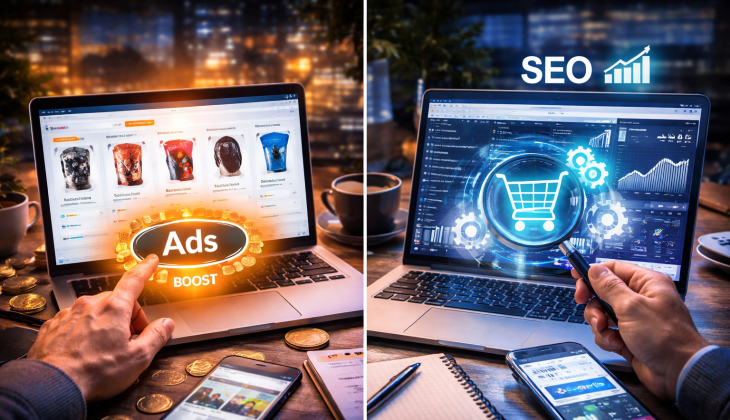
Ecommerce Growth · Traffic Strategy · Paid Advertising · SEO Marketing
Paid Ads vs SEO Marketing: Fastest Growing Traffic Strategy for Ecommerce Stores?
The real answer isn’t choosing between paid ads and SEO — it’s knowing when to use each one to build sustainable, profitable ecommerce growth.
Media Strobe Strategy Team · Updated March 2026 · 19 min read
Article-At-A-Glance
• Both paid ads and SEO are powerful ecommerce traffic strategies, but they work on completely different timelines and cost structures.
• Paid ads deliver immediate traffic but stop the moment your budget runs out — SEO keeps compounding long after you publish.
• New ecommerce stores often need paid ads to survive early on, while established stores unlock their lowest customer acquisition costs through organic search.
• The fastest-growing ecommerce brands use paid ad data to fuel their SEO strategy — a combination most stores overlook entirely.
• Later in this article, we break down exactly which strategy wins at each stage of store growth, with real traffic and ROAS results to back it up.
Table of Contents
- Paid Ads Drive Traffic Fast, SEO Builds It Permanently
- What Paid Ads Actually Do for Ecommerce Stores
- What SEO Does That Paid Ads Cannot
- Paid Ads vs SEO: Head-to-Head Comparison for Ecommerce
- Which Strategy Works Best at Each Stage of Your Store
- Real Ecommerce Results From SEO and Paid Ads
- How to Run Both Strategies Without Burning Your Budget
- The Fastest Growing Ecommerce Traffic Strategy Is Both
- How Media Strobe Can Help
- Frequently Asked Questions
Most ecommerce stores pick one and struggle — the real growth happens when you understand what each strategy actually does, and when to use it. For foundational understanding of search marketing, exploring what SEO marketing entails provides valuable context.
The debate between paid ads and SEO has been going on for years, but it’s the wrong framing. These aren’t competing strategies. They’re two engines that power different phases of your store’s growth. Paid ads get you on the map fast. SEO keeps you there without bleeding your margins dry. Knowing which one to lean on — and when — is what separates stores that plateau from stores that scale.
Media Strobe specializes in ecommerce growth strategy and has worked across both paid and organic channels, giving them a front-row seat to what’s actually moving the needle for online stores right now.
Paid Ads Drive Traffic Fast, SEO Builds It Permanently
Every ecommerce store faces the same core problem at launch: no one knows it exists. Paid ads solve that problem on day one. You set a budget, build a campaign, and traffic starts flowing within hours. That speed is genuinely powerful, especially when you need to validate a product, clear inventory, or hit a revenue target before the month ends. To explore paid advertising platforms, visit Google Ads and Meta Business.
But here’s what most store owners figure out the hard way — the moment the ad spend stops, so does the traffic. There’s no residual effect. No compounding. You’re essentially renting your audience, and the rent never stops going up. SEO flips that model entirely. It takes longer to build, but every ranking you earn keeps delivering traffic without an ongoing cost attached to it.
What Paid Ads Actually Do for Ecommerce Stores
Paid advertising in ecommerce is a direct exchange: money for visibility. You’re buying placement in front of people who are actively searching, scrolling, or browsing — and when the targeting is dialed in, the results can be extraordinary. Google Shopping campaigns, Meta dynamic ads, and TikTok Shop ads are currently the three highest-performing paid channels for ecommerce stores, each working differently depending on where your customer is in the buying journey.
How PPC Works on Google Shopping and Social Platforms
Google Shopping ads pull product data directly from your feed — title, price, image, and reviews — and display them at the very top of search results before any organic listing appears. When someone searches “wireless noise cancelling headphones under $100,” your product can appear with a photo and price before they’ve read a single organic result. Meta ads work differently, targeting based on behavioral data, interests, and lookalike audiences rather than search intent. TikTok ads lean heavily on video creative, making them ideal for visually demonstrable products that benefit from showing rather than telling.
A brand new ecommerce store has zero domain authority, zero backlinks, and zero content history. Paid ads bypass all of that. You can be in front of 10,000 targeted potential buyers within 48 hours of launching a campaign.
Why New Stores Lean on Paid Ads First
A brand new ecommerce store has zero domain authority, zero backlinks, and zero content history. SEO under those conditions takes months before any meaningful traffic appears. Paid ads bypass all of that. For stores that need to generate cash flow, validate a product concept, or build an initial customer base, paid ads are not optional — they’re a survival tool.
The Real Cost of Stopping Your Ad Spend
The most uncomfortable truth about paid ads is built into how they’re structured. The traffic is real, the conversions are real, but none of it belongs to you. Pause the campaign and your store goes dark overnight. For stores that have built their entire growth model around paid ads without developing any organic presence, this creates a dangerous dependency. Rising CPCs (cost-per-click) on Google and Meta have increased acquisition costs significantly in competitive ecommerce categories, squeezing margins in ways that weren’t a problem three years ago.
What SEO Does That Paid Ads Cannot
SEO builds an asset. Every optimized product page, every piece of content that earns a ranking, every backlink pointing to your store — these are equity you own. They don’t disappear when a budget gets cut. In fact, strong organic rankings tend to improve over time as your domain authority grows and your content earns more links and engagement signals. For comprehensive guidance, Google’s SEO Starter Guide provides foundational best practices.
The Compounding Effect
A well-optimized product category page that ranks on page one for a high-intent keyword like “best running shoes for flat feet” can drive thousands of qualified visitors per month — indefinitely. Unlike paid ads, that traffic doesn’t cost you more as it scales.
How Organic Rankings Compound Over Time
The compounding effect of SEO is what makes it the more powerful long-term traffic strategy. The effort was front-loaded into the optimization work, and the page keeps delivering returns long after the work is done.
Content-driven SEO amplifies this even further. Blog posts, buying guides, and comparison articles that target long-tail keywords funnel organic traffic into your product pages in ways that feel natural to the reader. A buyer searching “what’s the difference between trail and road running shoes” is early in their journey — getting in front of them with a helpful guide puts your store in their consideration set before they’ve even decided what to buy.
Why SEO Lowers Your Customer Acquisition Cost Long-Term
Customer acquisition cost (CAC) is the metric that tells you how much it costs to bring in one paying customer. For paid ads, CAC is directly tied to your ad spend and scales with every sale. For SEO, the CAC drops over time as your content and rankings accumulate. A store generating 50,000 monthly visitors from organic search is paying near-zero per visitor — making every conversion dramatically more profitable than one sourced through a $2.50 cost-per-click Google campaign.
Paid Ads vs SEO: Head-to-Head Comparison for Ecommerce
Choosing between paid ads and SEO isn’t really a binary decision, but understanding how they compare across the metrics that matter most helps you allocate your budget with clarity. The table below breaks down the core differences across the five dimensions ecommerce store owners care about most.
Paid Ads vs SEO: Complete Comparison
| Factor | Paid Ads | SEO |
|---|---|---|
| Speed of Results | Within 24–48 hours | 3–12 months |
| Cost Over Time | Ongoing — scales with traffic | Front-loaded — decreases per visitor |
| Traffic Stability | Stops when budget stops | Compounds and persists |
| Targeting Precision | High — demographic, behavioral, intent | Moderate — keyword-based intent |
| Trust & Credibility | Lower — users know it’s an ad | Higher — organic results carry more trust |
Targeting and Audience Control
This is where paid ads have a genuine structural advantage. Google Ads lets you target by search intent, device, location, time of day, and audience behavior simultaneously. Meta’s ad platform goes even deeper — you can target people based on life events, purchase behaviors, interests, and lookalike audiences built from your existing customer list. That level of precision is something organic search simply cannot replicate at the same speed.
Which Strategy Works Best at Each Stage of Your Store
The most common mistake ecommerce store owners make is treating paid ads and SEO as permanent either/or choices. In reality, the right strategy shifts dramatically based on where your store sits in its growth cycle.
Strategy by Growth Stage
Brand New Store (0-6 months)
Start with paid ads at $500-$1,000/month. Use conversion data to identify which products actually sell, then build SEO strategy around those proven winners. Paid ads are your survival tool and market research engine.
Growing Store (6-18 months)
Aggressively invest in SEO using paid campaign data to identify highest-intent keywords. Build optimized product pages and supporting content around exact terms driving conversions. You’re building the asset that will reduce CAC within 12-18 months.
Established Store (18+ months)
Use paid ads as precision amplification tool. Run retargeting for organic visitors who didn’t convert. Dominate high-competition keywords where SEO sits on page two. The combination creates search presence competitors can’t displace.
Real Ecommerce Results From SEO and Paid Ads
Numbers matter more than theory when you’re making budget decisions. The case for running both paid ads and SEO isn’t abstract — ecommerce stores across categories have demonstrated measurable, repeatable results from both channels when executed correctly.
Documented Ecommerce Results
120% Organic Traffic Growth From Long-Tail SEO in 12 Months
Stores that systematically build content around specific, low-competition product queries — think “waterproof hiking boots for wide feet women” rather than just “hiking boots” — routinely see organic traffic double within a 12-month period. Long-tail keywords have lower competition, higher purchase intent, and convert at significantly higher rates than broad terms.
200% ROAS From Google Shopping Ads in Six Weeks
Google Shopping campaigns consistently outperform standard search ads for ecommerce because they surface product images, pricing, and reviews directly in search results. Stores with well-structured product feeds, competitive pricing, and strong review profiles regularly achieve 200% to 400% ROAS within the first six weeks of an optimized campaign.
How to Run Both Strategies Without Burning Your Budget
Running paid ads and SEO simultaneously doesn’t mean doubling your marketing budget. It means being strategic about how each channel informs and supports the other.
Small Budget Framework: Running Both Channels
Early Stage (Months 1-6): Allocate 70% to paid ads for immediate revenue and data, 30% to foundational SEO (product optimization, technical fixes, 1-2 content pieces monthly)
Growth Stage (Months 6-18): Shift to 50/50 as organic traffic starts appearing. Use paid campaign insights to accelerate SEO content production.
Established Stage (18+ months): Reduce paid to 30%, increase SEO to 70% as organic traffic compounds and CAC drops.
Example: $1,500 monthly budget → Start at $1,000 paid / $500 SEO, gradually shift allocation as organic traffic grows.
Use Paid Ads to Test Which Products Deserve SEO Investment
Before committing months of SEO effort to a product category, use a small paid ads budget to validate demand. Run a two-week Google Shopping campaign across your top product lines and track which products convert at the lowest cost-per-acquisition. The products that perform best in paid ads are the same ones worth building long-term organic content around — because the market has already told you it wants them.
This approach eliminates the guesswork from SEO prioritization entirely. Instead of optimizing for products you think will sell, you’re optimizing for products that have already proven they convert under real traffic conditions. It also shortens your SEO timeline — you’re not waiting 12 months to discover a product category doesn’t have enough search demand to justify the content investment.
Paid Data → SEO Strategy Workflow
→ Export your Google Ads search term report monthly and filter for converting queries
→ Map high-converting paid keywords to existing product and category pages for on-page SEO updates
→ Build blog content and buying guides around long-tail variations of your top paid search terms
→ Use paid ad copy that performs well as inspiration for organic meta descriptions and title tags
→ Track keyword overlap between paid and organic campaigns to identify ranking gaps worth closing
Before increasing spend on any paid campaign, establish a minimum ROAS threshold — most ecommerce stores should require at least 200% to 300% ROAS before scaling a campaign further. Let the data drive allocation, not assumptions.
Set Budget Thresholds Before Scaling Either Channel
Scaling without performance benchmarks is how ecommerce stores burn through budget without building anything lasting. On the SEO side, set clear content output targets and review organic traffic growth monthly against your content investment. A practical rule: if paid campaigns aren’t hitting target ROAS after 60 days of active optimization, redirect a portion of that budget into SEO content production.
The Fastest Growing Ecommerce Traffic Strategy Is Both
The ecommerce stores growing fastest right now aren’t choosing between paid ads and SEO — they’re running both with intention, letting each channel do what it’s uniquely built to do. Paid ads generate immediate cash flow, validate product demand, and provide keyword intelligence that accelerates SEO. SEO builds compounding organic traffic, reduces customer acquisition costs over time, and creates a traffic asset that doesn’t disappear when a budget gets paused.
The exact split will depend on your store’s stage, margins, and competitive landscape — but the direction is always the same. Start with paid to survive and learn, then invest in SEO to scale efficiently and build something that lasts.
How Media Strobe Can Help
If you’re tired of choosing between paid ads and SEO — or watching your ad budget disappear with nothing to show long-term — Media Strobe’s MultiCast campaign solves both problems at once by building immediate visibility and permanent organic equity simultaneously.
MultiCast Campaign: Ecommerce Traffic That Compounds
Media Strobe’s MultiCast campaign is expertly created to answer highly relevant questions about your products that your future customers are asking (all over the internet) before they make their purchase decision. Your MultiCast is distributed to hundreds of high authority sites IN THE EXACT WAY that Google and AI love, and in 8 formats so that your answers show up everywhere people are asking questions.
How the MultiCast campaign solves the paid vs organic dilemma for ecommerce stores:
- Builds both immediate visibility AND long-term SEO equity — you’re not choosing one or the other
- Content automatically transformed into 8 different formats (product guides, comparison articles, Q&A, video scripts, social posts, email sequences, infographics, checklists)
- Distributed across hundreds of high-authority ecommerce and retail-relevant platforms Google already trusts
- Creates backlinks and domain authority that reduce your dependence on paid ads over time
- Targets high-intent product search queries that paid ads would cost $2-$5 per click to capture
- Works 24/7 generating qualified traffic even when your ad budget is paused
The benefits of running a MultiCast campaign for ecommerce:
- Increased visibility (leading to increased ranking) across search and shopping platforms
- Increased warm/hot traffic from buyers actively researching products
- Reduced customer acquisition costs as organic traffic compounds monthly
- Predictable growth that can be scaled across product categories
- Generate more revenue with higher net profit per sale (no CPC costs)
- True control over your lead generation without platform dependency
- Better return on paid ads when amplified by strong organic presence
Frequently Asked Questions
When ecommerce store owners start comparing paid ads and SEO, the same questions come up repeatedly — and the answers matter because getting this wrong can cost months of growth or thousands in wasted spend. For more insights, explore how media exposure and social media paid ads contribute to ecommerce success.
Is SEO or Paid Ads Better for a Brand New Ecommerce Store?
For a brand new ecommerce store, paid ads are the better starting point. A new domain has no authority, no backlinks, and no content history — conditions that make organic ranking nearly impossible in the short term. Paid ads on Google Shopping or Meta can generate real traffic and sales within 48 hours, giving you the cash flow and customer data you need to survive the early stages while your SEO foundation is being built in parallel.
How Long Does Ecommerce SEO Take to Show Results?
Ecommerce SEO typically takes between 3 and 12 months to produce meaningful organic traffic, depending on your domain’s existing authority, the competition level of your target keywords, and the quality and consistency of your content output. New domains in competitive categories should expect to sit closer to the 9 to 12 month range before significant ranking movement occurs. Established domains with existing authority can see results from new content in as little as 6 to 8 weeks when targeting low-competition long-tail keywords.
What Is a Good ROAS for Ecommerce Paid Ads?
A good ROAS benchmark for ecommerce paid ads is generally 300% to 400% — meaning for every $1 spent on ads, you’re generating $3 to $4 in revenue. However, the right target for your store depends entirely on your product margins. A store with 20% profit margins needs a much higher ROAS to remain profitable than a store with 60% margins. Calculate your break-even ROAS first (which is simply 1 divided by your profit margin percentage), then set your target ROAS above that number to ensure campaigns are contributing net profit, not just revenue.
Can You Do SEO and Paid Ads at the Same Time on a Small Budget?
Yes — running both on a small budget is not only possible, it’s often the smartest approach. The key is sequencing your investment correctly. Allocate the majority of your early budget (around 70%) to paid ads to generate immediate revenue and conversion data, and use the remaining 30% to fund foundational SEO work like product page optimization, technical fixes, and one to two pieces of high-quality content per month.
As your paid campaigns mature and your SEO starts producing organic traffic, gradually shift that allocation — reducing paid spend as a percentage of total budget while increasing content and link-building investment. A $1,500 monthly marketing budget split as $1,000 paid / $500 SEO is a realistic starting point that keeps cash flowing while building long-term organic equity.
Which Platform Is Best for Ecommerce Paid Ads: Google or Meta?
Google and Meta serve different roles in the ecommerce paid ads ecosystem, and the best platform depends on your product type and where your customer is in the buying journey. Google Shopping captures high-intent demand — people who are already searching for exactly what you sell. Meta creates demand — it puts your product in front of people who match your customer profile before they’ve started searching.
If you’re forced to choose one platform to start, Google Shopping is generally the better fit for established product categories with existing search demand. Meta becomes more powerful once you have customer data to build lookalike audiences from — typically after your first 500 to 1,000 purchases. The most effective ecommerce paid strategies use both platforms together: Google Shopping to capture bottom-of-funnel buyers who are ready to purchase, and Meta retargeting to re-engage top-of-funnel visitors who discovered your store through organic search but didn’t convert on the first visit.
Why Choose a MultiCast Campaign by Media Strobe?
All MultiCast campaigns are expertly created to answer highly relevant questions about your service/product that your future customers are asking (all over the internet) before they make their purchase decision. Your MultiCast is distributed to hundreds of high authority sites IN THE EXACT WAY that Google and AI love, and in 8 formats so that your answers show up everywhere people are asking questions.
The benefits of running a MultiCast campaign are:
- Increased visibility (leading to increased ranking)
- Increased warm/hot traffic
- Reduced customer acquisition costs
- Predictable growth that can be scaled
- Generate more revenue with higher net profit
- True control over your lead generation
- Better return on paid ads
Disclaimer: This article is for informational and educational purposes only. Results from paid advertising and SEO strategies vary based on industry, product category, competition levels, budget allocation, content quality, technical SEO execution, and numerous other factors. The performance benchmarks cited (200-400% ROAS, 120% organic traffic growth, 3-12 month SEO timelines) represent documented examples or industry standards but should not be interpreted as guaranteed results for any specific ecommerce store. ROAS calculations depend on accurate profit margin tracking and proper campaign attribution. SEO timelines are influenced by domain authority, backlink profiles, content consistency, and competitive dynamics in your category. Budget allocation strategies (70/30 splits, $1,500 minimum recommendations) are illustrative frameworks, not universal requirements. Media Strobe provides content distribution through MultiCast campaigns but does not guarantee specific traffic volumes, ranking positions, conversion rates, or ROAS outcomes. Ecommerce store owners should verify all advertising platform capabilities, costs, and policies independently before implementation. Always maintain compliance with Google Ads policies, Meta advertising standards, FTC disclosure requirements for sponsored content, and applicable ecommerce regulations in your jurisdiction. Platform features, auction dynamics, and algorithm updates can significantly impact campaign performance. Paid advertising involves financial risk — only allocate budgets you can afford to test and optimize. Consult with qualified marketing professionals or financial advisors for strategies specific to your business situation.
© 2026 Media Strobe. All rights reserved. | More Ecommerce Growth Strategies