Digital Marketing Strategy · Paid Advertising · Social Media ROI
Yes, paid social media marketing is worth it in 2026 for most businesses — but only when built on a solid creative foundation, targeted at the right funnel stage, and integrated with an organic strategy that builds long-term audience equity. The businesses that struggle with paid social are typically those treating it as a shortcut, expecting cold traffic campaigns to immediately offset ad spend without conversion-optimized funnels, strong creative, or the organic credibility that makes audiences trust the brand before clicking an ad.
Article at a Glance
- Paid social media marketing in 2026 delivers faster, more targeted results than organic content alone — but only when matched to the right platform and audience strategy
- Organic reach on major platforms like Facebook and Instagram has dropped to under 5%, making paid amplification increasingly necessary for consistent visibility
- AI-powered ad tools are reshaping how campaigns are built, with platforms like Meta Advantage+ and TikTok Smart Performance Campaigns automating targeting, creative, and bidding in real time
- The real question isn’t organic vs. paid — it’s how to blend both for compounding returns, and the answer depends heavily on your budget, goals, and content infrastructure
- Keep reading to find out which platforms offer the best ROI in 2026, what the true cost of paid social looks like, and how to avoid the most common budget-wasting mistakes
Table of Contents
- What Is Paid Social Media Marketing?
- The State of Organic Reach in 2026
- Paid vs. Organic: A Direct Comparison
- Best Platforms for Paid Social in 2026
- What Does Paid Social Actually Cost in 2026?
- The Real Pros and Cons of Paid Social Media Marketing
- How to Build a Paid Social Strategy That Actually Works in 2026
- How Media Strobe Can Help
- Is Paid Social Media Marketing Worth It in 2026?
Paid social media marketing in 2026 is not what it looked like three years ago — the platforms have changed, the algorithms have gotten smarter, and the cost of doing nothing has gone up. Media Strobe Press outlines how businesses that combine media exposure with paid social strategies are seeing compounding visibility gains that organic-only approaches simply can’t match in today’s landscape.
Whether you’re a small business owner wondering if boosted posts are worth it, or a marketing manager evaluating a six-figure ad budget, the fundamentals matter more than ever. The landscape is noisier, ad costs are climbing on some platforms while dropping on others, and consumer behavior is shifting toward short-form video and AI-curated feeds. Getting your paid social strategy right in 2026 means understanding both sides of the equation — what you gain from paying for reach, and what you sacrifice if you skip the organic foundation entirely.
What Is Paid Social Media Marketing?
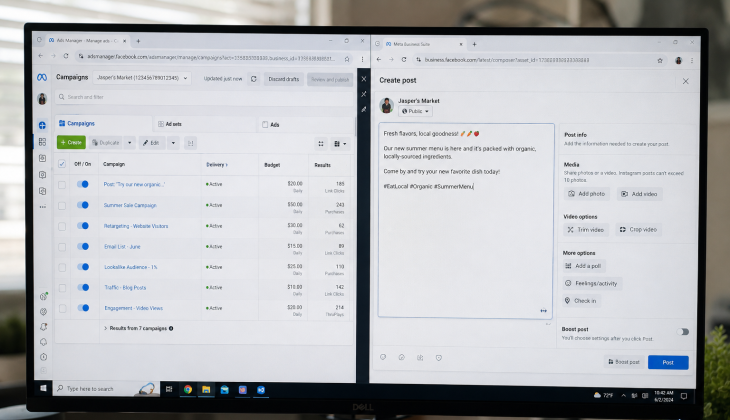
Paid social media marketing is any advertising you pay for directly on a social platform — from Facebook feed ads and Instagram Stories to TikTok In-Feed ads and LinkedIn Sponsored Content. Unlike organic posts, paid ads are shown to people outside your existing followers based on targeting parameters like demographics, interests, behaviors, and lookalike audiences.
The core mechanic is simple: you pay the platform for access to its audience. What’s changed in 2026 is how that access works. Most major platforms now rely heavily on machine learning to determine who sees your ad, when, and at what frequency. Manual targeting is still available, but automated and AI-assisted campaign types now dominate performance benchmarks across Meta, TikTok, and YouTube.
Core Components of Paid Social Media Marketing
Direct Platform Payment: You pay social networks for guaranteed audience reach
Advanced Targeting: Demographics, interests, behaviors, lookalike audiences beyond your followers
AI-Powered Delivery: Machine learning determines who sees your ad, when, and how often
Measurable Results: Every click, impression, and conversion tracked and attributed in real time
The State of Organic Reach in 2026
Organic reach — the number of people who see your content without paid promotion — has been in steady decline across every major platform for years. Facebook organic reach for business pages sits below 5% of total followers on average. Instagram has followed a similar trajectory, with algorithm updates in 2024 and 2025 further prioritizing Reels and content from personal accounts over brand pages.
This isn’t a coincidence. Platforms are businesses, and ad revenue is their primary income. Restricting organic reach creates pressure to pay for visibility. That said, organic content still plays a critical role — just not as a standalone growth channel for most businesses. For more insights on how to balance these strategies, check out this comparison between email marketing and social media.
Here’s where organic still holds genuine value in 2026:
Where Organic Social Still Delivers Value
- Brand trust and community building — Consistent organic posting signals credibility to both algorithms and human visitors who check your profile before converting
- Content testing — Organic engagement data tells you what resonates before you put ad spend behind it
- SEO crossover — Social content increasingly surfaces in AI-powered search results, including Google’s AI Overviews, which can drive referral traffic without direct ad spend
- Retargeting fuel — Organic video views, profile visits, and post engagements feed your custom audience pools for paid campaigns
The businesses winning in 2026 aren’t choosing between organic and paid — they’re using organic to build warm audiences and paid to scale what’s already working.
Organic Reach Reality Check
Under 5%
Average organic reach for Facebook business pages in 2026
Paid vs. Organic: A Direct Comparison
Understanding the practical differences between paid and organic social helps you allocate resources without guessing. Here’s how they stack up across the metrics that actually matter to business outcomes: for instance, consider the comparison between email marketing and social media in terms of conversion rates.
| Factor | Organic Social | Paid Social |
|---|---|---|
| Speed to Results | Slow — weeks to months | Fast — results within hours |
| Audience Reach | Limited to followers + algorithm favor | Scalable to any defined audience |
| Cost | Time investment, no direct ad spend | Requires budget; CPCs vary by platform |
| Targeting Precision | Low — algorithm decides distribution | High — demographic, behavioral, lookalike |
| Trust Signal | High — perceived as authentic | Lower — clearly labeled as an ad |
| Longevity | Content can surface for months or years | Stops the moment budget runs out |
| Testing Capability | Slow feedback loop | Fast A/B testing with measurable data |
The table makes one thing clear: paid and organic are not competing strategies — they serve fundamentally different functions. Organic builds the foundation; paid accelerates growth on top of it.
Best Platforms for Paid Social in 2026
Not all platforms deliver equal ROI, and where you spend matters as much as how much you spend. Platform performance varies significantly by industry, audience age, and ad format. Here’s what the data shows for 2026:
Meta (Facebook & Instagram)
Meta remains the dominant force in paid social advertising, with the most sophisticated targeting infrastructure available. Meta Advantage+ campaigns use AI to automatically optimize audience targeting, placements, and creative combinations — reducing manual setup time while consistently outperforming manually configured campaigns in conversion rate benchmarks. Facebook skews toward 35+ demographics, while Instagram continues to dominate for 18–34 audiences, particularly in e-commerce, fashion, beauty, and lifestyle verticals.
TikTok
TikTok’s ad platform matured significantly between 2024 and 2026. Smart Performance Campaigns now allow advertisers to set a goal — traffic, conversions, app installs — and let TikTok’s algorithm handle creative delivery and audience selection automatically. Average CPMs on TikTok remain lower than Meta, making it highly competitive for brands targeting Gen Z and younger Millennials. The catch: creative quality is everything. Low-production ads that don’t match native TikTok content style get penalized with higher CPMs and lower delivery.
LinkedIn is the clear leader for B2B paid social, with no serious competition in 2026. Cost-per-click is significantly higher than other platforms — often $8 to $15 or more — but the audience quality for decision-maker targeting justifies the spend in high-ticket B2B categories. Sponsored Content, Message Ads, and LinkedIn’s Thought Leader Ads (which promote posts from individual employee profiles) are the top-performing formats this year.
YouTube
YouTube sits at the intersection of paid social and video search. Skippable in-stream ads, non-skippable bumper ads, and YouTube Shorts ads all serve different funnel stages. For remarketing and brand awareness campaigns, YouTube consistently delivers strong cost-per-view metrics, particularly when campaigns are integrated with Google Ads data for intent-based targeting layering.
Pinterest & Snapchat
Pinterest remains a high-intent platform for home, food, fashion, and wedding verticals — users on Pinterest are actively planning purchases, which translates to strong conversion rates for the right product categories. Snapchat has maintained relevance for reaching 13–24 year olds, particularly for mobile app installs and product discovery campaigns.
Platform-by-Platform Strengths
Meta (Facebook/Instagram): Most sophisticated targeting, 35+ on Facebook, 18-34 on Instagram, e-commerce dominant
TikTok: Lower CPMs, Gen Z/younger Millennials, creative quality critical, Smart Performance automation
LinkedIn: B2B leader, $8-$15+ CPC, decision-maker targeting, high-ticket categories
YouTube: Video search crossover, remarketing strength, multiple ad formats for different funnel stages
Pinterest/Snapchat: Pinterest for high-intent product planning, Snapchat for 13-24 mobile app installs
What Does Paid Social Actually Cost in 2026?
Ad costs vary widely by platform, industry, ad format, and competition level. Rather than quoting single averages that can mislead, here are the realistic cost ranges marketers are working with in 2026:
| Platform | Cost Metric | 2026 Range | Notes |
|---|---|---|---|
| Meta (Facebook/Instagram) | CPM | $8–$20 | Higher in Q4 due to holiday competition |
| TikTok | CPM | $3–$10 | Lower for Spark Ads (boosted organic) |
| CPC | $8–$15+ | Depends on audience seniority and industry | |
| YouTube | CPV | $0.03–$0.10 | For skippable in-stream ads |
| CPM | $2–$8 | One of the lowest-cost visual platforms | |
| Snapchat | CPM | $3–$8 | For Snap Ads targeting younger demographics |
These numbers move constantly based on seasonality, audience size, and how competitive your niche is. The most reliable way to establish your true cost baseline is to run a controlled test campaign with a defined daily budget over 14–21 days before scaling. For more insights on optimizing your LinkedIn marketing strategy, consider understanding the platform’s algorithm.
The Real Pros and Cons of Paid Social Media Marketing
Every marketer pitching a paid social strategy will lead with the wins. But the honest picture includes real limitations that can burn through budget fast if you’re not prepared. Here’s what you actually need to know before committing spend, including insights on email marketing vs social media strategies.
The Pros
Speed is the biggest advantage. Organic content can take months to build momentum. A well-configured paid campaign can generate clicks, leads, and sales within the first 24–48 hours of going live. For product launches, time-sensitive promotions, or entering a new market, that speed is genuinely irreplaceable.
Targeting precision has never been better. In 2026, platforms like Meta and TikTok allow you to reach people based on purchase behavior, life events, job titles, interests, and even engagement with specific competitors. Lookalike audiences — where the platform finds new users who mirror your best existing customers — remain one of the highest-performing targeting methods available.
Scalability is built in. Unlike organic content, where doubling your output doesn’t guarantee double the reach, paid social scales predictably. If a campaign is generating a positive return on ad spend (ROAS), you can increase the budget and scale results in a relatively linear way — at least up to a point before audience saturation sets in.
Measurability is clear and direct. Every click, impression, conversion, and cost is tracked and attributed. Unlike some traditional marketing channels, paid social gives you hard data to evaluate what’s working and what isn’t, which allows for rapid iteration.
4 Major Advantages of Paid Social
1. Speed: Results within 24-48 hours vs. months for organic
2. Precision Targeting: Purchase behavior, life events, job titles, lookalike audiences
3. Predictable Scalability: Increase budget = linear growth in results (up to saturation point)
4. Direct Measurability: Every click, impression, conversion tracked and attributed
The Cons
It stops the moment you stop paying. This is the fundamental weakness of paid social. There’s no compounding effect — no residual traffic, no growing authority. The second your budget runs out, your visibility drops to zero. Businesses that rely exclusively on paid channels build on rented land with no long-term equity.
Ad fatigue is real and accelerating. Audiences in 2026 are more ad-saturated than ever. Creative fatigue — where your target audience has seen your ad enough times that performance starts declining — now sets in faster than it did even two years ago. Most performance marketers refresh creative every 2–4 weeks to combat this, which creates a constant demand for new content production.
Costs are rising on competitive platforms. Meta CPMs have increased year over year as more advertisers compete for the same inventory. In high-competition niches like insurance, finance, legal services, and e-commerce, the cost to acquire a customer through paid social alone can be prohibitive without strong conversion rate optimization on the landing page side.
Platform dependency is a real risk. Algorithm changes, policy updates, and account bans can shut down campaigns without warning. Advertisers who experienced Meta’s ad account suspension waves in 2023 and 2024 know exactly how fragile pure paid-social dependence can be. Diversifying across platforms mitigates — but doesn’t eliminate — this risk, as explained in our LinkedIn algorithm 2026 guide.
4 Major Disadvantages of Paid Social
1. No Compounding Effect: Visibility drops to zero the moment budget runs out
2. Creative Fatigue: Performance declines faster in 2026, requires refresh every 2-4 weeks
3. Rising Costs: Meta CPMs increasing year over year in competitive niches
4. Platform Dependency Risk: Algorithm changes, policy updates, account bans can shut down campaigns instantly
How to Build a Paid Social Strategy That Actually Works in 2026
A functional paid social strategy in 2026 follows a clear structure. Here’s the framework that consistently produces results across industries, including leveraging AI search and ICP strategies to enhance visibility and engagement.
6-Step Paid Social Strategy Framework
1. Define your funnel stage first. Are you building awareness, generating leads, or driving direct purchases? The answer determines your objective, ad format, and success metric. Running conversion campaigns to cold audiences who’ve never heard of your brand is one of the most common — and expensive — mistakes in paid social.
2. Start with warm audiences. Before spending on cold traffic, build campaigns targeting website visitors, video viewers, email list uploads, and social engagers. These audiences convert at lower costs and provide performance data that informs your cold audience expansion.
3. Let creative do the targeting. In 2026, with AI-driven broad targeting now outperforming narrow manual audiences on most platforms, your creative is effectively your targeting mechanism. Ads that speak directly to a specific pain point or desire self-select the right audience through engagement signals the algorithm learns from.
4. Test systematically, not randomly. Run structured A/B tests — one variable at a time — across headlines, visuals, CTAs, and formats. Document results and build a performance library that informs future campaigns.
5. Integrate organic and paid intentionally. Use organic content performance data to identify your best-performing posts, then amplify them with paid spend. On TikTok and Instagram, Spark Ads and Boosted Posts that run from organic content consistently outperform dark ads (ads with no organic presence) in both engagement rate and cost efficiency.
6. Monitor frequency and refresh creative proactively. Set frequency alerts — typically at 3–4 impressions per user — and rotate new creative before performance drops rather than after. Reactive creative refreshes cost more and lose momentum.
How Media Strobe Can Help
Building a successful paid social strategy in 2026 requires more than just ad spend — it requires a content infrastructure that feeds both your organic credibility and your paid amplification. Media Strobe’s MultiCast campaigns solve this exact problem by creating expert-level content that answers the questions your target audience is already asking, then distributing that content across 300+ high-authority platforms in formats optimized for both organic discovery and paid social performance.
Media Strobe’s MultiCast Campaign:
Every MultiCast campaign transforms a single high-value topic into 8 different content formats — articles, videos, infographics, podcasts, social posts, press releases, and more — then distributes them across 300+ high-authority platforms including Google News sites, MSN, FOX affiliates, Apple Podcasts, Spotify, YouTube, and industry-specific publications.
This cross-platform presence creates the organic credibility and warm audience pools that make your paid social campaigns convert at lower costs. Your ads perform better when prospects have already seen your brand mentioned on trusted third-party sites — and MultiCast builds that foundation systematically.
How MultiCast Campaigns Improve Paid Social Performance
- Increased Visibility: Brand appears across 300+ platforms, improving brand recall when prospects see your paid ads
- Warm Traffic Generation: Third-party mentions create pre-qualified audiences that convert at lower CPAs
- Reduced Customer Acquisition Costs: Organic credibility lowers resistance to paid ads
- Better Return on Paid Ads: Campaigns perform better when organic foundation exists
- Scalable, Predictable Growth: Content compounds over time while paid ads scale reach
Is Paid Social Media Marketing Worth It in 2026?
For most businesses, yes — but not unconditionally. Paid social delivers measurable, scalable results when it’s built on a solid creative foundation, targeted at the right funnel stage, and integrated with an organic strategy that builds long-term audience equity. Used correctly, it’s one of the most efficient ways to grow a business in 2026.
The businesses that struggle with paid social are typically the ones treating it as a shortcut — expecting cold traffic campaigns to immediately offset ad spend without a conversion-optimized funnel, without strong creative, and without the organic credibility that makes audiences trust the brand before clicking an ad.
The honest answer: Paid social is worth it when your funnel is ready for it. If your landing pages convert, your offer is compelling, and your creative speaks to a real pain point — paid social will amplify those results fast. If any of those elements are missing, you’ll pay to discover the gap.
The most successful marketers in 2026 aren’t debating organic vs. paid — they’ve moved past that conversation entirely. They’re using organic content to test, build trust, and warm audiences, then deploying paid spend to scale what’s already proven to work. That combination, executed consistently, is what separates brands that grow from brands that just spend.
If you’re ready to add media exposure and strategic content distribution to your paid social mix, Media Strobe Press specializes in amplifying brand visibility across 300+ high-authority platforms to complement and strengthen your paid social performance.
Frequently Asked Questions
Why Choose a MultiCast campaign by Media Strobe?
All MultiCast campaigns are expertly created to answer highly relevant questions about your service/product that your future customers are asking (all over the internet) before they make their purchase decision. Your MultiCast is distributed to hundreds of high authority sites IN THE EXACT WAY that Google and AI love, and in 8 formats so that your answers show up everywhere people are asking questions. The benefits of running a MultiCast campaign are increased visibility (leading to increased ranking), increased warm/hot traffic, reduced customer acquisition costs, predictable growth that can be scaled, generate more revenue with higher net profit, true control over your lead generation, and better return on paid ads.
Learn more about how MultiCast campaigns can amplify your paid social performance →