B2B Marketing · LinkedIn Strategy · 2026 Algorithm Update
Article at a Glance
- LinkedIn’s algorithm now prioritises ‘depth score’ – measuring how long users engage with content – over traditional metrics like likes and shares
- Personal profiles outperform company pages by 13:1 in organic reach, making employee advocacy essential for B2B brands
- External links, engagement bait, and AI-generated content face severe algorithmic penalties, with reach reduced by up to 60%
- Document carousels and native videos under 90 seconds deliver the highest engagement rates in 2026
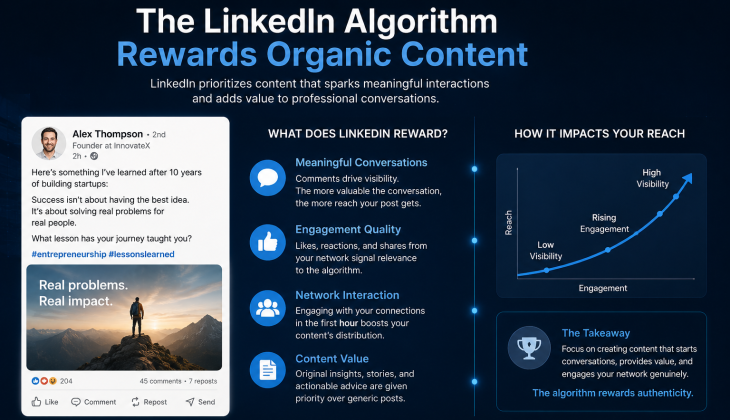
- The first 60 minutes after posting determine viral potential, with comments driving significantly more reach than likes
Table of Contents
- Depth Score Now Rules LinkedIn’s Feed
- Algorithm Penalties Hit B2B Marketers Hard
- Winning Content Formats Drive Maximum Engagement
- Personal Profiles Outperform Company Pages 13:1
- Master the Golden Hour for Maximum Distribution
- LinkedIn’s Interest Graph Rewards Authentic Expertise
- How Media Strobe Can Help
- Frequently Asked Questions
LinkedIn has fundamentally shifted how it distributes content, moving from a connection-based social graph to an interest-driven model that rewards authentic expertise and genuine engagement. For B2B marketers who’ve built strategies around outdated tactics, these changes represent both a significant challenge and an unprecedented opportunity.
The platform’s billion-strong user base creates immense potential, yet only a small percentage actively create content. This presents a massive advantage for brands willing to adapt to the new algorithmic reality. Media Strobe Press has been tracking these shifts extensively, revealing how forward-thinking marketers are already capitalising on these changes whilst their competitors struggle with deprecated strategies.
Depth Score Now Rules LinkedIn’s Feed
LinkedIn’s most significant algorithmic shift centres on ‘depth score’ – a sophisticated measurement of how long users actively engage with content rather than simply scrolling past. This fundamental change moves beyond surface-level metrics like reaction counts to evaluate genuine user interest and content value.
The algorithm now tracks multiple engagement signals: time spent reading, scrolling behaviour within posts, and whether users return to content after initial viewing. Document carousels particularly benefit from this metric, as each slide transition registers as continued engagement, creating compound scoring advantages.
This shift rewards content creators who prioritise substance over virality. Long-form posts that keep readers engaged for 30-60 seconds significantly outperform short, punchy updates that generate quick likes but minimal dwelling time. The implications for B2B marketers are profound – content must genuinely educate or entertain to succeed.
What Depth Score Measures
- Time spent actively reading content (30-60+ seconds optimal)
- Scrolling behaviour within posts (indicates engagement depth)
- Return visits to content after initial viewing
- Slide transitions in document carousels (compound scoring)
- Video watch time percentage and completion rates
- Comment thread participation and conversation depth
Algorithm Penalties Hit B2B Marketers Hard
LinkedIn’s AI has become increasingly sophisticated at detecting and suppressing manipulative content tactics that previously drove artificial engagement. These penalties aren’t minor algorithmic adjustments – they represent fundamental shifts that can devastate organic reach for unprepared marketers.
1. Engagement Bait Gets Detected and Suppressed
Posts containing phrases like “Comment YES if you agree” or “Tag someone who needs to see this” now trigger automatic reach reduction. LinkedIn’s machine learning models identify engagement bait patterns with remarkable accuracy, recognising not just obvious examples but subtle variations that attempt to circumvent detection.
The algorithm has evolved beyond simple keyword detection to analyse posting patterns, comment quality, and user behaviour around specific content types. Engagement pods – coordinated groups that artificially boost posts – face particularly harsh penalties, with LinkedIn’s systems capable of identifying unnatural engagement patterns across networks.
2. External Links Slash Reach by 60%
Including external links in post bodies triggers immediate algorithmic suppression, with reach reductions ranging from 25-60% depending on content type and posting history. Even the common workaround of placing links in first comments no longer provides protection, as LinkedIn’s systems now treat this as equivalent to direct linking.
This penalty reflects LinkedIn’s business model priorities – keeping users engaged within the platform rather than directing traffic elsewhere. The most successful B2B marketers now share insights natively, building authority through valuable content rather than driving immediate website traffic. For strategies on building organic authority, see this brand building approach.
3. AI-Generated Content Loses Distribution
LinkedIn’s algorithm actively identifies and deprioritises formulaic, AI-generated content, reducing distribution by up to 47% compared to authentic, human-created posts. The detection system analyses writing patterns, sentence structure variations, and topic coherence to distinguish between artificial and genuine content.
This creates particular challenges for marketing teams using AI tools for content creation. Successful brands now use artificial intelligence for research and ideation whilst ensuring final content maintains authentic voice and genuine insights that reflect real human experience and expertise.
| Penalty Trigger | Reach Reduction | Detection Method |
|---|---|---|
| Engagement Bait | 40-50% | ML pattern recognition |
| External Links in Body | 25-60% | Immediate algorithmic flag |
| AI-Generated Content | Up to 47% | Writing pattern analysis |
| Engagement Pods | 60%+ | Network behaviour tracking |
| Links in First Comment | 25-40% | Treated as direct linking |
Winning Content Formats Drive Maximum Engagement
The formats that dominate LinkedIn’s algorithm in 2026 share common characteristics: they encourage active user participation, generate substantial dwell time, and provide genuine value that users want to save or share with their networks.
Document Carousels Deliver Superior Dwell Time
Native PDF uploads, displayed as swipeable carousels, consistently achieve the highest engagement rates across LinkedIn. Each slide transition registers as active engagement, creating compounding algorithmic benefits that can extend reach exponentially beyond initial network connections.
Successful carousels follow specific structural principles: 10-15 slides maximum, one core concept per slide, and mobile-optimised design with large, readable text. The first slide functions as a thumbnail and must immediately communicate value, whilst the final slide typically includes a clear call-to-action for further engagement.
The most effective carousel topics include step-by-step processes, before-and-after case studies, industry benchmarks, and practical frameworks that users can immediately apply. These formats work because they transform passive consumption into active participation through deliberate user action.
Document Carousel Best Practices
Structure:
- 10-15 slides maximum (optimal engagement window)
- One core concept per slide (clear, focused messaging)
- Mobile-optimised design with large, readable text
- First slide as compelling thumbnail (drives initial clicks)
- Final slide with clear call-to-action (encourages next steps)
High-Performing Topics:
- Step-by-step processes and implementation frameworks
- Before-and-after case studies with data
- Industry benchmarks and comparative analysis
- Practical frameworks users can immediately apply
Native Video 30-90 Seconds Dominates Feed
Short-form native video content uploaded directly to LinkedIn receives preferential algorithmic treatment, particularly when optimised for silent viewing with captions. The 30-90 second duration aligns perfectly with average LinkedIn session lengths and mobile consumption patterns.
Successful video content focuses on direct, camera-facing communication rather than heavily produced promotional material. Behind-the-scenes insights, quick industry commentary, and concise educational content generate significantly higher engagement than polished corporate videos that feel overly promotional or disconnected from authentic expertise.
Personal Profiles Outperform Company Pages 13:1
The disparity between personal profile and company page performance has reached unprecedented levels, with individual accounts achieving 13:1 higher organic reach than branded pages. This shift reflects LinkedIn’s fundamental transition from a professional networking platform to a knowledge-sharing ecosystem that prioritises human connections over corporate messaging.
Company pages now represent approximately 5% of typical LinkedIn feed content, making employee advocacy programmes essential for B2B brands seeking organic visibility. The most successful companies empower team members to share expertise from personal profiles, amplifying company page reach by 5-10x through authentic individual voices.
This trend requires fundamental strategy shifts: instead of building company page followings, smart brands focus on developing employee thought leadership, creating content guidelines that maintain brand consistency whilst preserving authentic individual perspectives, and measuring success through collective team impact rather than single-page metrics. For more on content distribution strategies, explore this multicasting approach.
| Metric | Personal Profiles | Company Pages | Ratio |
|---|---|---|---|
| Organic Reach | High | Low | 13:1 |
| Feed Presence | ~95% | ~5% | 19:1 |
| Engagement Rate | 3-8% | 0.5-1.5% | 5:1 |
| Algorithm Priority | Interest-driven | Connection-based | — |
| Content Distribution | Extended networks | Existing followers | — |
Building an Employee Advocacy Programme
- Develop employee thought leadership through training and support
- Create content guidelines that maintain brand consistency
- Preserve authentic individual perspectives and voices
- Measure success through collective team impact
- Amplify company page reach by 5-10x through personal profiles
- Focus on knowledge-sharing over promotional messaging
Master the Golden Hour for Maximum Distribution
LinkedIn’s distribution algorithm makes critical reach decisions within the first hour after publishing, creating a narrow window where initial engagement patterns determine overall post performance and viral potential.
1. First 60 Minutes Determine Viral Potential
The algorithm tests new content with approximately 5-10% of the creator’s network during the initial hour, measuring engagement velocity and quality to determine broader distribution eligibility. Posts demonstrating strong early signals advance to secondary distribution phases, reaching extended networks and appearing in hashtag feeds.
Successful content creators schedule posting for times when their core audience is most active, then remain actively engaged on the platform for 60 minutes post-publication. This strategy maximises the probability of early engagement from highly connected network members whose interactions carry additional algorithmic weight.
2. Comments Drive Substantially More Reach Than Likes
Thoughtful comments generate exponentially more algorithmic value than simple reactions, with meaningful conversation threads signalling content quality far more effectively than passive engagement. The algorithm particularly values comments that demonstrate genuine engagement with the content topic rather than generic responses.
Content creators who actively reply to comments extend their posts’ visibility window, as each reply creates additional engagement opportunities. The most successful LinkedIn users spend considerable time crafting responses that add value to the original conversation, encouraging further participation and extending organic reach.
3. Saves Signal Premium Content Value
The ‘save’ function now drives substantially more reach than likes, indicating a fundamental shift towards content that users deem worthy of future reference. This metric reflects genuine content value rather than momentary appreciation, making it a critical algorithmic signal for quality assessment.
Content optimised for saving typically provides actionable frameworks, resource lists, or detailed case studies that serve as reference materials. The most successful B2B marketers deliberately create ‘saveable’ content that functions as valuable resources their audience wants to bookmark for future use.
Engagement Actions Ranked by Algorithmic Value
- Saves – Highest value: signals premium, reference-worthy content
- Thoughtful Comments – Very high value: demonstrates genuine engagement
- Shares – High value: extends reach to new networks
- Reply Comments – Medium-high value: extends visibility window
- Reactions (Varied) – Medium value: shows emotion/opinion
- Generic Likes – Lower value: passive engagement
The Golden Hour: First 60 Minutes Post-Publication
0-15 Minutes: Algorithm tests content with 5-10% of creator’s network
15-30 Minutes: Early engagement signals measured for quality and velocity
30-45 Minutes: Secondary distribution begins if strong signals detected
45-60 Minutes: Extended network reach activated; hashtag feed eligibility determined
Post-60 Minutes: Final distribution tier reached based on cumulative engagement
Creator Strategy: Remain actively engaged for full 60 minutes, respond to comments immediately, engage with other content to stay visible in feed
LinkedIn’s Interest Graph Rewards Authentic Expertise
LinkedIn has transitioned from a connection-based social graph to an interest-driven model that prioritises topical relevance and demonstrated expertise over network proximity. This shift fundamentally changes how content reaches audiences, rewarding consistent authority within specific subject areas.
The platform now analyses posting history, engagement patterns, and audience responses to identify genuine expertise areas for each user. Content creators who consistently share insights within defined topics receive preferential distribution to users interested in those subjects, even without direct connections.
This evolution benefits B2B marketers willing to establish clear expertise areas and consistently deliver valuable insights within those domains. Rather than chasing viral content across multiple topics, successful professionals focus on becoming authoritative voices within specific niches, building sustainable organic reach through demonstrated knowledge and consistent value delivery. The algorithm changes favour this approach.
Profile optimisation now directly influences content distribution, with clear headlines, about sections, and relevant experience descriptions serving as algorithmic credibility signals. The algorithm uses profile information to assess content relevance and determines appropriate audience targeting for each post.
Media Strobe helps B2B brands navigate these complex algorithmic changes through strategic content planning and authentic thought leadership development. For insights on optimising different platforms, see this comparison of email marketing versus social media strategies.
How the Interest Graph Benefits Consistent Creators
- Topical Authority Recognition: Algorithm identifies your expertise areas through consistent posting
- Extended Reach Beyond Network: Content distributed to interested users without direct connections
- Preferential Distribution: Subject matter experts receive priority for relevant topic queries
- Sustainable Growth: Compound reach increases through demonstrated knowledge
- Profile-Content Alignment: Headlines and experience descriptions serve as credibility signals
- Niche Dominance Advantage: Focused expertise outperforms broad, scattered content
How Media Strobe Can Help
Navigate LinkedIn’s Algorithm Changes With Strategic Content Distribution
LinkedIn’s 2026 algorithm rewards authentic expertise and genuine engagement, but building that authority requires consistent, high-quality content that reaches the right audiences. Media Strobe’s MultiCast campaigns help B2B brands establish thought leadership across multiple platforms while adapting to LinkedIn’s interest-driven distribution model.
Each MultiCast campaign creates content specifically designed to answer the questions your target audience is asking before they make purchase decisions. By distributing your expertise across hundreds of high-authority sites in 8 different formats, MultiCast campaigns build the authentic authority signals that LinkedIn’s algorithm now prioritises.
What MultiCast campaigns deliver for LinkedIn strategy:
- Authentic thought leadership content that demonstrates genuine expertise
- Multi-platform distribution that reinforces your authority across the web
- Interest-graph alignment through consistent topical focus
- Increased visibility leading to higher LinkedIn profile authority
- Content optimised for depth score and genuine engagement metrics
- Sustainable organic reach growth through demonstrated knowledge
Frequently Asked Questions
How has LinkedIn’s algorithm changed in 2026?
LinkedIn’s algorithm has shifted from connection-based distribution to an interest-driven model that prioritises ‘depth score’ – measuring actual engagement time rather than simple reactions. The platform now rewards authentic expertise, genuine engagement, and content that keeps users on the platform. Personal profiles receive 13:1 higher organic reach than company pages, and external links can reduce reach by up to 60%.
What is depth score and why does it matter?
Depth score measures how long users actively engage with content, including time spent reading, scrolling behaviour, and return visits. Unlike traditional metrics that count reactions, depth score evaluates genuine interest and content value. Long-form posts that maintain 30-60 seconds of engagement significantly outperform short updates with quick likes, fundamentally changing what content succeeds on LinkedIn.
Why do personal profiles outperform company pages?
LinkedIn’s algorithm now prioritises human connections and knowledge-sharing over corporate messaging, resulting in personal profiles achieving 13:1 higher organic reach than company pages. The platform treats individual expertise and authentic voices as more valuable than branded content. This makes employee advocacy programmes essential for B2B brands seeking organic visibility on LinkedIn.
What content formats perform best on LinkedIn in 2026?
Document carousels (10-15 slides) and native videos (30-90 seconds) deliver the highest engagement rates. Carousels benefit from compound depth scoring as each slide transition registers as continued engagement. Videos optimised for silent viewing with captions align perfectly with mobile consumption patterns. Both formats encourage active participation rather than passive scrolling, which the algorithm heavily rewards.
How do external links affect LinkedIn reach?
External links in post bodies trigger immediate algorithmic suppression, reducing reach by 25-60% depending on content type and posting history. Even placing links in first comments no longer provides protection, as LinkedIn’s systems treat this as equivalent to direct linking. The platform prioritises keeping users engaged within LinkedIn rather than directing traffic elsewhere.
What is the ‘golden hour’ for LinkedIn posts?
The first 60 minutes after posting determine viral potential. LinkedIn’s algorithm tests new content with 5-10% of the creator’s network during this period, measuring engagement velocity and quality. Posts with strong early signals advance to secondary distribution phases, reaching extended networks. Successful creators remain actively engaged for the full hour, responding to comments and maximising early engagement from highly connected network members. For more tips on adapting to algorithm changes, explore additional strategies.
How does LinkedIn detect AI-generated content?
LinkedIn’s algorithm analyses writing patterns, sentence structure variations, and topic coherence to identify formulaic, AI-generated content. Posts flagged as artificial receive up to 47% reduced distribution compared to authentic, human-created content. The system evaluates consistency of voice, depth of insights, and genuine expertise signals to distinguish between AI-assisted research and completely artificial content.
What engagement actions carry the most algorithmic weight?
Saves carry the highest algorithmic value, signalling premium content worthy of future reference. Thoughtful comments rank second, demonstrating genuine engagement with content topics. Simple reactions and generic likes carry significantly less weight. Content creators should optimise for saveable content and meaningful conversation rather than quick likes and vanity metrics.
How should B2B brands adapt their LinkedIn strategy?
Focus on employee advocacy programmes rather than company page growth, as personal profiles dramatically outperform branded pages. Create content that prioritises depth score through genuine value and substance. Avoid external links, engagement bait, and AI-generated content. Schedule posts for maximum early engagement during the golden hour. Develop consistent expertise in specific topics to benefit from LinkedIn’s interest-driven distribution model. For broader content strategies, consider optimisation approaches across platforms.
Why Choose a MultiCast campaign by Media Strobe?
All MultiCast campaigns are expertly created to answer highly relevant questions about your service/product that your future customers are asking (all over the internet) before they make their purchase decision. Your MultiCast is distributed to hundreds of high authority sites IN THE EXACT WAY that Google and AI love, and in 8 formats so that your answers show up everywhere people are asking questions. The benefits of running a MultiCast campaign are increased visibility (leading to increased ranking), increased warm/hot traffic, reduced customer acquisition costs, predictable growth that can be scaled, generate more revenue with higher net profit, true control over your lead generation, and better return on paid ads.