eCommerce Strategy · Buyer Journey · Multi-Platform Marketing · Conversion Optimization · Content Distribution
The New Buyer Journey: Wake up eComm Sellers Before it’s Too Late
How today’s eCommerce buyer researches across 8+ platforms before purchasing — and why brands invisible beyond Google are funding competitor sales without realizing it.
Media Strobe eCommerce Team · Updated April 2026 · 18 min read
Key Takeaways
• Today’ eCommerce buyer rarely buys after seeing just one ad — they research across YouTube, Google, TikTok, podcasts, and news sites before ever clicking “Add to Cart.”
• Google only handles 27% of all online searches — meaning if your brand only shows up on Google, you’re invisible to nearly three-quarters of your potential buyers.
• Your paid ad conversion rate is directly tied to your brand’s content footprint — one seller went from 1.8% to 5.2% conversion without changing a single ad.
• AI agents and recommendation algorithms pull from every platform — the more places your content lives, the more likely AI systems surface your brand as the answer.
• There’s a 3-step content system that helped a fitness brand achieve 61.5x return on content spend competing against Peloton’s $100M ad budget — keep reading to see exactly how it works.
Table of Contents
- The New Buyer Journey: From Ad Click to Purchase
- Google Only Handles 27% of All Online Searches
- Your Paid Ads Are Losing Money Right Now
- Your Product Titles Are Invisible to Buyers
- How to Find Topics Buyers Actually Search Before Buying
- The 8-Format Content System That Puts You Everywhere
- How Brand Authority Transforms Paid Ad Performance
- How a $5K/Month Content Budget Beat Peloton’s $100M Ad Spend
- 90 Days From Now, Your Paid Ads Will Never Perform the Same Way Again
- Frequently Asked Questions
Your buyer saw your ad, got curious, and went to look you up — and what they found (or didn’t find) decided whether you made the sale.
That’s the new eCommerce buyer journey, and most sellers are completely blind to it. They’re optimizing headlines, tweaking creatives, and A/B testing button colors while the real conversion problem is happening somewhere else entirely — in the research phase that follows every single ad impression. Media Strobe has documented this shift across dozens of eCommerce brands, and the pattern is impossible to ignore once you see it.
The New Buyer Journey: From Ad Click to Purchase
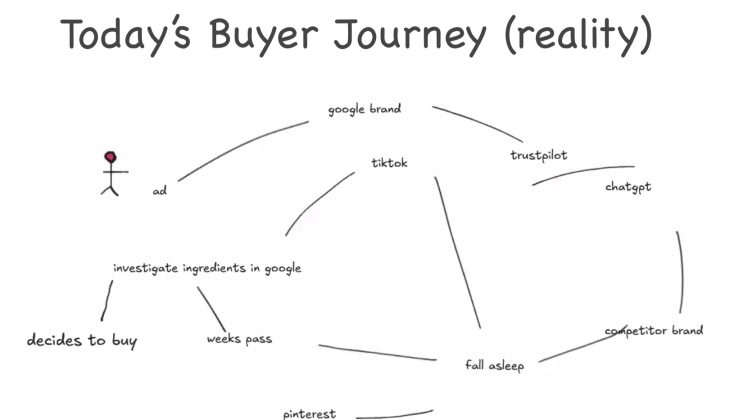
The old buyer journey was simple: see ad, click ad, buy product. That journey is dead. Today’s eCommerce buyer moves through a multi-platform research loop before committing to a purchase, and that loop runs across channels most sellers aren’t even tracking, let alone influencing.

Understanding this new journey isn’t optional — it’s the difference between ad spend that compounds and ad spend that bleeds out slowly every month.
Step 1: Buyer Sees Your Ad
This part still works. Paid ads on Meta, Google, TikTok, and YouTube are still reaching buyers at scale. Your targeting might even be solid. The ad creates curiosity — maybe even real purchase intent. But curiosity doesn’t convert. What happens next does.
Step 2: Buyer Goes to Research Your Brand
Before buying, the modern consumer validates. They Google your brand name. They search “[your product] review” on YouTube. They check Reddit threads. They look for news coverage, podcast mentions, social proof from strangers. This isn’t a fringe behavior — it’s the default behavior of anyone spending more than $30 online. The research phase is where trust is built or broken, and most eCommerce sellers have left this phase completely unmanaged.
Step 3: Buyer Finds Nothing — or Finds Your Competitor
The Invisible Brand Problem: A buyer searches your brand name after seeing your ad. Google returns your homepage — and nothing else. No reviews. No articles. No videos. No third-party mentions. Meanwhile, your competitor has a YouTube channel, three comparison articles on page one, a podcast episode, and a news feature. Who gets the sale?
This is where the conversion is actually lost. Not on your landing page. Not because of your headline. Because when a buyer went to verify that you were legitimate, trustworthy, and worth their money — your brand came up empty. An empty search result is a red flag to any buyer with options, and in eCommerce, buyers always have options.
The brands winning right now aren’t just running better ads. They’ve built a content presence across multiple platforms so that every time a buyer goes to research them, they find reinforcing signals everywhere they look. That’s not an accident — it’s a system.
Step 4: Your Ad Budget Funds Someone Else’s Sale
Here’s the part that should make every eCommerce seller pause. When your ad creates awareness but your brand can’t hold up to a basic Google search, you haven’t just lost that sale. You’ve actively warmed up a buyer and handed them to a competitor with better brand authority. Your ad spend funded their conversion.
- Buyer sees your paid ad and gets interested
- Buyer searches your brand or product category to validate
- Buyer finds your competitor’s content instead
- Competitor’s content answers the buyer’s questions and builds trust
- Buyer purchases from your competitor
- You pay for the ad. They get the revenue.
This cycle repeats thousands of times a month for sellers who haven’t addressed the research gap. And the worst part? Your ad metrics look fine on the surface. Impressions are up. CTR is acceptable. But conversion is soft, and no amount of creative testing fixes a problem that lives off-platform.
Google Only Handles 27% of All Online Searches
Most eCommerce brands treat Google like it’s the entire internet. It isn’t. There are 51 billion searches happening daily across 17 major platforms — and Google accounts for approximately 13.7 billion of them. That’s 27%. Significant, yes. But it means nearly three out of every four searches your buyer makes happen somewhere Google can’t help you, emphasizing the importance of understanding organic vs inorganic traffic in your marketing strategy.
Where the Other 73% of Your Buyers Are Searching

Your buyers are actively searching for answers, reviews, comparisons, and recommendations on platforms that most eCommerce sellers treat as afterthoughts — if they think about them at all. The 73% of searches happening outside Google are distributed across platforms where buyer intent is just as real, and sometimes even higher.
| Platform | What Buyers Search For | Why It Matters for eCommerce |
|---|---|---|
| YouTube | Product reviews, unboxings, comparisons | High-intent visual validation before purchase |
| TikTok | “TikTok made me buy it” product discovery | Organic virality drives impulse and researched purchases |
| Spotify / Apple Podcasts | Brand mentions, expert recommendations | Trust-building through third-party authority |
| Honest reviews, community recommendations | Buyers trust peer validation over brand claims | |
| Product aesthetics, social proof, influencer use | Visual trust signals that reinforce ad messaging | |
| Google News / News Sites | Brand credibility, press coverage | Legitimacy signals that convert skeptical buyers |
Why AI Agents Are Pulling Recommendations From Every Platform
AI-powered search tools — including ChatGPT, Google’s AI Overviews, and Perplexity — don’t just crawl Google. They pull signals from across the web: YouTube transcripts, podcast show notes, news articles, Reddit threads, and social content. When a buyer asks an AI agent “what’s the best home espresso machine under $500,” the AI synthesizes content from every platform where that question has been answered. If your brand’s content exists in multiple formats across multiple platforms, you have a real chance of being surfaced as the recommendation. If your content only lives on your product page, you don’t exist to that AI.
What This Means for Brands Focused on One Channel
Single-channel eCommerce brands are structurally disadvantaged in the new buyer journey — not because their channel is wrong, but because their buyers don’t stay in one channel. A buyer might discover you on Instagram, research you on YouTube, validate you through a Google News article, and finally convert through a retargeting ad. If you only control one of those touchpoints, you’re leaving the rest of the journey to chance — or to your competitors.
The brands that dominate their categories aren’t necessarily outspending everyone else. They’re simply showing up everywhere their buyers look. That presence isn’t built by accident, and it doesn’t require a massive team. It requires a content system designed for the actual buyer journey — not the one from five years ago.
Your Paid Ads Are Losing Money Right Now
Not because your targeting is wrong. Not because your creative is weak. Your paid ads are underperforming because the research environment surrounding your brand isn’t converting the interest those ads generate. Fix the environment, and your ads start working harder without a single change to your campaigns.
Why Ad Performance Has Nothing to Do With Your Ad
One eCommerce client was running $30,000 per month on Facebook ads and sitting at a 1.8% conversion rate. The ads weren’t bad — the targeting was solid, the creative was tested, the offer was competitive. But every buyer who clicked that ad and went to research the brand found almost nothing. No YouTube presence. No news coverage. No third-party validation. Just a website and a product page.
After three months of building organic brand presence across multiple platforms using Media Strobe’s MultiCasting system, the same ads — same targeting, same creative, same landing pages — jumped to a 5.2% conversion rate. The ads didn’t change. The research environment around the brand did.
The Research Gap Killing Your Conversion Rate
The research gap is the distance between what a buyer finds when they go to validate your brand and what they need to find in order to feel confident purchasing. A wide research gap means buyers arrive at your product page already skeptical, looking for reasons to leave. A narrow research gap — where a buyer finds articles, videos, reviews, and mentions everywhere they look — means they arrive at your product page already sold, looking for confirmation. That gap is measurable, closeable, and directly tied to your bottom line in ways most eCommerce sellers have never quantified.
Your Product Titles Are Invisible to Buyers
Most eCommerce sellers pour energy into their ad creative and ignore the thing buyers actually type into a search bar — and that disconnect is quietly costing them thousands in lost organic traffic every single month. One product title change can make a significant difference in visibility and sales.
Your product title is your first handshake with a search engine and a searching buyer. If that title leads with your brand’s internal naming convention instead of the words real buyers use, you’ve already lost the match before it starts. This isn’t a minor optimization. It’s the foundation of whether your product gets found at all outside of paid traffic.
Why “BrewMaster Pro 3000” Gets Zero Searches
Nobody wakes up and searches “BrewMaster Pro 3000.” They search “programmable drip coffee maker with thermal carafe 12-cup.” That specific phrase — descriptive, functional, buyer-language — is what triggers purchase-ready traffic. Branded product names that don’t mirror real search behavior are essentially invisible to organic discovery.
This applies to nearly every product category in eCommerce. Buyers search by function, specification, comparison, and problem — not by the creative name your product team landed on in a brainstorm. The gap between what you call your product and what buyers actually search is exactly where organic traffic dies.
The fix isn’t complicated, but it does require you to step outside your own brand perspective and think like a buyer who has never heard of you. What problem are they trying to solve? What specifications matter to them? What comparison are they making? Those answers belong in your product title.
Before vs. After: Product Title Rewrite Examples
Before: “BrewMaster Pro 3000” → After: “Programmable Drip Coffee Maker with Thermal Carafe, 12-Cup”
Before: “VeloRide X2” → After: “Folding Electric Bike for Adults, 26-Inch, 500W Motor, 25 MPH”
Before: “SleepCloud Ultra” → After: “Cooling Memory Foam Mattress Topper, Queen, 3-Inch, Gel-Infused”
Before: “NovaSkin Glow Kit” → After: Vitamin C Face Serum Set with Hyaluronic Acid and Retinol, 3-Piece
How to Rewrite Product Titles to Match Real Search Phrases
Start with what buyers type when they’re ready to buy — not when they’re browsing. Use tools like Google’s autocomplete, Amazon’s search bar suggestions, and the “People Also Search For” section to surface the exact language buyers use. Then build your product title around those phrases: lead with the product type, follow with the most searched specifications, and include the use case or target buyer where relevant. A title rewritten this way doesn’t just rank better — it also communicates value faster to the buyer who lands on it.
Fix Your Image File Names and Alt Text in One Afternoon
Search engines can’t see your images — they read the file names and alt text you assign to them. An image saved as “IMG_4872.jpg” with blank alt text is a completely wasted SEO signal. An image saved as “cooling-memory-foam-mattress-topper-queen-gel-infused.jpg” with alt text that describes the product and its use case is a searchable asset that drives image search traffic. For more insights on optimizing your content, explore SEO strategies vs. PPC to enhance your online presence.
This is a one-afternoon fix that most eCommerce sellers have never done. Go through your top 20 products and rename every image file to a descriptive, keyword-rich phrase using hyphens between words. Then write alt text for each image that describes what’s in the photo and connects it to the buyer’s search intent. It’s unglamorous work, but it’s the kind of foundational fix that compounds quietly in the background for years.
- Rename image files using descriptive, hyphenated keyword phrases (e.g., “red-running-shoes-mens-size-10-lightweight.jpg”)
- Write alt text that describes the image AND connects to buyer search intent
- Include your primary product keyword naturally — don’t keyword stuff
- Update every product image, not just hero shots — thumbnails get indexed too
- Check that your eCommerce platform isn’t auto-stripping your file names on upload
Combined with rewritten product titles, these changes create a completely different organic footprint for your store — and they cost nothing except an afternoon of focused work.
How to Find Topics Buyers Actually Search Before Buying
The single biggest content mistake eCommerce sellers make is creating content about their brand instead of content about their buyer’s questions. Your buyer doesn’t care about your origin story until after they trust you. Before trust, they care about one thing: getting their question answered.
Buyer-driven content starts with a simple shift in perspective. Instead of asking “what should we write about our products,” you ask “what is our buyer Googling three days before they make a purchase?” Those are completely different questions with completely different answers — and only one of them drives traffic that converts. For more insights, consider exploring SEO vs PPC strategies that can enhance your content’s reach and effectiveness.
The research phase of the buyer journey is where content does its heaviest lifting. A buyer searching “elliptical vs treadmill for weight loss” is not browsing casually — they are actively in a decision-making process. If your content answers that question better than anyone else, you’ve inserted your brand into their purchase journey at exactly the right moment, with exactly the right authority. For insights on maximizing your eCommerce ROI, understanding the nuances of affiliate and influencer marketing can be pivotal.
- Use Google autocomplete to find what buyers search before purchasing your product type
- Mine Amazon Q&A sections and reviews for exact buyer language and recurring questions
- Check Reddit threads in your product category — buyers ask their most honest questions there
- Use “People Also Ask” boxes in Google to find the exact questions buyers want answered
- Look at competitor blog content ranking on page one — those topics are proven buyer interests
Once you’ve built a list of 20 to 30 buyer questions, you have a content roadmap that maps directly to purchase intent. Every piece of content you create from that list is a direct investment in capturing buyers who are already looking for what you sell.
Buyer Topics vs. Brand Topics: The Critical Difference
A brand topic is “Why Our Treadmills Are Built to Last.” A buyer topic is “How Long Should a Treadmill Last? (And What to Look for Before You Buy).” The first one is about you. The second one is about your buyer’s question — and it’s the second one that shows up in search results when a buyer is evaluating whether to purchase. Brand topics might feel natural to write, but buyer topics are the ones that drive organic traffic from people who are actively in a buying decision. Make buyer topics the foundation of your content strategy and save the brand storytelling for after you’ve earned the reader’s attention.
Specific Beats Broad: “Sole F63 vs F80” vs. “Best Treadmill Brand”
“Best treadmill brand” is searched by millions of people in all stages of awareness — most of them nowhere near a purchase. “Sole F63 vs F80” is searched by a buyer who has already narrowed their options to two specific models and needs one final push to decide. Specific topics like model comparisons, “best [product] for [specific use case],” and “[product] for [specific buyer type]” carry far higher purchase intent and face far less competition than broad category keywords. Specific beats broad — every time — when the goal is converting buyers, not collecting impressions.
The 8-Format Content System That Puts You Everywhere
Creating content for a single platform is the old model. The new buyer journey spans YouTube, Google, podcasts, news sites, social media, and AI-powered search — and each of those platforms favors different content formats. The brands winning right now aren’t creating eight times more content. They’re taking one piece of content and deploying it in eight formats across every platform where their buyers search. For more insights, check out this multicasting case study that highlights the effectiveness of this strategy.
This approach — sometimes called MultiCasting — is how a brand with a $5,000/month content budget can build a presence that rivals companies spending a hundred times more. It’s not about volume. It’s about systematic distribution of the same core idea across every format and platform that matters to your buyer’s research journey.
Turn One Topic Into 8 Pieces of Content
Take a single buyer topic — say, “best elliptical for small apartments” — and build it into eight distinct content formats: a long-form news article, a blog post, an interview-style podcast episode, a YouTube video, a short-form video reel or YouTube Short, an infographic, a slideshow, and a set of social posts. Each piece is styled for its native platform. Each one answers the same core buyer question. And each one creates a new entry point into your brand’s ecosystem for a buyer who might never have found you through paid ads alone. One campaign. Eight assets. Dozens of discovery paths.
The 300+ Platform Distribution Strategy
Publishing across 300+ platforms sounds overwhelming until you understand what it actually means in practice. It doesn’t mean manually posting to 300 websites. It means using a distribution system — like Media Strobe’s MultiCasting infrastructure — that simultaneously places your content across Google News affiliates, YouTube, Spotify, Apple Podcasts, FOX-affiliated news sites, Instagram, TikTok, and hundreds of other indexed platforms. Each placement is a new signal to search engines, AI agents, and buyers that your brand is a legitimate, multi-platform authority. The cumulative effect of those signals is what moves the needle on both organic discovery and paid ad conversion.
How 30 Campaigns Drove 195% Organic Traffic Growth for a Home Robots Store
A home robotics eCommerce brand was competing directly against Amazon-listed products for page-one Google rankings — a fight most small sellers assume they’ve already lost. Instead of accepting that outcome, they ran 30 MultiCast campaigns over 9 to 10 months. Each campaign took one buyer topic and turned it into 8 content formats distributed across 300+ platforms.
The results weren’t instant, but they were compounding. Month by month, new content assets indexed, ranked, and began driving consistent traffic. By the end of the campaign period, the numbers told a clear story about what systematic multi-platform content distribution actually produces at scale.
Home Robots Store: MultiCasting Results After 30 Campaigns
✅ Organic Traffic Growth: 195% increase
✅ Google Rankings: First page for multiple competitive keywords
✅ Estimated Additional Sales: $200,000 – $250,000
✅ Competitor: Amazon-listed products on page one
✅ Campaign Structure: 30 campaigns × 8 formats × 300+ platforms
What made this result possible wasn’t a single viral piece of content or a lucky ranking. It was the systematic accumulation of brand signals across every platform where buyers and algorithms look for answers. That’s a moat that Amazon’s ad budget can’t easily buy its way over.
How Brand Authority Transforms Paid Ad Performance
Brand authority isn’t a soft, feel-good metric — it’s a direct variable in your paid ad conversion rate. When buyers encounter your ads inside a research environment that confirms your brand is credible, established, and trustworthy, they convert at dramatically higher rates. When they encounter your ads in a vacuum of brand validation, they click away. Building brand authority across platforms is one of the highest-ROI investments an eCommerce seller can make precisely because it makes every other marketing channel work harder at no additional cost. Learn more about AI brand citations on high authority sites to boost your brand’s credibility.
How One Client Went From 1.8% to 5.2% Ad Conversion — Without Changing a Single Ad
An eCommerce seller running $30,000 per month in Facebook ads was stuck at a 1.8% conversion rate. The creative was tested. The targeting was refined. The landing pages were optimized. Nothing moved the needle. The actual problem was that buyers who clicked those ads and went to research the brand found almost no supporting content anywhere online. No articles. No YouTube presence. No news coverage. No third-party mentions. After three months of building that presence through MultiCasting, the same campaigns — unchanged — hit 5.2% conversion.
Facebook Ads Performance: Before vs. After Brand Authority Build
| Metric | Before MultiCasting | After 3 Months |
|---|---|---|
| Monthly Ad Spend | $30,000 | $30,000 |
| Conversion Rate | 1.8% | 5.2% |
| Ad Creative Changes | — | None |
| Targeting Changes | — | None |
| Landing Page Changes | — | None |
| Organic Sales Added | $0 | $1,600,000 |
The conversion rate improvement alone — from 1.8% to 5.2% — represents nearly triple the return on the same ad spend. On $30,000 per month, that’s a fundamental change in unit economics that no amount of creative testing was ever going to deliver.
And the $1.6 million in attributed organic sales wasn’t a bonus — it was a direct result of the same content system that fixed the conversion rate. The brand authority built to support the paid ads created its own independent revenue stream that kept compounding long after the campaigns ran. That’s the leverage point most eCommerce sellers are missing entirely: fixing your research environment doesn’t just help your ads. It builds an asset that generates revenue on its own.
Why Content Published 6 Months Ago Still Drives 73% of Traffic at Month 15
Paid ads stop working the moment you stop paying. Content doesn’t. At month 15 of the fitness brand campaign, 73% of all incoming traffic was being driven by content published in the first six months of the campaign. Those articles, videos, podcast episodes, and news features kept indexing deeper, ranking higher, and pulling in buyers — without a single additional dollar spent to maintain them. That’s the compounding nature of a multi-platform content system that paid advertising will never replicate. Every piece of content you publish is a permanent asset. Every ad you run is a rental.
How a $5K/Month Content Budget Beat Peloton’s $100M Ad Spend
Peloton and NordicTrack collectively spend over $100 million per year on advertising. They own the paid channels. They dominate the awareness layer. But awareness isn’t the same as answers — and when buyers went to Google their questions about fitness equipment, a client spending $5,000 per month on content was there with the answers. That asymmetry is the entire business case for the new buyer journey content strategy. You don’t need to out-spend the category leaders. You need to out-answer them.
Blog Traffic: 500 to 41,000 Monthly Visitors
When the fitness brand started, their blog was pulling 500 monthly visitors. Twelve months into a systematic MultiCasting campaign — 30 campaigns, 8 formats each, distributed across 300+ platforms — that number had climbed to 41,000 monthly visitors. That’s not a marginal improvement. That’s an 8,100% increase in the organic audience actively reading their content, trusting their recommendations, and moving toward a purchase decision.
The content that drove that traffic wasn’t brand storytelling or product announcements. It was buyer-topic content: comparison articles, “best for” breakdowns, use-case guides, and specification deep-dives that matched exactly what fitness equipment buyers were searching for before making a purchase. Every piece of content answered a real buyer question — and every answer pulled in a buyer who was already in the decision phase of their journey. For those interested in understanding the ROI in eCommerce, these insights are crucial.
$300K Monthly Revenue From Google Alone
At the peak of the campaign results, the fitness brand was generating $300,000 per month in revenue attributable directly to Google organic traffic. That revenue stream was built on a $5,000/month content investment — the same budget many eCommerce sellers spend on a single week of paid ads. And unlike paid traffic, which evaporates the moment the campaign pauses, the organic revenue kept flowing because the content assets kept ranking. The blog posts, YouTube videos, news articles, and podcast episodes that built that revenue channel were still indexed, still ranking, and still converting buyers 15 months after the first campaign launched.
61.5x Return on Content Spend at Month 15
The cumulative return on content spend for the fitness brand reached 61.5x at month 15. On a $5,000/month investment, that means every dollar spent on content returned sixty-one and a half dollars in measurable revenue. To put that in direct contrast: Peloton’s $100 million ad budget had to keep running at full spend to maintain its market presence. The fitness brand’s content system was still compounding on the same original investment a year and a half later. This is the economic argument for building brand authority through multi-platform content — and it’s one that the new eCommerce buyer journey makes impossible to ignore.
90 Days From Now, Your Paid Ads Will Never Perform the Same Way Again
Three months of systematic content distribution across multiple platforms is enough to measurably shift your brand’s research environment. That shift changes what buyers find when they go to validate your brand after seeing your ad. And that change directly impacts your conversion rate — on the same ads, with the same targeting, without touching a single campaign setting. Ninety days from now, you could be looking at a conversion rate that’s climbed from 1.8% to 5.2%. You could have content assets indexing across hundreds of platforms, pulling in buyer-intent traffic around the clock. You could have an organic revenue stream beginning to compound alongside your paid channels. Or you could be exactly where you are now, still testing headlines and wondering why nothing is moving. The buyer journey has already changed. The only question is whether your strategy has.
Frequently Asked Questions
What Is the New Buyer Journey in eCommerce?
The new eCommerce buyer journey is the multi-platform research process modern consumers go through before making a purchase. It starts with an ad impression or organic discovery, moves immediately into a validation and research phase that spans Google, YouTube, Reddit, podcasts, news sites, and social platforms, and only ends in a purchase when the buyer has found enough trust signals to feel confident. The old linear journey — see ad, click, buy — is no longer the dominant pattern for any product category above impulse-purchase price points.
For eCommerce sellers, understanding this journey means recognizing that the conversion decision is rarely made on your product page. It’s made in the research phase that precedes it. Sellers who build brand presence across every platform where that research happens convert at dramatically higher rates than sellers who rely solely on paid ad traffic hitting a product page cold.
Why Is Google Only 27% of All Online Searches?
Google processes approximately 13.7 billion searches per day, which sounds enormous — until you account for the 51 billion total daily searches happening across all platforms. YouTube, TikTok, Amazon, Reddit, Spotify, Apple Podcasts, Pinterest, and dozens of other platforms each capture significant search volume from buyers actively looking for information, recommendations, and validation. Google’s 27% share makes it the single largest search platform, but it means the majority of your buyer’s research journey is happening somewhere Google’s search index alone can’t help you reach.
How Do I Find the Right Buyer Topics for My Product?
Start with the questions your buyers are asking in the 48 to 72 hours before they make a purchase decision. Google autocomplete, Amazon’s search bar, the “People Also Ask” section in Google results, and Reddit threads in your product category are all direct windows into buyer language and buyer intent. Look for comparison searches (“Product A vs Product B”), use-case searches (“best [product] for [specific situation]”), and specification searches (“[product] with [specific feature]”). These high-intent, specific queries are where buyer-topic content beats brand-topic content every time — and they’re the topics that drive traffic from buyers who are already close to purchasing.
How Long Does It Take to See Results From a MultiCasting Content Strategy?
Most sellers begin seeing measurable organic traffic improvements within 60 to 90 days of launching a systematic MultiCasting campaign. Conversion rate improvements on existing paid ad campaigns can appear even sooner, as brand authority signals begin populating across platforms that buyers use to validate purchases. The compounding growth — where content published in month one is still driving significant traffic in month fifteen — typically becomes visible around the four to six month mark. The fitness brand case study showed 73% of month-15 traffic coming from content published in the first six months, which illustrates both the compounding nature of the strategy and the importance of starting before you feel like you need to.
Can Small eCommerce Brands Compete Against Large Retailers With This System?
Yes — and the case studies above are the proof. A fitness brand spending $5,000 per month on content competed directly against Peloton’s $100 million annual ad budget and generated $300,000 per month in Google organic revenue at month 15. A home robotics store achieved 195% organic traffic growth while competing against Amazon-listed products for page-one rankings. In both cases, the advantage wasn’t budget — it was systematic multi-platform content distribution that put buyer-intent answers everywhere buyers were searching.
Large retailers have brand recognition and ad budgets, but they rarely have the agility to create highly specific, buyer-focused content across dozens of niche topics in their product categories. That’s where smaller eCommerce brands have a genuine structural advantage. You can answer the specific questions your buyers are asking faster, more authentically, and across more platforms than a $10 billion retailer managing thousands of SKUs ever could. The new buyer journey doesn’t reward the biggest budget. It rewards the brand that shows up with the right answer in the right place at the right moment — and a well-executed MultiCasting strategy is precisely how you engineer that outcome at scale, regardless of how large your competitors are.
Why Choose a MultiCast Campaign by Media Strobe?
All MultiCast campaigns are expertly created to answer highly relevant questions about your service/product that your future customers are asking (all over the internet) before they make their purchase decision. Your MultiCast is distributed to hundreds of high authority sites IN THE EXACT WAY that Google and AI love, and in 8 formats so that your answers show up everywhere people are asking questions.
The benefits of running a MultiCast campaign are:
- Increased visibility (leading to increased ranking)
- Increased warm/hot traffic
- Reduced customer acquisition costs
- Predictable growth that can be scaled
- Generate more revenue with higher net profit
- True control over your lead generation
- Better return on paid ads
If you’re ready to stop funding your competitors’ conversions and start building the brand authority that turns ad spend into compounding revenue, Media Strobe specializes in exactly this kind of multi-platform content distribution — built for eCommerce sellers who are serious about winning the new buyer journey.
The new buyer journey is evolving rapidly, and eCommerce sellers must adapt to stay ahead. As consumer behavior shifts, sellers need to focus on what is moving the needle today, and that is answering the questions people ask to research your product or service – before they buy. Master that and you can print money for the next year or two while your competitors scratch their heads trying to figure out what to do.
© 2026 Media Strobe. All rights reserved. | More eCommerce Marketing Strategies