Article at a Glance
- AI tools like ChatGPT, Google AI, and Perplexity now answer buying questions directly — if your brand isn’t being cited, you’re invisible to a growing segment of buyers.
- AI brand citations are not random. These tools pull from high-authority platforms they already trust, meaning publishing on the right sites is the fastest path to getting recommended.
- A 7-figure fitness equipment brand became the #1 cited source across Google AI, ChatGPT, and Perplexity by leveraging authority site publishing — without waiting years to build domain trust from scratch.
- The MultiCasting effect — publishing consistent brand content across dozens of trusted platforms — is what creates the cross-referencing signals AI needs to treat your brand as credible.
- Keep reading to discover the exact content formats, platform strategies, and technical triggers that push brands into AI-generated answers faster than traditional SEO ever could.
Your customers are skipping Google and asking AI instead — and if AI doesn’t know your brand exists, someone else is getting that sale.
This shift is not gradual. ChatGPT crossed 100 million users faster than any platform in recorded history at the time of its launch, and Google’s own AI Overviews now appear at the top of search results for millions of queries every day. Perplexity is growing fast as a research tool that buyers trust for product comparisons and recommendations. Together, these platforms have fundamentally changed how purchase decisions get made. Media Strobe has been tracking this shift closely, helping brands understand exactly how to position themselves inside the AI recommendation ecosystem before it becomes too competitive to enter cheaply.
The AI Adoption Reality in 2026
ChatGPT users acquired faster than any platform in history
Estimated citation frequency lift from proper schema markup implementation
Time for a Florida business to appear in Google AI answers after authority-site publish
Estimated share of AI-generated citations that come from “best of” & comparison content
AI Is Now the First Stop for Buyers — Is Your Brand There?
Traditional search required patience. A buyer would type a query, scroll through ten blue links, click three or four of them, compare tabs, and eventually make a decision. That process is being replaced. AI gives a single, confident answer — and most buyers accept it.
How AI Tools Like ChatGPT, Google AI, and Perplexity Answer Buying Questions
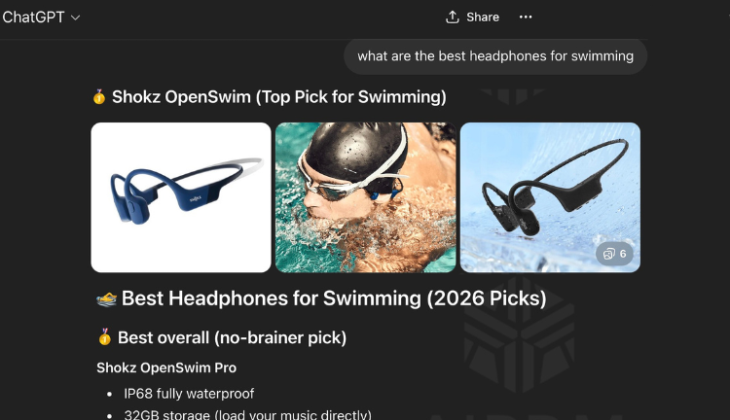
When someone asks ChatGPT “What’s the best home gym equipment for small spaces?”, it doesn’t send them to a search results page. It answers directly, recommending specific brands, comparing features, and sometimes linking to a source it considers credible. Google AI Overviews do the same thing at the top of search results, summarizing answers before the user even sees a single organic listing. Perplexity works similarly, pulling from live web sources and citing them inline, which is an effective way to manage organic vs inorganic traffic.
These tools are not neutral. They have preferences baked in — shaped by which websites they trust, which content formats they can easily parse, and how many credible sources say the same thing about a brand. Understanding those preferences is the entire game.
The buying journey now often starts with a conversational AI query rather than a keyword search. A buyer researching CRM software might ask Perplexity to compare the top five options, read the AI-generated answer, and never visit a search engine at all. If your brand isn’t in that answer, you didn’t lose a click — you lost the entire conversation.
“If your brand isn’t in that AI answer, you didn’t lose a click — you lost the entire conversation.”
Why Buyers Research Across Multiple Channels Before Purchasing
Buyers rarely make decisions from a single source. They ask AI, check reviews, scan social media, and look for brand mentions across multiple platforms before committing. This multi-channel validation behavior is exactly why your brand’s presence across high-authority sites matters so much — AI cross-references what it finds, and a brand that appears in multiple trusted locations gets treated as far more credible than one that only exists on its own website.
The Cost of Being Invisible to AI Recommendation Engines
If your brand doesn’t appear in AI-generated answers, the cost isn’t just missed clicks. It’s missed trust. Buyers who get a confident AI recommendation for a competitor’s product don’t usually go looking for alternatives — they act on the recommendation. Every query your brand fails to appear in is a closed door, not just a missed opportunity. And as AI adoption accelerates, the brands that establish AI brand citation authority now will be exponentially harder to displace later.
How AI Decides Which Brands to Cite
AI tools are trained on massive datasets pulled from the internet, prioritizing content from high-authority domains. When generating answers, they cross-reference multiple trusted sources to determine which brands, products, and claims are credible enough to recommend. The more your brand appears on trusted platforms — with consistent, accurate, and well-structured content — the more likely AI is to cite you.
It helps to think of AI citation like a reputation vote. Every time a high-authority site mentions your brand positively and factually, that’s a vote. AI systems count those votes, look for consistency across sources, and use that signal to decide whether your brand is worth recommending. One vote is noise. Dozens of votes across trusted platforms are a signal strong enough to influence AI outputs.
Where ChatGPT, Google AI Overviews, and Perplexity Pull Their Answers From
ChatGPT with browsing enabled pulls from Bing’s index and its own training data, which was built from a curated mix of high-authority domains. Google AI Overviews pull directly from Google’s index, heavily weighting E-E-A-T signals — Experience, Expertise, Authoritativeness, and Trustworthiness. Perplexity performs live web searches, citing sources inline, and shows a clear preference for well-structured pages on credible domains.
| AI Platform | Primary Source Pool | Key Citation Trigger | Best Content Format |
|---|---|---|---|
| Google Gemini / AI Overviews | Google’s indexed web | E-E-A-T signals, schema markup | Question-answer format with clear headings |
| ChatGPT (with browsing) | Bing index + training data | Domain authority, content consistency | Comparison articles, “best of” lists |
| Perplexity | Live web search | Content freshness, citation density | Data-rich content with clear sourcing |
The common thread across all three platforms is trust in the source domain. Your own website — especially if it’s relatively new or has limited backlink authority — starts at a disadvantage. High-authority platforms, however, already have that trust built in. Understanding SEO vs PPC can help in building that trust.
Why High-Authority Sites Like USA Today and Business Insider Get Prioritized
Sites like USA Today, Business Insider, Forbes, and major news networks have spent years — sometimes decades — building the domain authority and editorial credibility that AI systems treat as reliable. When your brand appears on those platforms, you inherit their credibility instantly. AI doesn’t distinguish between “this brand built authority slowly on their own site” and “this brand published on a site that already has authority.” It just sees a trusted source saying something credible about your brand.
This is the core of the backdoor strategy. Instead of competing with established brands on your own domain, you publish on the platforms those AI tools already trust — and let that platform’s authority do the heavy lifting for you.
The Role of Cross-Referencing in AI Trust Signals
No single mention makes an AI system confident enough to recommend a brand. What creates that confidence is seeing the same brand, the same claims, and the same positioning repeated across multiple high-authority sources. When Perplexity finds your brand mentioned on five different credible platforms all saying similar things, it treats that consensus as a strong trust signal. This is why publishing in one or two places is rarely enough — and why a scaled, multi-platform approach consistently outperforms single-channel strategies.
Cross-referencing also works against you when sources conflict. If your brand’s messaging is inconsistent across platforms, AI systems register that confusion and become less likely to cite you with confidence. Consistency across every platform you publish on is not optional — it’s foundational.
One Platform vs. Multi-Platform Publishing
Single Platform
- One data point for AI to reference
- Treated as an isolated mention, not consensus
- Low cross-referencing signal
- Rarely cited with confidence
- Easy for competitors to outpublish
Multi-Platform (MultiCast)
- Dozens of corroborating signals
- AI treats repetition as authority proof
- Strong cross-referencing consensus
- Consistently recommended across queries
- Compounding authority over time
The High-Authority Site Backdoor Strategy Explained
The fastest path to AI brand citations is not building your own domain authority from the ground up — it’s borrowing the authority of platforms that AI already trusts and making sure your brand content lives there.
Why Publishing on Trusted Platforms Transfers Credibility to Your Brand
When AI systems crawl and index the web to build their knowledge base, they don’t evaluate every source equally. A brand mentioned in a Business Insider article carries far more citation weight than the same brand mentioned on an unknown blog — even if the information is identical. Publishing on trusted platforms means your brand gets evaluated through the lens of that platform’s existing credibility. You don’t need to earn that trust yourself. You need to get your content placed where that trust already exists.
The practical implication is significant. A brand with six months of history can appear in AI answers within days if they publish well-structured, factual content on the right platforms. That same brand could spend two years doing traditional SEO on their own site and never reach the same visibility threshold. The leverage available through authority site publishing is disproportionate — especially for newer brands and eCommerce businesses without established domain authority.
The Core Insight: AI doesn’t distinguish between “this brand built authority slowly on their own site” and “this brand published on a site that already has authority.” It just sees a trusted source saying something credible about your brand. Publishing on authority platforms is the fastest known path to AI brand citations.
How a 7-Figure Fitness Equipment Brand Became the #1 Cited Source Across All Three AI Platforms
A seven-figure fitness equipment brand used the authority site publishing strategy to systematically claim AI citation dominance in their niche. Rather than competing on their own domain, they focused on getting comparison content, buyer guides, and “best of” lists published across a network of high-authority platforms covering fitness, health, and consumer products.
The content was structured specifically for AI parsing — direct answer blocks, clear headings, consistent brand messaging, and factual product comparisons that mentioned competitors by name. By appearing on multiple trusted platforms with that consistent structure, the brand triggered the cross-referencing consensus that AI systems look for when deciding what to recommend.
The result was citation dominance across Google AI Overviews, ChatGPT, and Perplexity for comparison-style queries in their category — the exact type of queries buyers use right before making a purchase decision. That kind of positioning doesn’t happen by accident. It’s engineered through deliberate platform selection, content structure, and publishing volume.
How a Florida Mobile Home Moving Company Appeared in Google AI Answers Within 48 Hours
Speed is one of the most compelling arguments for the authority site strategy. A Florida-based mobile home moving company published a well-structured, factual article on a high-authority news platform answering a specific local service query. Within approximately 48 hours, that content was appearing in Google AI-generated answers for relevant searches in their area.
This timeline is not typical of traditional SEO, where ranking for competitive terms can take months of link building, content optimization, and technical improvements. The difference is the platform. Because the content lived on a domain Google already trusted deeply, the indexing and AI brand citation happened at a pace that would have been impossible on the company’s own website. For local businesses and niche service providers, this speed advantage alone makes the authority site strategy worth prioritizing over conventional approaches.
Identify every query your buyers ask AI before making a purchase decision.
Build structured articles, comparison guides, and FAQ content AI loves to extract.
Distribute across dozens of trusted platforms to trigger multi-source consensus.
Map the Questions Buyers Ask Before They Purchase
Before you create a single piece of content, you need to know exactly what your buyers are asking AI — because those questions are the entry points where your brand either shows up or disappears.
Awareness Questions, Comparison Searches, and Final Decision Queries
Buyer questions follow a predictable journey. At the awareness stage, they ask broad questions like “What’s the best way to move a mobile home?” or “What equipment do I need for a home gym?” These are high-volume queries where AI gives general category answers. Getting cited here builds brand familiarity, but it’s not where purchases happen.
The comparison and final decision stages are where AI brand citations convert directly into revenue. Queries like “Media Strobe vs. [competitor] for content distribution” or “best fitness equipment brands under $500 compared” are asked by buyers who are ready to decide. These are the queries you need to be answering — with content structured specifically for AI to pull and cite. Map every stage of your buyer’s journey into specific questions, then build your content strategy around making sure your brand appears in the AI answers for each one.
The AI Buyer Journey Funnel
AI brand citations at the bottom of the funnel convert directly into revenue
Why Mentioning Competitors by Name in Your Content Improves AI Citation Chances
AI tools love comparison content because buyers ask comparison questions. When your content directly compares your brand to named competitors — factually, not dismissively — it becomes exactly the type of answer AI systems are trained to surface for “X vs Y” and “best alternatives to X” queries. Naming competitors isn’t a risk; it’s a targeting strategy. It tells AI exactly which competitive queries your content is relevant for, dramatically increasing the range of questions your brand can appear in.
Create the Right Content Formats AI Loves to Cite
Not all content gets cited equally. AI systems have clear, observable preferences for specific formats — and aligning your content to those preferences is one of the highest-leverage moves you can make in your content repurposing strategy.
Why “Best Of” Lists and Comparison Articles Make Up an Estimated 44% of AI-Generated Citations
“Best of” lists and comparison articles dominate AI citations because they directly match how buyers phrase their questions. When someone asks “What are the best project management tools for small teams?”, AI looks for content that already answers that exact question in a structured, scannable format. Lists provide that structure instantly. They’re easy to parse, easy to quote, and easy for AI to summarize into a recommendation. If your brand appears consistently in “best of” lists across multiple high-authority platforms, AI will start treating your inclusion as a consensus signal rather than a one-off mention.
“Write the AI’s answer for it — make the extraction effortless, and citation becomes almost automatic.”
How to Structure Direct Answer Blocks That AI Can Easily Pull
A direct answer block is a short, self-contained passage that answers a specific question completely in two to four sentences. It doesn’t require context from surrounding paragraphs to make sense. AI systems are specifically designed to identify and extract these blocks because they mirror the format of the answers AI needs to generate. Think of it as writing the AI’s answer for it — make the extraction effortless, and citation becomes almost automatic.
The structure is simple: lead with the question as a heading, follow immediately with a direct, factual answer in plain language, then expand with supporting detail below. Avoid burying the answer in the middle of a long paragraph. The cleaner and more direct the answer block, the more reliably AI will pull from it when generating responses to related queries.
Where to Place Answer Blocks for Maximum AI Visibility (First 20% of the Page)
Position matters. AI crawlers and summarization tools weight content that appears early in a document more heavily than content buried deeper in the page. Placing your most important direct answer blocks within the first 20% of your content — before subheadings, supporting arguments, or supplementary detail — gives AI systems the clearest possible signal about what your content covers and what it’s most relevant for. Think of the opening section of your article as prime real estate for the answers you most want AI to cite.
| Content Format | AI Citation Strength | Best For | Key Optimization |
|---|---|---|---|
| Comparison Articles | ⬛⬛⬛⬛⬛ Very High | Decision-stage queries | Name competitors, use direct answer blocks |
| “Best Of” Lists | ⬛⬛⬛⬛⬛ Very High | Awareness & consideration queries | Publish on authority platforms, feature brand clearly |
| FAQ Blog Posts | ⬛⬛⬛⬛☐ High | Long-tail AI queries | FAQPage schema, exact question phrasing |
| Video + Transcripts | ⬛⬛⬛☐☐ Medium-High | Google AI Overviews | Keyword-rich descriptions, timestamped sections |
| Podcast Episodes | ⬛⬛⬛☐☐ Medium-High | Multi-platform presence | Show notes with direct answer text |
| Infographics + Copy | ⬛⬛☐☐☐ Medium | Visual + text citation surfaces | Alt text + strong supporting copy |
Content Formats That Boost Citation Chances: Videos, Podcasts, Blog Posts, and Infographics
Text-based content is the most directly citable format, but AI brand citations don’t stop there. A multi-format presence across authority platforms creates a richer signal footprint that makes your brand more visible across a wider range of AI tools and queries. Google’s AI systems, in particular, can now extract information from video transcripts and structured metadata — making video content on YouTube an increasingly viable citation source.
The key is ensuring every format is optimized for discoverability and structured around the same core questions and brand messaging. A podcast episode, a blog post, an infographic, and a short-form video covering the same topic from different angles multiply your citation chances without requiring entirely different content strategies. The content types that consistently perform best for AI citation include:
Top Content Formats for AI Brand Citations
- Long-form comparison articles — buyer guides that compare your brand to named competitors with factual, structured breakdowns
- “Best of” listicles — published on authority platforms with your brand clearly featured alongside category leaders
- FAQ-format blog posts — built around exact question phrases buyers use in AI queries
- Video content with transcripts — uploaded to YouTube with keyword-rich descriptions and timestamped sections
- Podcast episodes — especially those distributed across major platforms like Spotify and Apple Podcasts with show notes containing direct answer text
- Infographics with alt text and supporting copy — giving AI both visual context and extractable text data
Covering multiple formats isn’t about doing more work — it’s about giving AI more surfaces to find your brand on, in more contexts, with more consistent messaging. Each additional format is another entry point for AI brand citation.
Publish Across High-Authority Platforms at Scale
Creating great content in the right format is only half the equation. Where that content lives determines whether AI trusts it enough to cite. A perfectly structured comparison article on an unknown blog will almost never appear in AI-generated answers. The same article on a platform AI already trusts can start generating citations within days.
Scale matters here just as much as platform selection. Publishing one piece of content on one authority platform creates a single data point. AI systems need multiple corroborating signals before they’re confident enough to recommend a brand consistently. That means publishing across multiple platforms, in multiple formats, with enough frequency to create the kind of signal density that AI treats as authoritative consensus rather than isolated noise.
The brands that dominate AI brand citations in competitive niches are almost never the ones with the single best piece of content. They’re the ones with the broadest, most consistent presence across the platforms AI trusts most. Volume and distribution, paired with strong content structure, is what tips the scale from “occasionally mentioned” to “consistently recommended.”
Which Platforms AI Tools Trust Most for Product and Brand Recommendations
The highest-value platforms for AI citation are those with established editorial credibility, high domain authority, and existing inclusion in AI training datasets or live search indexes. Major news networks, national publications, and large-scale content distribution platforms consistently appear in AI citations across ChatGPT, Google AI, and Perplexity. Platforms like Google News-approved publishers, AP News syndication partners, and major lifestyle and business publications carry the kind of domain weight that transfers directly to brand credibility in AI outputs.
YouTube deserves special mention as a platform that spans both traditional search and AI citation. Google owns YouTube, and its content is deeply integrated into Google’s AI systems. A brand with strong YouTube presence — optimized titles, descriptions, and transcripts — has a meaningful advantage in Google AI Overviews specifically. Beyond YouTube, podcast distribution across Spotify, Apple Podcasts, and Amazon Music creates additional citation surfaces for AI tools that increasingly pull from audio content metadata. For more insights on digital strategies, consider exploring SEO vs. PPC strategies and how they can impact your brand’s visibility.
Why Appearing on One or Two Platforms Is Not Enough
A single mention on even the most authoritative platform creates a weak citation signal. AI systems are designed to cross-reference — they look for patterns, not outliers. A brand that appears on one platform looks like a one-time feature. A brand that appears on fifteen credible platforms, all saying consistent things, looks like an established authority. The difference in citation frequency between these two scenarios is dramatic, and it’s the primary reason brands that invest in multi-platform publishing consistently outperform those that focus their efforts in a single channel.
“A brand that appears on fifteen credible platforms, all saying consistent things, looks like an established authority to every major AI system.”
The MultiCasting Effect: How Repeated Signals Across Trusted Sources Build AI Consensus
The MultiCasting effect is what happens when your brand content appears across dozens of trusted platforms simultaneously, creating a web of corroborating signals that AI systems interpret as strong proof of credibility. Each platform that mentions your brand in a consistent, factual, well-structured way adds weight to the consensus. At a certain threshold — which varies by niche and competition level — that consensus becomes strong enough that AI systems default to citing your brand whenever a relevant query appears. This is the tipping point every brand should be engineering toward, and multi-platform publishing at scale is the fastest known path to reaching it.
Technical Factors That Influence How Often AI Cites Your Content
Content quality and platform authority are the biggest drivers of AI citation, but technical factors create the infrastructure that allows AI to find, read, and extract your content reliably. Ignoring the technical layer means leaving citation opportunities on the table — even when your content and platform selection are strong.
The most impactful technical factor is structured data markup, specifically schema.org vocabulary implemented directly in your page’s HTML. Schema markup tells AI crawlers exactly what type of content a page contains, who created it, what it’s about, and how the information is organized. Pages with properly implemented Article, FAQPage, Product, or HowTo schema are significantly easier for AI systems to parse and extract answers from than unstructured pages — making schema one of the highest-ROI technical investments for brands pursuing AI citation visibility.
How Schema Markup and Structured Data Can Significantly Increase Citation Chances
Schema markup is code added to your page’s HTML that speaks directly to AI crawlers in a language they’re optimized to read. Rather than forcing an AI system to interpret the structure of your content through context clues, schema tells it explicitly: this is an FAQ, this is a product review, this is a how-to guide. That clarity meaningfully increases the likelihood that AI extracts your content accurately and cites it confidently. Industry observations suggest citation frequency improvements in the range of up to 58% for pages with properly implemented schema compared to equivalent pages without it — though results will vary by niche and competition.
Key Schema Types for AI Brand Citations
- FAQPage schema — marks up question-and-answer content so AI can pull individual Q&A pairs directly into generated responses
- Article schema — signals authorship, publication date, and content category, boosting E-E-A-T signals for Google AI specifically
- Product schema — gives AI structured access to pricing, ratings, availability, and brand data for eCommerce citation
- HowTo schema — structures step-by-step content so AI can extract individual steps for instructional query responses
- BreadcrumbList schema — helps AI understand site hierarchy and content categorization, improving topical authority signals
Implementing schema doesn’t require advanced development skills. Tools like Google’s Structured Data Markup Helper allow you to tag content visually and generate the appropriate JSON-LD code for your page. For brands publishing on third-party authority platforms, confirming that the platform itself uses structured data is an important step — most major publishers already do, which is another advantage of the authority site strategy over publishing exclusively on your own less-optimized domain.
Beyond schema, internal linking structure and canonical tags also influence how AI systems attribute content to your brand. If multiple versions of similar content exist across different platforms, canonical tags ensure AI systems identify the authoritative source correctly — preventing citation dilution across duplicate or near-duplicate pages. These are small technical details that compound significantly at scale, especially when you’re publishing across dozens of platforms simultaneously.
Page Speed and Mobile Responsiveness as AI Trust Signals
Google’s AI systems are built on the same infrastructure as Google Search, which means Core Web Vitals — including page load speed, interactivity, and visual stability — directly influence how Google’s crawlers prioritize and index your content. A page that loads in under 2.5 seconds on mobile scores significantly better on Largest Contentful Paint (LCP), one of the primary Core Web Vitals metrics Google uses to evaluate page quality. Slow, unresponsive pages get crawled less frequently and ranked lower in the trust hierarchy that feeds Google AI Overviews. For brands publishing on their own domain alongside authority platforms, ensuring fast load times and full mobile optimization is a non-negotiable baseline — not a performance enhancement, but a citation prerequisite.
| Technical Factor | Impact on AI Citations | Priority Level |
|---|---|---|
| Schema Markup (FAQPage, Article, Product) | Directly improves AI parsing accuracy and extraction confidence | Critical |
| Page Load Speed (LCP < 2.5s) | Affects crawl frequency and indexing priority in Google AI | High |
| Mobile Responsiveness | Core Web Vitals signal; required for Google AI Overview eligibility | High |
| Canonical Tags | Prevents citation dilution across duplicate content | Medium |
| Internal Linking Structure | Reinforces topical authority signals for AI context mapping | Medium |
How to Keep Your Brand Cited Over Time
Getting cited by AI once is a milestone. Staying cited consistently as AI models update, retrain, and expand their knowledge bases requires an ongoing content strategy built around freshness, consistency, and continuous distribution. The brands that dominate AI brand citations over the long term are not the ones who publish a great batch of content and stop — they’re the ones who treat authority site publishing as a recurring investment rather than a one-time campaign.
Why Fresh, Updated Content Gets Cited More Often Than Outdated Pages
AI systems — especially Perplexity, which performs live web searches — show a strong preference for recently published or recently updated content. An article published two years ago and never touched is competing against fresher content from brands actively managing their citation presence. Updating existing authority site content with new data, refined comparisons, and current product information signals to AI crawlers that your brand is actively maintaining its knowledge base. For high-value comparison articles and buyer guides, a quarterly review and refresh cycle is a practical minimum to maintain citation relevance as AI models update their outputs. Consider exploring strategies like DFY content marketing to keep your content fresh and engaging.
Tools to Monitor and Track Your Brand’s AI Visibility
Tracking AI brand citations requires different tools than traditional SEO rank tracking. Manually querying ChatGPT, Perplexity, and Google AI Overviews with your target buyer questions on a regular schedule is the most direct method — it shows you exactly when your brand appears, in what context, and with what framing. Emerging tools like Profound, Brandwatch, and dedicated AI visibility trackers are building dashboards that automate this monitoring at scale, flagging when your brand is cited, when competitors are cited instead, and which query types are driving the most AI recommendation activity in your category. Building a monitoring cadence into your marketing workflow transforms AI citation from a guessing game into a measurable, optimizable channel.
Your Brand Is What AI Says It Is — Here Is How to Control That Narrative
AI doesn’t wait for your permission to form an opinion about your brand. It’s already pulling data, cross-referencing sources, and building a picture of who you are, what you offer, and whether you’re worth recommending — based entirely on what it finds across the web. The brands that show up first, most consistently, and most authoritatively in that process are the ones that proactively shape their AI presence rather than leaving it to chance.
Publishing on high-authority platforms, structuring content for AI parsing, maintaining cross-platform consistency, and refreshing content regularly are not optional enhancements to your marketing strategy — they are the core of what digital brand authority looks like in an AI-first world. The window to establish that authority before your category becomes too competitive is open right now, and every week you delay is a week your competitors can use to claim the AI brand citations you should own.
Publishing on high-authority platforms, structuring content for AI parsing, maintaining cross-platform consistency, and refreshing content regularly are not optional enhancements — they are the core of what digital brand authority looks like in an AI-first world. Every week you delay is a week your competitors can use to claim the citations you should own.
How Media Strobe Can Help
Media Strobe’s MultiCast Campaign is the complete done-for-you solution for brands that want to dominate AI brand citations across ChatGPT, Google AI, and Perplexity — without the guesswork.
All MultiCast campaigns are expertly created to answer highly relevant questions about your service or product that your future customers are asking all over the internet before they make their purchase decision. Your MultiCast is distributed to hundreds of high-authority sites in the exact way that Google and AI love, and in 8 formats so that your answers show up everywhere people are asking questions.
The benefits of running a MultiCast campaign include:
- Increased visibility (leading to increased ranking)
- Increased warm/hot traffic
- Reduced customer acquisition costs
- Predictable growth that can be scaled
- Generate more revenue with higher net profit
- True control over your lead generation
- Better return on paid ads
Frequently Asked Questions
As AI citation strategies become more central to digital marketing, a few questions come up consistently from brands trying to understand the landscape and prioritize their efforts. The answers below cut through the noise and focus on what actually moves the needle.
It’s worth noting that AI brand citation is not a single-step tactic — it’s a system. Each element reinforces the others: platform authority amplifies content quality, content structure amplifies freshness, and distribution volume amplifies everything. Understanding how the pieces interact is what separates brands that occasionally appear in AI answers from those that dominate them.
The questions below represent the most common decision points brands face when building their AI citation strategy for the first time. Whether you’re starting from scratch or refining an existing approach, these answers provide a practical framework for moving forward with confidence.
- How quickly can publishing on authority sites produce AI citation results?
- Can small or newer brands realistically compete with established corporations for AI citations?
- Which specific platforms give the highest citation return across the major AI tools?
- Does publishing volume across multiple platforms genuinely affect how often AI cites your brand?
- What single content type should a brand create first if resources are limited?
How Long Does It Take for a Brand to Start Appearing in AI Answers After Publishing on Authority Sites?
The timeline varies, but the Florida mobile home moving company example illustrates what’s possible at the fast end — AI citation within approximately 48 hours of publishing on a high-authority platform. More typically, brands begin seeing consistent citation activity within one to two weeks of publishing well-structured content across multiple authority platforms. The key variable is platform authority: the higher the domain authority of the platform you publish on, the faster AI systems index and begin citing that content. For Perplexity specifically, which performs live searches, the turnaround can be especially fast — sometimes within hours for content published on Google News-approved domains.
Do Small eCommerce Brands Have a Real Chance of Getting Cited by AI Against Big Corporations?
Not only do they have a chance — the authority site strategy specifically levels the playing field in ways that favor smaller, more agile brands. Large corporations are often slow to adapt content strategies and heavily dependent on their own domain authority, which takes years to build. A small eCommerce brand that publishes consistently on high-authority platforms with well-structured, niche-specific content can appear in AI answers for targeted buyer queries faster than a large competitor whose content is broad, outdated, or poorly structured for AI parsing. Niche specificity is a major advantage — AI systems favor precise, expert-level answers to specific questions, and smaller brands often have more genuine depth in their niche than generalist corporate content teams produce.
Which High-Authority Sites Are Most Likely to Get My Brand Cited by ChatGPT and Perplexity?
The highest-performing platforms for cross-AI citation include Google News-approved publishers, major national news syndication networks, and large-scale content hubs in your industry vertical. Platforms that distribute to 300 or more downstream publishers — including Google News, Apple News, and major news networks — create the kind of broad indexing footprint that triggers multi-platform citation signals simultaneously. For ChatGPT specifically, content that gets indexed in Bing’s search results from authoritative domains performs strongly, since ChatGPT’s browsing capability is Bing-powered. For Perplexity, freshness and clear sourcing are the dominant factors — meaning platforms that prominently date-stamp content and have strong domain authority perform best. Industry-specific authority sites also carry meaningful weight for niche queries, where Perplexity’s live search pulls from specialized credible sources rather than defaulting to general news platforms. The practical recommendation is to prioritize platforms that offer both high domain authority and broad distribution reach, rather than choosing between depth and breadth.
Does Publishing on Multiple Platforms Really Make a Difference to AI Citation Frequency?
Yes — and the difference is not marginal. The cross-referencing behavior built into AI citation systems means that a brand appearing on ten credible platforms gets cited with dramatically higher frequency than a brand appearing on one, even if that single platform is highly authoritative. AI systems treat multi-source consensus as a primary trust signal. The more platforms that independently corroborate your brand’s positioning, expertise, and offering, the stronger the AI’s confidence in recommending you — and the wider the range of queries your brand can appear in. Think of it as the difference between one person recommending a restaurant and twenty people independently saying the same thing about it. The AI’s recommendation logic works the same way. Multi-platform publishing doesn’t just increase citation frequency — it expands the breadth of queries your brand is eligible to appear in, because each platform adds its own topical associations and audience context to your brand’s citation profile.
What Is the Single Most Important Content Type to Create First to Get AI Citations?
If you can only create one content type first, make it a structured comparison article that places your brand alongside two or three named competitors, answers the core buyer question your category revolves around, and includes a clear direct answer block in the first 20% of the content. This format directly targets the comparison and decision-stage queries where AI brand citations convert into purchases — and it’s the format AI systems most consistently pull from when generating product and service recommendations.
The comparison article should be published on the highest-authority platform available to you, structured with FAQPage or Article schema, and written with the consistent brand messaging you intend to reinforce across all future content. Think of it as your citation anchor — the foundational piece that establishes your brand’s positioning in AI systems and that all subsequent content reinforces and expands upon.
Once that anchor piece is live and generating citation activity, the next priority is expanding into “best of” list formats and FAQ-driven blog posts that cover the awareness-stage questions feeding into your comparison queries. Building from the bottom of the funnel upward — starting with decision-stage content and working toward awareness — ensures that every stage of your citation strategy is connected to measurable buyer action from the start.
Why Choose a MultiCast Campaign by Media Strobe?
All MultiCast campaigns are expertly created to answer highly relevant questions about your service or product that your future customers are asking all over the internet before they make their purchase decision. Your MultiCast is distributed to hundreds of high-authority sites in the exact way that Google and AI love, and in 8 formats so that your answers show up everywhere people are asking questions. The benefits of running a MultiCast campaign are: increased visibility (leading to increased ranking), increased warm/hot traffic, reduced customer acquisition costs, predictable growth that can be scaled, generate more revenue with higher net profit, true control over your lead generation, and better return on paid ads. Learn more about Media Strobe MultiCast campaigns here.
Ultimately, getting AI to cite your brand is a system, not a single tactic — and Media Strobe specializes in exactly this kind of multi-platform content distribution, helping brands of all sizes build the authority site presence needed to become the go-to recommendation across ChatGPT, Google AI, and Perplexity.