Digital Marketing Strategy · Traffic Generation · SEO vs PPC · Content Marketing
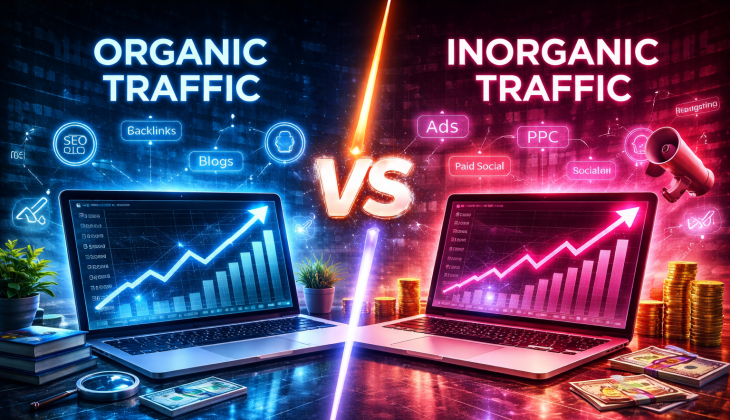
Organic vs Inorganic Traffic: Which One Works Better & 2026 Costs
The complete breakdown of cost structures, timelines, and strategic use cases for earned versus paid traffic — and how to combine both for maximum ROI.
Media Strobe Strategy Team · Updated March 2026 · 18 min read
Article-At-A-Glance
• Organic traffic builds long-term authority — SEO-driven content compounds over time, delivering visitors without ongoing ad spend.
• Inorganic traffic delivers speed — Paid campaigns can generate targeted visitors within hours of launch, ideal for time-sensitive goals.
• Cost structures are fundamentally different — Organic requires time and content investment; paid requires continuous budget to stay visible.
• The smartest marketers use both — Later in this article, you’ll see exactly how to combine organic and paid strategies to reduce acquisition costs and scale faster.
• Trust levels differ dramatically — Studies show organic search results receive significantly higher click-through rates than paid ads in most industries.
Table of Contents
- Understanding Organic vs Inorganic Traffic: What You Need to Know First
- What Is Organic Traffic?
- What Is Inorganic Traffic?
- Organic vs Inorganic Traffic: A Direct Comparison
- How Much Does Inorganic Traffic Cost?
- The Real Cost of Organic Traffic
- When to Use Organic Traffic Strategies
- When Paid Traffic Makes More Sense
- Combining Organic vs Inorganic Traffic for Maximum Results
- How Media Strobe Can Help
- Frequently Asked Questions
Understanding Organic vs Inorganic Traffic: What You Need to Know First
Every visitor who lands on your website came from somewhere — and understanding organic vs inorganic traffic determines how much it cost you, how long it lasts, and how likely they are to convert. When you compare organic vs inorganic traffic, you’re really comparing two fundamentally different philosophies about how to grow an online presence. The decision between organic vs inorganic traffic is one of the most critical strategic choices in digital marketing.
One is built. The other is bought. Both work. But they work differently, on different timelines, and with very different implications for your budget and long-term growth strategy. Media Strobe breaks down exactly what separates these two traffic sources and how to get the most from each.
What Is Organic Traffic?
Organic traffic refers to visitors who find your website through unpaid channels — most commonly through search engines like Google, Bing, or Yahoo. When someone types a query into a search engine and clicks a non-advertised result, that click is organic. It costs you nothing per visit, but it took significant effort to earn that ranking in the first place.
How Search Engines Decide Who Ranks
Google uses over 200 ranking factors to determine which pages appear at the top of search results. These include the relevance of your content to the search query, the number and quality of external websites linking to your page (backlinks), page load speed, mobile-friendliness, user engagement signals like bounce rate and time-on-site, and how well your content demonstrates E-E-A-T: Experience, Expertise, Authoritativeness, and Trustworthiness.
Ranking isn’t random — it’s earned. Google’s algorithm is designed to surface the most genuinely useful content for any given search. That means gaming the system with low-quality content is increasingly ineffective, while consistently publishing well-researched, relevant content tends to compound in value over time.
Types of Organic Traffic Sources
Organic traffic isn’t limited to Google search alone. It spans several distinct channels, each with its own audience behavior and content requirements:
The 5 Primary Organic Traffic Sources
Search Engine Traffic (SEO): Visitors arriving via Google, Bing, or DuckDuckGo after searching a keyword your content ranks for.
Social Media Organic Reach: Followers engaging with and clicking through non-promoted posts on platforms like LinkedIn, Instagram, or Facebook.
Referral Traffic: Clicks from other websites that link to your content naturally, often earned through backlink outreach or being cited as a source.
Direct Traffic: Users who type your URL directly into their browser or visit from a bookmark — a signal of brand recall and loyalty.
YouTube and Video Search: Traffic from video content that ranks organically within YouTube’s search algorithm or appears in Google’s video results.
How Long It Takes to See Organic Traffic Results
This is where most marketers hit a wall with organic strategy. Realistically, SEO takes 3 to 6 months to show meaningful movement and 6 to 12 months to reach significant, consistent traffic volume. New domains with zero authority can take even longer. The payoff, however, is a traffic channel that does not disappear the moment your budget runs dry.
What Is Inorganic Traffic?
Inorganic traffic — also called paid traffic — is any website visit that results from a paid promotion. You are essentially purchasing access to an audience, either by bidding on search keywords, paying for display placements, or running ads across social platforms. The moment someone clicks your ad, a cost is incurred.
How Paid Traffic Campaigns Work
Most paid traffic operates on either a Cost-Per-Click (CPC) or Cost-Per-Thousand-Impressions (CPM) model. In a CPC campaign like Google Ads, you bid on specific keywords and only pay when someone clicks your ad. In a CPM model, common on display networks and social platforms, you pay a fixed rate per 1,000 times your ad is shown, regardless of whether anyone clicks.
Campaigns are managed through platforms like Google Ads, Meta Ads Manager, LinkedIn Campaign Manager, or Microsoft Advertising. Each platform allows granular control over who sees your ad — by location, age, interests, search intent, income bracket, job title, and more. This level of precision is something organic traffic simply cannot match in the short term.
Types of Inorganic Traffic Sources
Paid traffic comes in many formats, each suited to different campaign goals:
- Google Search Ads (PPC): Text-based ads appearing at the top and bottom of Google search results pages, triggered by specific keyword bids.
- Google Display Network: Visual banner ads placed across millions of partner websites, targeting audiences based on behavior and demographics.
- Facebook and Instagram Ads: Highly visual paid placements within Meta’s platforms, with some of the most advanced interest and behavior targeting available.
- YouTube Pre-Roll Ads: Video ads served before or during YouTube content, charged on a CPV (cost-per-view) basis.
- LinkedIn Sponsored Content: B2B-focused paid posts targeting users by job role, industry, company size, or seniority level.
- Programmatic Display and Retargeting: Automated ad placements served to users who have previously visited your site or match a defined audience profile.
Organic vs Inorganic Traffic: A Direct Comparison
To truly understand organic vs inorganic traffic, you need to look beyond the surface-level distinction of “free vs. paid.” The differences run deep across cost structure, timeline, control, trust, and long-term return. Here is how they stack up across the metrics that actually matter to a growing business.
One is built. The other is bought. Both work — but they work differently, on different timelines, and with very different implications for your budget and long-term growth strategy.
Cost Differences Between Organic and Paid Traffic
Organic traffic has no per-click cost, but it requires sustained investment in content creation, SEO tooling, link building, and often technical website optimization. These are largely fixed or recurring costs that build equity over time — your content keeps ranking and attracting visitors long after you’ve stopped actively working on it.
Paid traffic, on the other hand, is a direct exchange: money for visits. Stop spending, and the traffic stops immediately. There is no residual value from a paused ad campaign the way there is from a well-ranked blog post. For businesses without a content strategy already in motion, this creates a dependency that can become expensive to maintain at scale.
Speed of Results
Paid campaigns can generate traffic within hours of going live. A Google Search campaign targeting a high-intent keyword like “CRM software for small businesses” can deliver hundreds of qualified clicks within 48 hours of launch. For product launches, seasonal promotions, or testing a new offer, this speed is irreplaceable.
Organic strategies operate on a completely different clock. Even with excellent content and solid technical SEO, you are looking at months before a new page competes meaningfully in search results. This is not a flaw — it is the nature of building something with lasting value — but it does mean organic traffic is rarely the right answer when you need results this week.
Long-Term Value and Sustainability
A single well-optimized article can attract thousands of visitors per month for years without any additional investment. That kind of compounding return is the defining advantage of organic traffic. Paid traffic offers no such legacy — every dollar spent produces a finite result with no carry-forward value once the campaign ends.
Audience Targeting and Control
Paid traffic gives you surgical precision over who sees your content. You can target by age, location, income level, job title, search intent, past website behavior, and even the specific devices people use. This level of control means your ad budget goes toward the exact audience most likely to convert, rather than hoping the right people stumble across your content organically.
Organic traffic offers far less immediate control. You can optimize for specific keywords and topics, but you cannot dictate who ultimately finds and clicks your content. That said, ranking for high-intent search queries does attract audiences who are already researching solutions — which often means higher purchase intent than a social media user who was served an ad mid-scroll.
Trust and Click-Through Rates in Organic vs Inorganic Traffic
Organic search results consistently outperform paid ads in click-through rate across most industries. Research by SparkToro found that organic results capture the majority of clicks on Google search pages, with users actively skipping paid placements in favor of what they perceive as more credible, unbiased results. When you evaluate organic vs inorganic traffic on the trust dimension, organic wins almost every time — simply because there is no financial transaction behind the ranking.
Organic vs Inorganic Traffic: Key Differences
| Factor | Organic Traffic | Inorganic Traffic |
|---|---|---|
| Cost Structure | No per-click cost; requires content & SEO investment | Direct payment per click or impression |
| Speed to Results | 3-12 months for meaningful traffic | Traffic within hours of launch |
| Long-Term Value | Compounds over time; content works indefinitely | Stops immediately when budget stops |
| Targeting Control | Limited; relies on search intent | Precise demographic & behavioral targeting |
| Trust Level | High; users perceive as unbiased | Lower; users know it’s paid promotion |
| Scalability | Scales with content production capacity | Scales with budget; instant on/off control |
How Much Does Inorganic Traffic Cost?
Paid traffic costs vary enormously depending on the platform, industry, competition level, and how well your campaigns are optimized. There is no flat rate — what a legal services firm pays per click looks nothing like what an e-commerce clothing brand pays. Understanding the realistic cost ranges before launching any paid campaign is essential to avoid burning budget without results.
Average Cost Per Click by Platform (2026)
| Platform | Average CPC Range | Best For |
|---|---|---|
| Google Search Ads | $1–$2 (low competition) / $50+ (legal, finance) | High-intent search traffic |
| Facebook & Instagram Ads | $0.50–$3.50 CPC / $7–$14 CPM | Visual products, broad awareness |
| LinkedIn Ads | $5–$15+ per click | B2B lead generation |
| YouTube Ads | $0.03–$0.30 per view (CPV) | Video marketing at scale |
| Programmatic Display | $0.50–$5 CPM | Brand awareness, retargeting |
These numbers represent averages — your actual costs depend heavily on your Quality Score in Google Ads, your ad creative performance on social platforms, and how tightly defined your target audience is. A poorly structured campaign in a competitive niche can easily spend $10,000 per month with negligible return.
The key metric to track is not cost-per-click but cost-per-acquisition (CPA) — what it ultimately costs you to turn a paid visitor into a paying customer. CPC tells you what you’re paying for traffic. CPA tells you whether that traffic is actually worth buying.
Google Ads Average Cost Per Click by Industry
According to WordStream data, the industries with the highest average Google Ads CPCs include legal services at around $6.75, consumer services at approximately $6.40, and finance and insurance averaging near $3.44 per click on the Search Network. E-commerce and retail verticals tend to sit far lower, often between $0.88 and $1.50 per click, making paid search significantly more accessible for product-based businesses than for service-based ones.
Facebook and Instagram Ad Pricing
Meta’s advertising platform remains one of the most cost-effective ways to reach large audiences at scale. Average CPC on Facebook sits around $0.94 across all industries, while Instagram skews slightly higher due to its visual, engagement-heavy format. However, conversion rates on Meta platforms tend to be lower than Google Search because you are reaching users based on interest and behavior rather than active search intent — meaning visitors are often earlier in the buying journey.
What Affects Your Ad Costs
Several variables directly influence what you pay for inorganic traffic, and understanding them puts you in a stronger position to manage spend efficiently. Ad relevance and Quality Score are the biggest levers in Google Ads — a higher score means lower CPCs and better placement. On social platforms, creative quality, audience saturation, and bidding strategy all drive cost fluctuations. Seasonality matters too: ad costs spike during Q4, particularly in November and December, when competition for ad inventory intensifies across nearly every industry.
The Real Cost of Organic Traffic
Calling organic traffic “free” is one of the most persistent myths in digital marketing. While you are not paying per click, building meaningful organic visibility requires real investment — in time, tools, content production, and technical expertise. The difference is that these investments build compounding assets rather than renting visibility for a fixed period.
A realistic organic strategy for a competitive niche might involve a dedicated SEO strategist or agency retainer, a content team producing multiple pieces per month, link building outreach, and ongoing technical SEO audits. These costs are not trivial — but unlike paid ads, every piece of content you publish and every backlink you earn continues working for you indefinitely.
SEO Tools and What They Cost
Running an effective organic strategy without dedicated tooling is possible but significantly slower. The major SEO platforms each come with real price tags that should factor into your organic traffic budget from day one.
Monthly SEO Tool Investment Ranges
Ahrefs: Plans start at $129/month for the Lite plan, scaling to $449/month for the Advanced plan with full site audit, keyword research, and backlink analysis capabilities.
SEMrush: Pro plan starts at $139.95/month, with Guru at $249.95/month for content marketing toolkit access and historical data.
Moz Pro: Entry-level pricing starts around $99/month, making it a more accessible option for smaller teams or solopreneurs.
Google Search Console and Google Analytics: Both are completely free and should be the baseline of any organic strategy regardless of what paid tools you layer on top.
Content Creation Costs
Content is the engine of organic traffic. Without a consistent output of well-researched, search-optimized material, even the best technical SEO setup will underperform. The cost of content creation varies widely based on whether you hire in-house writers, work with freelancers, or use a content agency.
Freelance writers for SEO blog content typically charge between $0.10 and $0.50 per word for general topics, with specialized or technical content running $0.50 to $1.00+ per word. A single 1,500-word article optimized for a competitive keyword can cost anywhere from $150 to $1,500 depending on depth and expertise required.
For businesses publishing four to eight articles per month — a reasonable content cadence for meaningful SEO growth — monthly content costs alone can run between $600 and $12,000 before factoring in editing, design, internal linking strategy, or content distribution. When you add tooling costs on top of that, a modest but serious organic strategy realistically requires $1,500 to $5,000 per month in total investment, at minimum.
The “Free Traffic” Myth
Organic traffic has no per-click cost — but a realistic SEO strategy for competitive niches requires $1,500 to $5,000+ per month in content production, tools, and technical optimization. The difference? This investment builds a compounding asset, not a rented audience.
When to Use Organic Traffic Strategies
Organic traffic is the right primary strategy when you are playing a long game and have the runway to build authority before needing returns. It works best for businesses with established domains, consistent content budgets, and products or services that benefit from educational, research-driven buying journeys. If your customers spend time comparing options, reading reviews, and searching for answers before purchasing, organic search is where you want to be visible.
It is also the smarter investment when your target keywords carry high commercial intent but prohibitively expensive CPCs in paid search. Ranking organically for a keyword that costs $15 to $30 per click in Google Ads means every organic visitor represents genuine saved budget — and those savings compound with every additional visitor over the lifetime of the ranking. For more strategies on maximizing your online presence, consider learning about repurposing blog content to multiply traffic.
When Paid Traffic Makes More Sense
There are specific situations where waiting months for organic results simply is not an option, and paid traffic is the only logical move. Recognizing these scenarios prevents the common mistake of applying a long-term strategy to a short-term problem. For more insights, explore our detailed comparison of paid ads vs SEO to understand which strategy suits your needs better.
5 Scenarios Where Paid Traffic Is The Right Move
You are launching a new product or service and need immediate visibility before organic rankings develop.
You have a time-sensitive promotion, seasonal offer, or limited inventory that cannot wait for SEO to kick in.
You need to validate a new market, messaging angle, or landing page concept before committing to organic content production.
Your domain is brand new with zero authority, and organic rankings are realistically 6 to 12 months away.
Your competitors are dominating the organic results for your core keywords, and paid placement is the fastest way to appear alongside them.
Paid traffic also excels when your customer lifetime value (LTV) is high enough to absorb the cost of acquisition. A B2B SaaS company closing deals worth $10,000 to $50,000 annually can justify significantly higher CPAs than a low-margin e-commerce store. The math has to work — but when it does, paid traffic becomes a reliable, scalable growth lever.
The other major advantage of paid is the data it generates almost instantly. Within days of launching a campaign, you know which headlines resonate, which audiences convert, and which offers fall flat. This intelligence is invaluable, and many sophisticated marketers use paid campaigns specifically to gather this data before investing in longer-term organic content around the same themes.
When comparing organic vs inorganic traffic purely on flexibility and speed of insight, paid wins without question. The ability to turn a campaign on or off, shift budget between ad sets, and test five variations of a landing page simultaneously gives marketers a level of agility that organic strategy simply cannot match in the short term.
Product Launches and Time-Sensitive Offers
Nothing illustrates the strength of paid traffic better than a product launch scenario. Imagine you have developed a new software tool and need to generate signups within a 30-day launch window. An organic strategy targeting relevant keywords might not surface your new content in search results for three to six months — well past your launch deadline.
A Google Ads or Meta campaign, launched the same day your product goes live, can place your offer directly in front of a precisely targeted audience within hours. Combined with a well-crafted landing page and a compelling offer, paid traffic during a launch phase can generate the initial user base, social proof, and revenue needed to fund the longer-term organic strategy that sustains growth after the launch buzz fades.
Testing Messaging and Audiences Quickly
Paid traffic is one of the fastest market research tools available to digital marketers. Instead of guessing which headline, offer, or value proposition will resonate with your audience, you can run A/B split tests across multiple ad variations simultaneously and have statistically meaningful data within days. This kind of rapid feedback loop is impossible to replicate through organic content alone, where a single article might take months to accumulate enough traffic to draw conclusions from.
The smartest application of this capability is using paid campaign data to inform your organic strategy. If a specific message consistently generates clicks and conversions in your Google Ads or Meta campaigns, that same messaging should become the foundation of your SEO content, landing pages, and email sequences. You are not just buying traffic — you are buying market intelligence that makes every other channel more effective.
Combining Organic vs Inorganic Traffic for Maximum Results
The most effective digital marketing strategies do not choose between organic and paid traffic — they use both in a way where each amplifies the other. When you think about organic vs inorganic traffic not as competitors but as complements, a clearer and more powerful growth framework emerges. Paid fills the gaps that organic cannot cover quickly. Organic builds the foundation that reduces your long-term dependence on paid spend.
Use Paid Ads to Find What Works, Then Double Down With SEO
Launch paid campaigns around your core keywords and offers first. Track which keywords drive the highest conversion rates, not just the most clicks. Once you identify the terms with the strongest commercial intent and conversion performance, shift resources toward building authoritative organic content around those exact keywords. Over time, as your organic rankings climb for those validated terms, you can reduce paid spend on them and reallocate that budget to testing new opportunities — creating a self-funding content growth engine.
Retargeting Organic Visitors With Paid Ads
Organic visitors who find your content through search are already interested — they sought you out. But most of them will not convert on the first visit. Retargeting campaigns allow you to serve paid ads specifically to users who have already visited your website organically, keeping your brand visible while they continue their research. This combination of organic first-touch and paid retargeting consistently outperforms either channel used in isolation, because you are reinforcing trust with an already-warm audience rather than interrupting a cold one.
Building an Email List With Paid Traffic and Nurturing It Organically
One of the highest-ROI applications of paid traffic is using it to build an owned audience — specifically, an email list. Run targeted paid campaigns to a high-converting lead magnet: a free guide, a webinar, a checklist, or a free tool relevant to your audience’s core problem. The cost to acquire an email subscriber is almost always lower than the cost to acquire a direct customer through paid ads, and the long-term value of a nurtured subscriber is far higher.
Once someone is on your list, the nurturing process becomes almost entirely organic. Email sequences, educational content, product updates, and personal outreach cost nothing per send beyond your email platform subscription. A list of 10,000 engaged subscribers built through paid acquisition can generate consistent revenue for years with no additional ad spend — a genuine compounding asset in the same vein as organic search rankings.
This approach essentially converts a short-term paid traffic expense into a long-term organic relationship channel. You spend once to acquire the lead and then invest in content and communication to convert and retain them over time. For businesses with strong email marketing capabilities, this hybrid model often delivers the best blended cost-per-acquisition across all traffic strategies.
The Hybrid Traffic Strategy: Best of Both Worlds
Month 1-3: Launch paid campaigns to generate immediate traffic and revenue. Use this data to identify which keywords, messages, and audiences convert best. Begin content production for organic strategy.
Month 3-6: Shift budget toward creating organic content around validated keywords from paid campaigns. Maintain paid spend on highest-ROI campaigns while organic rankings develop.
Month 6-12: As organic traffic builds, gradually reduce paid spend on keywords where you now rank organically. Reallocate paid budget to testing new keywords and markets.
Month 12+: Organic traffic becomes primary driver. Paid campaigns focus on retargeting, new product launches, and seasonal promotions. Total cost-per-acquisition decreases while traffic volume increases.
Organic traffic builds equity. Paid traffic delivers speed. The businesses that grow fastest use paid campaigns to generate immediate revenue and market intelligence, then reinvest those learnings into organic strategies that reduce cost of acquisition over time.
How Media Strobe Can Help
Whether you choose organic traffic, paid traffic, or both, Media Strobe’s MultiCast campaign provides the content infrastructure that makes either strategy more effective. By distributing your brand’s story across 300+ high-authority platforms in 8 optimized formats, MultiCast creates the research-phase visibility that turns both organic search traffic and paid ad clicks into conversions.
MultiCast Campaign: Amplify Your Traffic Strategy
Media Strobe’s MultiCast campaign is expertly created to answer highly relevant questions about your products that your future customers are asking across the internet before they make their purchase decision. Your MultiCast is distributed to hundreds of high-authority sites in the exact way that Google and AI love, and in 8 formats so that your answers show up everywhere people are asking questions.
How MultiCast supports both organic and paid traffic strategies:
- Creates the branded search visibility that converts paid ad traffic into sales
- Builds authoritative backlinks that accelerate organic SEO rankings
- Provides product comparison and review content that supports buyer decision-making
- Strengthens brand credibility that makes both paid and organic channels more effective
- Distributes in 8 formats optimized for every stage of the buyer journey
- Indexed within 48-72 hours across Google, Bing, and major search platforms
The benefits of running a MultiCast campaign include:
- Increased visibility (leading to increased ranking)
- Increased warm/hot traffic
- Reduced customer acquisition costs
- Predictable growth that can be scaled
- Generate more revenue with higher net profit
- True control over your lead generation
- Better return on paid ads
Final Thoughts on Organic vs Inorganic Traffic
When you step back and honestly evaluate organic vs inorganic traffic, neither wins outright — and that is precisely the point. Organic traffic builds equity. Every piece of content you publish, every backlink you earn, and every keyword you rank for adds to an asset base that generates returns long after the initial investment. Paid traffic delivers speed, precision, and control that organic simply cannot replicate on a short timeline. Both are tools, and the best marketers know when to reach for each one.
The businesses that grow fastest are not the ones that pick a side in the organic vs inorganic traffic debate. They use paid campaigns to generate immediate revenue and market intelligence, then reinvest those learnings into organic strategies that reduce their cost of acquisition over time. The result is a traffic ecosystem that becomes progressively more efficient, more resilient, and harder for competitors to disrupt — because it is not dependent on any single channel or any single budget cycle.
Frequently Asked Questions
Understanding the distinction between organic and paid traffic is one thing. Knowing how to act on that understanding in a real business context is another. The questions below address the most common decision points marketers face when evaluating these two traffic strategies.
Whether you are just starting to build your online presence or looking to optimize a strategy that is already in motion, these answers will help you move forward with clarity and confidence.
What is the main difference between organic and inorganic traffic?
Organic traffic comes from unpaid sources — primarily search engines, social media posts, referral links, and direct visits. Inorganic traffic comes from paid promotions, including Google Ads, Meta campaigns, display advertising, and any other channel where you pay for placement or clicks.
The core distinction goes beyond just cost. Organic traffic is earned through relevance, authority, and consistent content effort over time. Inorganic traffic is purchased and delivers results immediately, but only for as long as you are actively spending. When you analyze organic vs inorganic traffic on longevity, organic builds a compounding asset while paid creates a rented audience.
Neither is inherently better — the right choice depends entirely on your timeline, budget, goals, and where your business currently sits in its growth journey. Most successful digital strategies incorporate both, with the balance shifting as the business matures and organic authority builds.
Which traffic source is better for a small business with a limited budget?
For most small businesses with limited budgets, organic traffic offers better long-term ROI — but it requires patience. If you have more time than money, invest in consistent content creation, basic SEO optimization, and building genuine backlinks through outreach and partnerships. If you need leads or sales within weeks rather than months, a tightly targeted paid campaign with a small daily budget — even $10 to $30 per day on Google or Meta — can generate measurable results while your organic presence develops in the background.
How long does it take for organic traffic to start working?
Organic traffic growth follows a predictable but slow curve. Here is what a realistic timeline typically looks like for a new or low-authority domain:
Organic Traffic Growth Timeline
| Timeframe | What to Expect | Focus Areas |
|---|---|---|
| Months 1–3 | Google indexes content, minimal rankings, negligible traffic | Technical SEO, content foundation, initial link building |
| Months 3–6 | Early keyword rankings appear for long-tail terms, traffic trickles in | Consistency pays off, maintain content schedule |
| Months 6–12 | Meaningful traffic growth visible, rankings consolidate and compound | Quality content, backlink acquisition consistency |
| Month 12+ | Authority accumulated, new content ranks faster, upward traffic curve | Scale content production, diversify keywords |
Established domains with existing authority can move through these stages faster — sometimes seeing results from new content within weeks. Brand-new domains with no backlink profile should plan for a minimum of six months before expecting organic traffic to contribute meaningfully to business goals.
Can you run paid ads and SEO at the same time?
Absolutely — and in most cases, you should. Running paid ads and SEO simultaneously is not just possible, it is one of the most effective growth strategies available. Paid campaigns generate immediate traffic and revenue while your organic rankings develop. The data from paid campaigns — which keywords convert, which messages resonate, which audiences respond — directly informs and accelerates your SEO content strategy. There is no conflict between the two channels; when integrated deliberately, they create a feedback loop that makes both more effective over time.
Is inorganic traffic worth the cost if it stops the moment you stop paying?
Yes — when the economics make sense. The fact that paid traffic stops when your budget stops is a genuine limitation, but it does not make paid advertising a poor investment. It makes it a different kind of investment. If your cost-per-acquisition is lower than your customer lifetime value, paid traffic is generating profitable growth regardless of whether it produces residual results.
The real risk is over-dependence. Businesses that rely exclusively on paid traffic without building any organic presence are one budget cut or algorithm change away from losing their entire traffic source overnight. That fragility is the strongest argument for investing in organic alongside paid, not against using paid traffic altogether.
Think of paid traffic as a faucet and organic traffic as a well. The faucet delivers water instantly and precisely but requires constant pressure to run. The well takes time to dig but produces water on its own once it is built. The most resilient water strategy involves both — and the same logic applies to your traffic strategy.
If you are ready to build a traffic strategy that works across both channels and compounds over time, MultiCasting with Media Strobe helps businesses amplify their content and organic reach across hundreds of high-authority platforms — turning consistent content into a powerful, scalable source of organic visibility. Additionally, you might consider how to repurpose blog content to multiply traffic effectively.
Why Choose a MultiCast campaign by Media Strobe?
All MultiCast campaigns are expertly created to answer highly relevant questions about your service/product that your future customers are asking (all over the internet) before they make their purchase decision. Your MultiCast is distributed to hundreds of high authority sites IN THE EXACT WAY that Google and AI love, and in 8 formats so that your answers show up everywhere people are asking questions.
The benefits of running a MultiCast campaign are:
- Increased visibility (leading to increased ranking)
- Increased warm/hot traffic
- Reduced customer acquisition costs
- Predictable growth that can be scaled
- Generate more revenue with higher net profit
- True control over your lead generation
- Better return on paid ads
© 2026 Media Strobe. All rights reserved. | More Digital Marketing Strategies