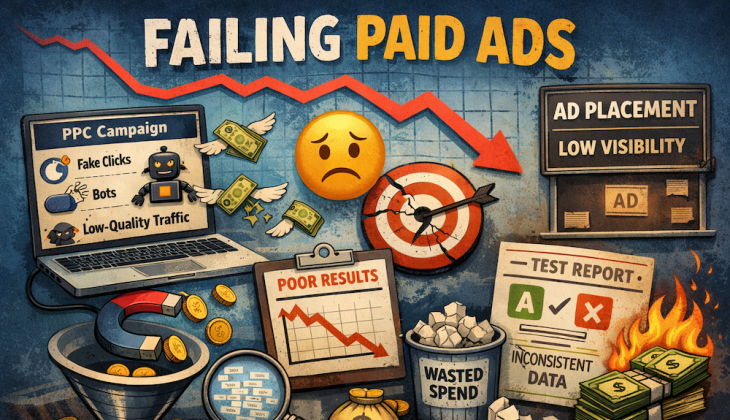
Why Your Paid Ads Are Quietly Failing And Draining Your Bank Account in 2026
The silent budget killer no one is talking about — and the 7 proven strategies to stop it before it destroys your ROI.
⚡ Key Takeaways
- Today’s paid advertising landscape is experiencing diminishing returns with increased costs and decreased effectiveness across platforms
- Many businesses focus on vanity metrics like impressions and clicks instead of meaningful conversion metrics that actually drive revenue
- Privacy changes and cookie deprecation have severely impacted targeting capabilities, making many traditional ad strategies less effective
- Ad fatigue and ad blockers have significantly reduced audience engagement, with over 30% of internet users actively avoiding paid advertisements
- Media Strobe helps companies build smarter acquisition strategies that focus on qualified pipeline rather than high-volume noise
The digital landscape has shifted dramatically, yet many businesses continue pouring money into paid advertising strategies that no longer deliver results. What worked brilliantly in 2020 or even last year might be silently draining your budget today without you even realizing it. This isn’t just about minor performance fluctuations — we’re witnessing a fundamental transformation in how digital ads function and how audiences respond to them.
The Silent Profit Drain: Why Your Ad Budget Isn’t Delivering Results
Your paid ads might be failing without setting off any obvious alarms. Media Strobe has observed a concerning trend across industries: marketing teams increasing ad spend while seeing diminishing returns on investment. The problem isn’t necessarily that you’re doing something wrong — it’s that the entire advertising ecosystem has changed beneath your feet.
CPL (Cost Per Lead) and CAC (Customer Acquisition Cost) metrics are climbing across nearly every platform. Facebook CPMs have increased by over 61% year-over-year in some industries, while Google click costs continue their upward trajectory. Meanwhile, conversion rates are trending downward — creating a perfect storm for marketing budgets.
Privacy changes, algorithm shifts, and audience fatigue have fundamentally altered how digital advertising performs. The reliable playbooks that built businesses for years now struggle to generate positive ROI. Let’s examine why this is happening and what you can do about it.
5 Warning Signs Your Paid Ads Are Failing
Before diving into solutions, it’s crucial to recognize if you’re experiencing the symptoms of failing paid advertising. These warning signs often appear gradually, making them easy to miss until they’ve significantly impacted your marketing performance.
-
High Click Rates But Few Conversions
Your ads might be attracting plenty of clicks that justify the ad spend, but those visitors aren’t taking meaningful actions on your site. This disconnect indicates a targeting problem or a messaging misalignment between your ads and landing pages. When people click but don’t convert, you’re essentially paying for expensive website traffic rather than business results.
-
Steadily Increasing Cost-Per-Lead
If you’re paying more for each lead than you were six months ago, this isn’t just normal market fluctuation. Rising acquisition costs signal deteriorating campaign efficiency or increased competition in your niche. When CPL increases aren’t matched by improvements in lead quality, your ROI diminishes with each passing month.
-
Traffic Spikes Without Revenue Growth
Many businesses make the mistake of celebrating traffic increases without connecting those metrics to bottom-line results. Your analytics might show impressive visitor numbers, but if revenue remains flat or declines, your paid traffic isn’t contributing meaningfully to business growth. This disconnect often stems from targeting problems or conversion path issues.
-
Poor Quality Leads That Don’t Convert to Sales
One of the most frustrating symptoms is when marketing targets are reached, but sales are not following. This gap usually indicates that your targeting parameters are too broad or your ad messaging attracts the wrong audience. The result is a marketing funnel filled with prospects who don’t have genuine buying intent or purchasing authority — which is basically worthless.
-
Ad Fatigue Causing Declining Performance
If your once-successful campaigns show steadily declining performance despite optimizations, you’re likely experiencing ad fatigue. Today’s audiences see thousands of marketing messages daily, leading to diminished attention and engagement. When frequency is too high or creative assets aren’t refreshed regularly, audiences simply tune out your messaging.
The Optimization Trap: Clicks Don’t Equal Customers
The fundamental disconnect in most failing ad strategies is optimizing for surface metrics rather than actual business outcomes. This optimization trap leads marketers to chase vanity metrics that don’t translate to revenue growth.
Why Click-Focused Metrics Mislead Small Businesses
Clicks, impressions, and even basic conversion tracking can create the illusion of success while masking deeper problems. Many ad platforms deliberately emphasize these top-of-funnel metrics because they’re easier to deliver than actual business results. The problem is that clicks represent attention, not intent — and certainly not completed purchases.
A campaign might generate 1,000 clicks at $2 each, seeming reasonable at first glance. But if only 1% of those clicks convert to customers, your actual acquisition cost is $200 per customer. Without proper end-to-end tracking, you might continue optimizing for cheaper clicks while your true economics remain completely hidden.
The Real Metrics That Determine Ad Success
Successful advertising isn’t measured by traffic volume but by revenue impact. The metrics that truly matter include sales qualified leads (SQLs), customer acquisition cost (CAC), lifetime value to CAC ratio (LTV:CAC), and pipeline influence. These downstream metrics reveal whether your ads are attracting the right audience or just generating expensive clicks.
| VANITY METRIC | WHAT IT ACTUALLY TELLS YOU | REAL METRIC TO TRACK INSTEAD | PRIORITY |
|---|---|---|---|
| Impressions | How many times an ad was shown | Pipeline Influence | High |
| Clicks | Attention — not intent | Sales Qualified Leads (SQLs) | High |
| Click-Through Rate | Ad relevance only | Customer Acquisition Cost (CAC) | High |
| Basic Conversions | Surface-level engagement | LTV to CAC Ratio | Medium |
| Bounce Rate | Page experience only | Closed Revenue by Channel | Medium |
Advanced marketers implement multi-touch attribution models to understand how ads contribute to the entire customer journey rather than just the initial click. This approach reveals that some campaigns with modest click performance might actually drive significant pipeline value through awareness and consideration effects.
Targeting Problems That Sabotage Your Ad Campaigns
Even perfectly crafted ads fail when shown to the wrong audiences. Most failing ad campaigns suffer from fundamental targeting problems that waste budget and diminish performance.
❌ Too Broad
- Wastes money on uninterested audiences
- Leads to high impressions but abysmal conversion rates
- Forces generic ads that appeal to no one specifically
- Instantly forgettable among thousands of daily messages
- Lacks buying intent entirely
❌ Too Narrow
- Limits your growth potential and scalability
- Quickly exhausts available audience
- Hits a hard performance ceiling fast
- Costs more per impression due to premium segments
- Cannot sustain long-term campaign performance
Cookie Deprecation and Privacy Changes Affecting Your Targeting
The digital advertising landscape has been fundamentally altered by privacy regulations like GDPR, CCPA, and technical changes like iOS 14+ privacy features and Google’s planned deprecation of third-party cookies. These shifts have severely impacted advertisers’ ability to track user behavior across sites and apps, limiting retargeting capabilities and attribution accuracy.
Facebook advertisers reported up to 40% drops in performance following Apple’s App Tracking Transparency implementation. Google’s planned removal of third-party cookies threatens the very foundation of programmatic advertising. This new reality requires completely different strategies than those that worked just a few years ago.
The Audience Fatigue Crisis
Beyond technical limitations, advertisers face an even more challenging problem: audiences are increasingly tuning out paid advertising altogether. This attention recession affects even perfectly targeted ads with compelling messaging.
The psychological mechanisms behind this fatigue are well-documented. The human brain automatically filters out repetitive stimuli to prevent cognitive overload — a phenomenon called “banner blindness” when applied to digital advertising. As users encounter more ads, their brains become increasingly efficient at ignoring them.
This fatigue is compounded by the sheer volume of advertising in modern digital experiences. The average person now encounters between 6,000–10,000 ads daily, creating a natural defense mechanism where potential customers unconsciously filter out promotional content.
Ad fatigue disproportionately affects your best prospects. The more digitally savvy a user is — often correlating with higher income and education — the more likely they are to develop sophisticated ad avoidance behaviors. You’re losing your highest-value customers first.
How Ad Blockers Are Affecting Your Campaign Reach
Ad fatigue isn’t just a passive phenomenon — it’s driving active countermeasures. Over 30% of internet users now employ ad blockers, with adoption rates highest among desirable demographic segments like higher-income professionals and younger tech-savvy consumers. This technology prevents your ads from displaying regardless of how well-targeted or relevant they might be.
Signs Your Target Market Has Developed Ad Blindness
Even when your ads display properly, they increasingly go unnoticed. Eye-tracking studies show that users have developed “ad blindness” — the ability to navigate digital environments while completely ignoring sections recognized as advertisements. The regions of websites where ads traditionally appear (sidebars, headers, between content) have become psychological dead zones for many users.