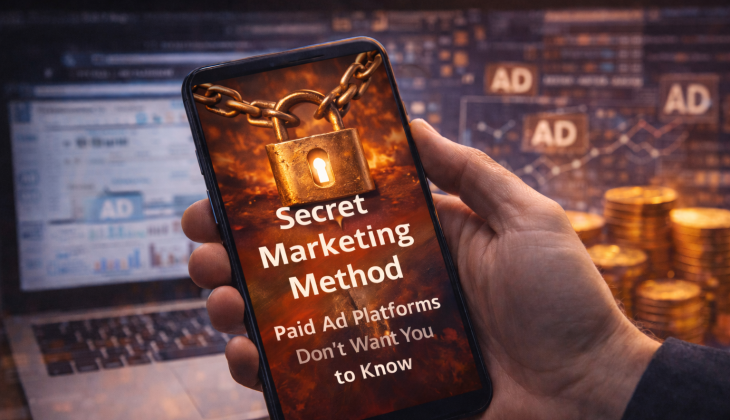
Digital Marketing · 2026 Strategy Guide
The platforms profiting from your ad spend would rather you didn’t read this.
Media Strobe Research Desk · Updated 2026 · 12 min read
Key Takeaways
Organic marketing delivers a significantly higher ROI over time, with 35% of ecommerce traffic coming from organic search versus just 4% from paid ads.
While paid advertising offers quick results, organic marketing builds permanent assets that continue generating traffic and leads long after creation.
Nearly 80% of internet users actively ignore paid advertisements, preferring to click on organic search results instead.
Unlike paid platforms that increase costs when campaigns succeed, organic marketing actually becomes more cost-effective as your authority grows.
Strategic organic marketing protects your business from algorithm changes and paid platform price hikes that can devastate ad-dependent companies.
The digital marketing landscape is dominated by platforms that profit from your advertising budget. They’re not necessarily incentivized to tell you about alternatives that might work better for your business long-term. The truth? While paid ads have their place, organic marketing delivers benefits that paid platforms would rather keep quiet.
Organic vs. Paid — The Numbers at a Glance
|
35%
Of ecommerce traffic comes from organic search |
4%
Of ecommerce traffic comes from paid ads |
|
80%
Of internet users actively ignore paid ads |
8.75x
More traffic from organic vs. paid channels |
The Truth About Paid Ads vs Organic Marketing
When comparing organic and paid marketing strategies, it’s crucial to understand what each approach actually delivers. Paid advertising operates on a simple premise: you pay, you play, you stop paying, you disappear. Organic marketing follows a completely different model — one based on building lasting value that continues working for your business 24/7.
The real distinction lies not just in cost structure but in how these strategies align with consumer behavior. While platforms like Google and Facebook optimize their interfaces to make ads more prominent, users have become increasingly skilled at identifying and avoiding paid content.
80% of Internet Users Skip Paid Ads
The statistics are striking. According to multiple studies, approximately 80% of internet users actively ignore paid advertisements when browsing or searching online. This phenomenon, sometimes called “banner blindness,” has evolved as users have become more sophisticated in distinguishing between paid placements and organic content. When users recognize something as an advertisement, their trust level immediately decreases.
This behavior isn’t limited to display ads. Even in search results, users have learned to scroll past the “Ad” labeled results at the top of the page to reach the organic listings — content that has earned its position rather than paid for it.
“Users scroll past ‘Ad’ labeled results to reach organic listings — content that has earned its position rather than paid for it.”
Organic Results Drive 35% of Ecommerce Traffic
While paid ads account for only 4% of e-commerce traffic, organic search generates 35%. This 8.75x difference reveals the true power of organic marketing strategies. These aren’t vanity metrics — they translate directly to revenue opportunities.
What makes this disparity even more significant is the quality of this traffic. Organic visitors typically arrive with higher intent and engagement levels compared to those clicking on ads. They’ve actively searched for solutions related to your offerings rather than being interrupted by an advertisement, resulting in higher conversion rates and customer satisfaction scores.
The most successful digital brands understand this reality and invest accordingly. Rather than pouring their entire marketing budget into paid channels that deliver diminishing returns, they build robust organic marketing systems that generate sustainable results.
Long-Term ROI Comparison
Paid vs. Organic — ROI Over Time
| Factor | Paid Advertising | Organic Marketing |
|---|---|---|
| Short-Term Results | Fast — visible same day | Slower — 3–6 months to build |
| Long-Term Results | Stops when budget stops | Compounds indefinitely |
| Cost Over Time | Increases as competition grows | Decreases per lead as authority grows |
| Asset Value | Zero — spend is gone forever | Permanent digital assets |
| Trust Level | Lower — flagged as “Ad” | Higher — earned position |
| Algorithm Risk | High — rules change overnight | Lower — quality content is resilient |
The Organic Advantage
“Organic traffic rocks! You’re not paying for it. But here it is. And the visitors just keep on coming.”
How Paid Platforms Keep You Hooked on Spending
Paid advertising platforms have mastered the art of keeping marketers dependent on their services. Their business models rely on this continued dependency, which explains why they rarely emphasize the superior long-term benefits of organic marketing strategies. Understanding these tactics can help you make more balanced marketing investments.
The Diminishing Returns Trap
Paid platforms operate on auction-based systems that automatically increase costs when campaigns perform well. The moment your ads start delivering meaningful results, you’ll notice your cost-per-click rising as the algorithm recognizes value and adjusts pricing accordingly. This creates a frustrating cycle where success actually becomes more expensive over time rather than more efficient.
“In organic marketing, as your content gains authority, each additional piece becomes more effective — not more expensive.”
Algorithm Changes That Force Higher Bids
Anyone who’s managed paid campaigns for more than a few years has experienced the sudden shock of algorithm updates. These changes frequently result in decreased ad visibility, lower quality scores, or higher minimum bids — all designed to extract more budget from advertisers. What once cost $2 per click suddenly jumps to $5 or more, with little warning or recourse.
These platform-initiated changes have forced countless businesses to either dramatically increase their advertising budgets or abandon campaigns that were previously profitable. The unpredictability creates significant challenges for financial planning and sustainable growth strategies.
The “Quick Results” Illusion
Perhaps the most compelling selling point for paid advertising is the promise of immediate results. Launch a campaign today, see traffic tomorrow. This instant gratification is psychologically powerful — and deliberately so. It creates a dependency pattern that’s difficult to break, even when the data clearly shows diminishing effectiveness.
This addiction to immediate results blinds many marketers to the superior long-term performance of organic strategies. The platforms know that once you’ve experienced the dopamine rush of watching real-time click data, the patience required for organic growth seems far less appealing. They’re banking on your preference for immediate gratification over superior long-term outcomes.
Hidden Fee Structures
Beyond the obvious cost-per-click, paid platforms layer in numerous additional expenses that aren’t immediately apparent. The estimated true all-in cost of paid advertising typically exceeds the media spend by 40–60%.
The True Cost of Paid Ads
Media spend — what you see on your invoice
+ Management fees — internal staff time or agency costs
+ Creative production — design, copy, video
+ Landing page development — build and ongoing optimization
+ Conversion rate optimization — testing and iteration
= Estimated total cost: 40–60% above your media spend
By comparison, organic marketing often consolidates these functions. A well-crafted piece of content simultaneously serves as the creative asset, the landing page, and the conversion opportunity — delivering significant cost efficiencies that paid platforms rarely acknowledge.
7 Reasons Organic Marketing Outperforms Paid Ads
Despite the pervasive messaging from advertising platforms, organic marketing delivers numerous advantages that make it the superior choice for sustainable business growth. Understanding these benefits helps clarify why a balanced approach — with appropriate emphasis on organic strategies — typically delivers the best overall results.
7 Organic Marketing Advantages
| # | Advantage | What It Means for Your Business |
|---|---|---|
| 1 | Builds Trust Through Authority | Google’s endorsement carries weight paid placements cannot buy |
| 2 | Creates Permanent Assets | Content keeps working for years after creation — paid spend disappears immediately |
| 3 | Compounds Over Time | Your 50th article performs better than your first — from day one |
| 4 | Lower Cost Per Acquisition | $500 content piece generating leads for 12 months = $8.33 per lead |
| 5 | Attracts Pre-Qualified Traffic | Visitors arrive already interested — higher intent, higher conversion rates |
| 6 | Protects Against Algorithm Changes | Diverse quality content weathers updates; paid campaigns can die overnight |
| 7 | Higher Conversion Rates | Trust built through helpful content outperforms ad persuasion at every stage |
1. Builds Trust Through Authority
When users encounter your content through organic search, they’re finding you because a trusted platform like Google has determined your information is valuable enough to recommend. This implied endorsement carries significant weight in establishing credibility with potential customers. Unlike paid placements that are clearly marked as advertisements, organic visibility sends a powerful signal that your business has earned its position.
This authority-based trust translates directly into higher engagement metrics. Visitors who discover your business through organic channels typically spend more time exploring your content, visit more pages per session, and demonstrate higher return visit rates compared to paid traffic.
2. Creates Permanent Assets
Every dollar spent on paid advertising is essentially gone once the campaign ends. By contrast, investments in organic marketing create permanent digital assets that continue working for your business indefinitely. A high-quality blog post, video tutorial, or comprehensive guide may require significant upfront investment, but its ability to generate traffic and leads extends for years without additional cost.
Cost Per Lead — The Math
$8.33 per lead
A $500 piece of content generating 5 leads/month for 12 months = 60 total leads at $8.33 each. The same $500 in paid ads? Gone after one month.
3. Compounds Over Time
Unlike paid campaigns that typically deliver consistent or declining results over time, organic marketing efforts exhibit compounding returns. Each piece of content you create increases your overall digital footprint, domain authority, and keyword coverage. As your content library grows, new assets benefit from the accumulated authority of your previous work.
This compounding effect means your 50th article typically performs better from day one than your first article did, even with identical quality and promotional support. The network effect of interlinked content creates an ecosystem where individual pieces strengthen each other — a multiplicative growth pattern entirely absent from paid marketing models.
4. Lower Cost Per Acquisition
When measured over appropriate timeframes, organic marketing consistently delivers a lower cost-per-acquisition than paid channels. Businesses with mature organic marketing programs can often acquire customers at a fraction of the cost their competitors pay through paid channels — a cost efficiency that can be reinvested into product development, customer experience, or more aggressive pricing.
5. Attracts Pre-Qualified Traffic
Organic traffic typically arrives with higher intent and self-qualification than paid traffic. When someone searches for specific information related to your products or services and finds your content in the organic results, they’re already expressing interest in what you offer. This natural alignment between searcher intent and your content creates a foundational advantage in conversion potential.
6. Protects Against Algorithm Changes
Diversified organic marketing provides significant insulation against platform algorithm changes and policy updates. While Google and social platforms frequently adjust their ranking algorithms, these changes rarely cause catastrophic traffic drops for sites with authentic, valuable content across multiple topics. The breadth of your content portfolio creates natural protection against any single update. Paid advertising offers no such protection — a single policy change can render previously successful ad campaigns completely ineffective overnight.
7. Higher Conversion Rates
The trust advantage of organic marketing translates directly into higher conversion rates across all stages of the customer journey. This performance difference becomes particularly pronounced for complex purchases or B2B sales cycles. The educational nature of organic content aligns perfectly with the deliberate research process these buyers undertake, dramatically outperforming the persuasive capacity of advertisements.
Content Types That Drive Organic Traffic
Effective organic marketing requires creating the right types of content that align with both search engine algorithms and user needs. The most successful content strategies focus on solving real problems and answering specific questions that your target audience is actively searching for online.
|
Content Type 01 Problem-Solving Blog Content Articles that directly address customer pain points consistently outperform promotional content. The most effective pieces combine comprehensive information with actionable, step-by-step advice — demonstrating understanding while providing immediate value. |
Content Type 02 Video Tutorials & Demonstrations Video content appears prominently in search results and generates significant engagement. Pair video with supporting text to create multimedia assets that accommodate different learning preferences while giving search engines rich content to index. |
|
Content Type 03 Downloadable Resources Templates, checklists, calculators, and guides encourage link-building and social sharing while creating data capture opportunities. Resources audiences reference repeatedly reinforce brand presence with every use. |
Content Type 04 Case Studies That Showcase Results Well-crafted case studies combine real-world results with narrative elements that engage readers emotionally. Follow a clear problem-solution-results structure with specific metrics, direct quotes, and detailed methodology to maximize credibility. |
Measuring Real Organic Marketing Success
Evaluating the true impact of organic marketing requires looking beyond surface-level metrics to understand the complete value these efforts deliver. The right measurement framework connects content performance directly to business outcomes rather than focusing exclusively on traffic statistics.
Metrics That Actually Matter
| Metric Category | What to Track | Why It Matters |
|---|---|---|
| Traffic Quality | Page depth, time on page, return visits | Reveals actual business value being created |
| Engagement Signals | Scroll depth, video completion, interaction rates | Directly correlates with search ranking improvements |
| Conversion Attribution | Multi-touch models across the full buyer journey | Shows organic content’s true role in driving sales |
| Cost Per Lead Trend | Monthly effective CPL by channel | Demonstrates compounding efficiency of organic over time |
“Multi-touch attribution reveals how educational blog posts and comparison guides create the foundation for conversions that might otherwise be credited entirely to bottom-funnel assets.”
Building Your Organic Marketing System
Creating an effective organic marketing program requires a systematic approach that builds momentum over time. Understanding the typical progression helps set realistic expectations and focus efforts appropriately at each stage of development.
The Organic Marketing Growth Timeline
| Phase | Timeframe | Focus | Expected Results |
|---|---|---|---|
| Foundation | Days 1–30 | Website architecture, core landing pages, keyword research, analytics setup | Baseline established; production workflows in place |
| Amplification | Days 60–90 | Distribution relationships, internal linking, social sharing activation | Initial rankings for low-competition keywords emerging |
| Optimization | 6 Months | Data-driven refinement; expand top performers; update high-potential content | Clear performance patterns; quick-win opportunities identified |
| Scaling | 12 Months | Strategic scaling based on proven models; prioritize high-conversion topics | Meaningful traffic growth validating sustained investment |
What If You Don’t Have 6–12 Months to Wait for Results?
Organic marketing’s compounding returns are undeniable — but they take time to build. For businesses that need market visibility now while still investing in long-term organic equity, there is a faster path: MultiCasting from Media Strobe.
The Fast-Track to Authority
MultiCasting from Media Strobe
MultiCasting is the strategic, simultaneous distribution of your content across multiple platforms — social media, email, blog, video, local directories, and community forums — creating a coordinated surge of visibility that compresses months of authority-building into weeks.
Instead of waiting for a single piece of content to slowly gain traction, MultiCasting deploys your message across 8+ platforms simultaneously. When potential customers encounter your expertise across different channels in a single week, you don’t just build awareness — you establish unquestionable authority.
One business using MultiCasting saw a 156% increase in consultation requests — results that traditional organic marketing alone would have taken 6 to 12 months to achieve.
How to Balance Organic and Paid Marketing
While organic marketing offers superior long-term economics, an effective overall strategy typically includes both organic and paid elements working in complementary roles. Understanding when and how to leverage each approach maximizes overall marketing effectiveness and budget efficiency.
When Paid Ads Make Strategic Sense
Certain business scenarios clearly warrant paid advertising investment, even for companies committed to organic growth. New product launches, time-sensitive promotions, and market testing all benefit from the immediacy that paid channels provide. Competitive defense represents another strategic application — when competitors are bidding aggressively on your brand terms or key product categories, selective paid campaigns can protect your visibility while your organic positioning strengthens.
Using Paid to Boost Organic Content
One of the most effective integrated approaches uses paid promotion to amplify your highest-performing organic content. By identifying articles, videos, and resources that demonstrate strong engagement and conversion metrics, then selectively promoting them through paid channels, you can accelerate content performance while maintaining the credibility advantages of organic formats.
The Perfect Content Distribution Mix
The ideal balance between organic and paid varies based on business maturity, competitive landscape, and growth objectives. Early-stage companies typically require higher paid percentages to generate immediate visibility, while established brands can shift more resources toward organic as their content authority strengthens.
“The most sophisticated approach implements dynamic allocation models that adjust investment based on performance data — letting results guide the balance.”
Make the Shift from Paid Dependency to Organic Growth
Transitioning from paid-dominated marketing to a more balanced approach requires deliberate planning and expectation management. The migration should happen gradually, with organic systems building alongside existing paid campaigns before progressively assuming more responsibility for traffic and lead generation.
Start by identifying your highest-performing paid keywords and topics, then develop comprehensive organic content addressing these same themes. This parallel approach ensures you’re building organic strength in the areas already proven to drive business results through paid channels.
Your Transition Action Plan
01 Audit current paid performance to identify top-converting keywords and topics
02 Develop a content calendar prioritizing these proven high-value themes
03 Implement a consistent publishing cadence focused on depth and quality
04 Gradually shift budget from paid to content production as organic results improve
05 Maintain selective paid campaigns for strategic objectives and competitive terms
The most successful transitions maintain detailed performance tracking that directly compares the economics of both channels over time. This data-driven approach helps overcome organizational resistance by clearly demonstrating the improving efficiency of organic channels as they mature.
Frequently Asked Questions
How long does it take for organic marketing to show results?
Initial organic marketing results typically become visible within 3–6 months of consistent implementation, though this timeline varies based on your industry’s competitive intensity and your existing domain authority. Early indicators include ranking improvements for less competitive long-tail keywords, which often appear before significant traffic changes become apparent.
Meaningful business impact usually emerges between 6–12 months, with progressive improvement continuing for years with sustained execution. This delayed gratification represents both the challenge and the opportunity of organic marketing.
Is SEO still effective with Google’s constant algorithm updates?
SEO remains highly effective despite ongoing algorithm evolution, particularly when focused on creating genuinely valuable content that addresses real user needs. Modern SEO success comes from aligning with Google’s fundamental objective of delivering the best possible answer to each search query, rather than manipulating technical factors or building artificial link profiles.
The companies most vulnerable to algorithm disruption are those employing outdated tactics focused on manipulation rather than value creation. Organizations committed to comprehensive, authoritative content that genuinely serves their audience have demonstrated remarkable resilience through even major algorithm updates like BERT and core updates.
What’s the minimum budget needed for effective organic marketing in 2026?
| Budget Item | Typical Monthly Range (2026) |
|---|---|
| Content production | $2,000 – $5,000/month |
| SEO tools and software | $100 – $500/month |
| Technical optimization | $1,000 – $3,000 (one-time) |
| Analytics and measurement | $0 – $300/month |
| Optional content promotion | $500 – $2,000/month |
The minimum viable approach typically involves producing at least 2–4 high-quality content pieces monthly with basic technical SEO. Unlike paid advertising where budget directly correlates with exposure, organic marketing effectiveness depends more on quality, relevance, and consistency than raw spending levels.
How can I convince my boss to invest in organic over paid ads?
The most compelling arguments focus on long-term economics and sustainable competitive advantage. Prepare a side-by-side analysis showing the cumulative cost comparison between continued paid spending versus organic investment over 6, 12, and 24-month periods. Include the residual value of content assets that continue performing after creation, contrasted with paid campaigns that stop delivering the moment spending ends. Anchor your case with the headline stat: organic search drives 35% of e-commerce traffic versus just 4% from paid ads.
Can organic marketing work for all industries and business types?
Organic marketing strategies can be effectively adapted for virtually any industry or business model. B2B companies with complex sales cycles see strong results from educational content; e-commerce businesses benefit from product-focused content that addresses comparison and validation needs; local businesses leverage geography-specific content and local search optimization; service professionals establish authority through demonstrated expertise. Even highly regulated industries like financial services and healthcare can build successful organic programs through educational, compliance-aware content.
The universal principle applies across every sector: if your customers use the internet to research solutions to their problems, organic marketing offers a viable and powerful approach to connecting with them.
Disclaimer: This article is for informational purposes only. Marketing results vary based on industry, competition, execution quality, and numerous other factors. The statistics cited reflect general research findings and may not apply to every business situation. Media Strobe recommends developing a customized strategy based on your specific business objectives and market conditions.