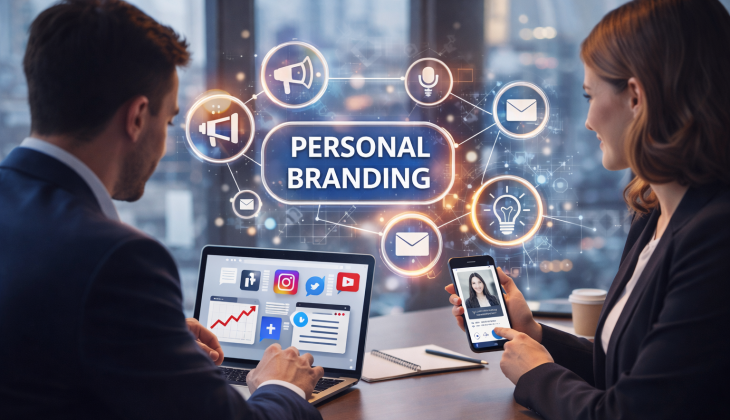
Personal Branding Through Content Marketing: The 2026 Guide for Business Professionals
How consistent, value-driven content positions you as a thought leader and attracts opportunities rather than chasing them
⚡ Key Takeaways
- Personal branding through content marketing increases your visibility by 78% among potential clients and employers compared to traditional networking alone
- Consistent, value-driven content positions you as a thought leader in your industry, helping you attract opportunities rather than chase them
- LinkedIn remains the most effective platform for business professionals, with 80% of B2B leads coming through social connections
- The most successful personal brands blend professional expertise with authentic personality, creating a memorable impression that distinguishes you from competitors
- OverIt’s branding specialists have found that business professionals who publish weekly content experience 3x more professional opportunities within six months
The line between personal and professional identity has never been more blurred. In today’s hyper-connected business landscape, you aren’t just representing your company—you are a brand unto yourself.
Why Personal Branding Makes or Breaks Business Professionals
Personal branding isn’t just nice to have—it’s now essential for career advancement. In a sea of qualified professionals, your expertise alone won’t differentiate you. What will set you apart is how effectively you package, present, and promote your professional value through deliberate personal branding.
Think about the last time you searched for someone online before a meeting or interview. What impression did their digital footprint leave? According to research, 70% of employers now screen candidates’ social profiles, and 57% have eliminated candidates based on what they found—or didn’t find.
The absence of a personal brand doesn’t mean neutrality; it means invisibility. When decision-makers can’t find evidence of your expertise or thought leadership, they fill that void with assumptions—rarely in your favor. Personal branding isn’t about self-promotion—it’s about controlling the narrative of your professional story.
The Content Marketing-Personal Brand Connection
Content marketing serves as the vehicle that delivers your personal brand to your target audience. Without content, your personal brand remains theoretical—a collection of values and expertise that never reaches those who could benefit from it. To enhance your strategy, consider learning about featured vs. self-promoted marketing strategies that can change everything.
How Content Marketing Amplifies Your Professional Voice
Creating and sharing valuable content amplifies your professional voice beyond your immediate network. When you publish insights on industry trends, lessons from your experiences, or solutions to common problems, you’re essentially broadcasting your expertise to a wider audience who may never have encountered you otherwise.
This amplification effect compounds over time. The professional who consistently shares valuable content becomes the go-to resource when opportunities arise. Instead of constantly pitching your services or expertise, your content does the heavy lifting—attracting opportunities to you rather than forcing you to chase them.
The Trust-Building Effect of Consistent Content
Trust doesn’t develop instantly in professional relationships. It builds gradually through repeated positive interactions. Content marketing creates these touch points at scale, allowing you to establish credibility with hundreds or thousands of potential connections simultaneously.
When someone encounters your thoughtful analysis on LinkedIn, reads your case study, or watches your instructional video, they’re getting a risk-free sample of your expertise. These interactions build familiarity and trust long before any formal business relationship begins. By the time a prospect reaches out, they’ve already developed confidence in your capabilities through your content. For insights on how to enhance your online presence, explore how to get Google recommendations and AI citations.
“The most effective personal brands aren’t built through self-promotion but through consistent demonstration of value. Your content should answer the question: ‘Why would someone want to work with me?’ before they even ask it.”
Why Authority Content Outperforms Traditional Marketing
Traditional marketing tells people you’re an expert. Authority content shows them. When you share genuinely helpful insights rather than promotional material, you shift from selling to serving—a distinction that modern audiences immediately recognize and appreciate.
Amplify Your Personal Brand with MultiCast
A MultiCast Campaign helps brands get noticed online (without paid ads) by creating hyper-focused content that is expertly optimized for each platform as it shows up in multiple formats across highly trusted websites—everywhere their ideal clients are already searching. The result is predictable growth and increased visibility they can count on.
Choose Your Platforms Strategically
Not all platforms deserve equal time investment when building your personal brand. Your choice should reflect where your target audience spends their time and which platforms align with your content strengths. Spreading yourself too thin across multiple platforms often yields poorer results than maintaining excellence on just one or two.
LinkedIn: The Non-Negotiable Business Platform
For business professionals, LinkedIn isn’t optional—it’s essential. With over 875 million users focused specifically on professional connections, LinkedIn offers unparalleled access to decision-makers across industries. The platform’s algorithm favors thoughtful, long-form content that demonstrates expertise, making it ideal for personal brand building.
The key to LinkedIn success lies in consistency and engagement. Publishing valuable content weekly keeps you visible in your network’s feed, while thoughtfully engaging with others’ content expands your reach. The professionals who see the greatest return from LinkedIn aren’t necessarily those with the largest following—they’re the ones who consistently provide value and engage authentically with their network.
Industry Publications That Boost Credibility
Contributing to respected industry publications instantly elevates your credibility beyond what self-published content can achieve. When an established publication accepts your content, they’re essentially endorsing your expertise to their audience. This third-party validation carries significant weight with potential clients and employers.
Start by identifying publications your target audience regularly consumes. Study their content requirements and submission guidelines carefully. Most importantly, pitch ideas that serve the publication’s readers rather than promoting your services. A helpful approach is to address common industry challenges with fresh perspectives or actionable solutions.
Podcast Appearances vs. Creating Your Own Show
Podcasts offer an intimate connection with your audience that written content cannot match. The choice between guest appearances and hosting your own show depends on your goals and resources. Guest appearances on established podcasts provide immediate access to built-in audiences without the production commitment, making them ideal for initial brand building. Learn how to get published in USA Today with a multicast to further enhance your brand’s reach.
Launching your own podcast requires significant investment in time and resources but offers complete control over your message and format. If you choose this route, differentiate your show by addressing specific audience pain points or bringing unique perspective to industry topics. Remember that consistency matters more than frequency—a monthly podcast maintained for years builds more credibility than a weekly show that fizzles out after a few months. For more insights, explore how AI digital marketing trends can enhance your podcast strategy.
When Email Newsletters Outperform Social Media
While social media offers broader reach, email newsletters provide direct access to your audience without algorithm interference. Subscribers have actively chosen to hear from you, making newsletters particularly effective for nurturing relationships with your most engaged followers. The intimacy of email allows for deeper dives into complex topics and more personal communication than most social platforms permit.
Successful newsletters prioritize value over frequency. Whether you choose weekly, biweekly, or monthly distribution, focus on delivering content your subscribers can’t easily find elsewhere. This might include industry analysis, behind-the-scenes insights, or early access to your latest thinking. Each newsletter should reinforce your unique perspective and expertise. For more insights, consider exploring 2026 AI digital marketing trends to stay ahead in your field.
Video Content: Worth the Investment?
Video content requires greater production effort but often generates stronger engagement and recall than text alone. The key question isn’t whether video works—it does—but whether it aligns with your personal presentation strengths and audience preferences. Some professionals connect naturally through video, while others communicate more effectively in writing.
If you choose to incorporate video, start with simple formats that emphasize your expertise rather than production quality. Short-form videos explaining complex concepts, answering common questions, or providing quick tips often perform best for business professionals. As your comfort and capabilities grow, you can experiment with more sophisticated formats.
Content Types That Build Your Professional Brand
Different content types serve different purposes in your personal branding strategy. The most effective approach combines several formats to showcase different aspects of your expertise while accommodating various audience preferences and consumption habits. Your goal should be creating a diverse but cohesive body of work that consistently reinforces your core value proposition.
1. Thought Leadership Articles
Thought leadership articles position you at the forefront of industry thinking by tackling emerging trends, challenging conventional wisdom, or providing fresh perspectives on persistent challenges. The most effective thought leadership doesn’t just identify problems—it proposes solutions or frameworks that demonstrate your unique approach. Discover how to get published in major outlets to enhance your thought leadership reach.
When writing thought leadership content, prioritize depth over breadth. A focused exploration of a single important concept typically provides more value than a surface-level overview of multiple topics. Remember that true thought leadership isn’t about having all the answers—it’s about asking better questions and advancing the conversation in meaningful ways. For insights on how to rank content effectively, check out this method to rank a site in 17 days.
2. Case Studies and Success Stories
Case studies transform abstract expertise into concrete results, showing rather than telling your professional value. By documenting specific challenges you’ve overcome and results you’ve achieved, you provide tangible evidence of your capabilities. The most compelling case studies follow a clear narrative structure: challenge, approach, solution, and measurable outcomes.
When creating case studies for personal branding, prioritize lessons over self-promotion. Explain not just what you accomplished but how you approached the problem and what others can learn from your experience. This positions you as both accomplished and generous—a powerful combination for personal brand building.
3. Expert Interviews and Collaborations
Collaborating with other respected professionals amplifies your reach while associating your personal brand with theirs. Interviews, panel discussions, and co-created content allow you to leverage established audiences and demonstrate your ability to contribute to high-level conversations. These collaborations often reach people who might never have discovered your individual content.
When pursuing collaborations, look for partners whose expertise complements rather than directly competes with yours. This creates value-adding conversations rather than redundant perspectives. Approach potential collaborators with clear proposals that emphasize mutual benefit—explaining not just why the collaboration would help you but how it would serve their audience and objectives. For more insights, explore the 2026 method to rank a site effectively.
4. Behind-the-Scenes Content
Behind-the-scenes content humanizes your expertise by showing the process behind the polished results. Sharing your workspace, workflow, or decision-making process creates authentic connection that purely instructional content cannot achieve. This transparency builds trust by demonstrating that your success is based on consistent method rather than mysterious talent. For more insights on building trust and transparency, explore how to get Google recommendations.
The most effective behind-the-scenes content balances professionalism with personality. You’re not sharing purely personal content but rather revealing the human elements of your professional life. This might include workflows that make you more effective, tools you rely on, or your approach to overcoming common challenges in your field.
5. Data-Driven Insights
Original research or thoughtful analysis of existing data demonstrates both your technical expertise and your commitment to evidence-based thinking. In a business landscape often driven by opinion and conventional wisdom, professionals who ground their perspectives in data stand out as particularly credible and thorough.
You don’t need a research department to create data-driven content. Analyzing patterns from your own client work, conducting simple surveys within your network, or synthesizing findings from multiple existing studies can produce valuable insights. The key is presenting the data clearly and explaining its practical implications for your audience.
Your Personal Brand Content Calendar
Consistency trumps frequency when building a personal brand through content. A sustainable content calendar aligns with your available time and resources while ensuring regular touchpoints with your audience. The most successful professional content creators maintain a consistent cadence that their audience can anticipate and rely upon.
Weekly vs. Monthly Content Planning
The ideal publishing frequency depends on your capacity and content type. Weekly publishing on a platform like LinkedIn maintains optimal visibility in algorithm-driven feeds, while monthly in-depth articles or newsletters allow for more substantive exploration of complex topics. What matters most isn’t hitting a specific frequency but maintaining whatever cadence you establish.
Many professionals find success with a hybrid approach: weekly short-form content on social platforms supplemented by monthly long-form pieces. This strategy maintains visibility while creating space for the deeper thinking that establishes true authority. Remember that quality must never be sacrificed for frequency—one excellent article per month creates more impact than four mediocre weekly posts.
The 70/20/10 Content Mix Rule
A balanced content mix prevents your personal brand from becoming one-dimensional while maintaining focus on your core expertise:
- 70% – Core expertise content (your primary professional focus)
- 20% – Adjacent topics that interest your audience
- 10% – Personal elements that humanize your brand
Authenticity Beats Perfection
The most resonant personal brands prioritize authenticity over polished perfection. In an era of filtered images and carefully curated feeds, genuine expression stands out. This doesn’t mean sharing everything or abandoning professionalism, but rather finding the right balance between competence and human connection.
When to Share Business Setbacks
Selectively sharing professional challenges and setbacks demonstrates confidence, self-awareness, and commitment to growth. The key word is “selective”—share struggles that you’ve processed and learned from rather than unresolved difficulties you’re currently navigating. The most effective setback stories follow a clear arc: challenge, learning moment, changed approach, and improved outcome. For more insights on how to effectively communicate your professional journey, you might consider exploring how to get published in major outlets.
When discussing failures, focus on the insights gained rather than dwelling on the disappointment. This transforms potentially negative content into constructive learning that benefits your audience while showcasing your resilience and growth mindset. Remember that vulnerability serves your personal brand when it reveals strength of character rather than ongoing struggles.
Balancing Personal Stories with Professional Content
Personal elements humanize your professional expertise without diluting its impact. The most effective approach shares personal stories that illustrate professional points rather than treating personal and professional content as entirely separate categories. This integration creates memorable content while maintaining clear relevance to your audience’s professional interests. For more insights on creating impactful content, explore the 2026 AI digital marketing trends.
Consider how personal experiences have shaped your professional perspective or approach. Perhaps family traditions influenced your leadership style, travel experiences sparked innovation in your work, or personal challenges developed resilience that serves you professionally. These connection points create authentic content that only you can offer.
The Vulnerability Sweet Spot
Effective vulnerability in professional contexts requires finding the right balance—enough openness to create genuine connection without oversharing in ways that undermine your credibility. This sweet spot differs across industries, platforms, and individual comfort levels, but the guiding principle remains consistent: share personal elements that enhance rather than detract from your professional narrative.
Consider whether a personal disclosure serves your audience and supports your professional positioning before sharing. The most effective vulnerable moments in personal branding reveal character strengths like resilience, adaptability, empathy, or commitment to growth—qualities that enhance rather than diminish your professional standing.
Measuring Your Personal Brand Growth
Personal brand building requires consistent effort over time, making meaningful measurement essential for maintaining motivation and refining your approach. Rather than focusing exclusively on visibility metrics, develop a balanced scorecard that tracks progress toward your specific professional goals.
Beyond Vanity Metrics: What Really Matters
Follower counts and engagement rates provide useful feedback but often fail to capture meaningful professional impact. More telling indicators include audience quality (are you attracting decision-makers in your target market?), content resonance (do people engage meaningfully with your ideas?), and professional opportunities (are you receiving relevant invitations and inquiries?).
Track these deeper metrics by monitoring not just quantitative engagement but qualitative feedback. Pay attention to who responds to your content, what specific points resonate most strongly, and which pieces generate direct professional opportunities. This qualitative analysis often reveals insights that pure numbers miss.
| Metric Category | Vanity Metrics | Impact Metrics |
|---|---|---|
| Audience | Total follower count | Decision-maker percentage |
| Engagement | Like/comment totals | Meaningful discussions |
| Content | Views and impressions | Content that generates inquiries |
| Growth | Follower growth rate | Opportunity conversion rate |
The ultimate measure of personal brand effectiveness is its impact on your professional goals. Whether you’re seeking new clients, career advancement, speaking opportunities, or industry recognition, establish clear connections between these objectives and your content strategy. This alignment ensures your personal branding efforts drive meaningful professional progress rather than simply generating online activity.
Connection Quality Over Follower Quantity
A smaller network of engaged, relevant connections typically generates more professional value than a larger audience of passive followers. Rather than pursuing growth for its own sake, focus on attracting and engaging the specific professionals who can advance your goals—whether potential clients, employers, collaborators, or industry influencers.
Tracking Business Opportunities from Content
Establishing clear attribution between content and opportunities helps justify continued investment in personal branding. When new opportunities arise, make it a habit to ask how the person discovered you and what specific content influenced their decision to reach out. This direct feedback provides invaluable insights into which elements of your personal brand are driving real results.
Some professionals create dedicated tracking codes or landing pages for different content pieces to measure their direct impact. Others simply maintain a spreadsheet noting which content pieces preceded which opportunities. Either approach helps identify your highest-performing content and refine your strategy accordingly.
Remember that attribution isn’t always straightforward in personal branding. Someone might discover you through one piece of content, follow your work for months without direct interaction, and eventually reach out based on cumulative impression rather than any single piece. This “slow burn” effect makes consistent content production valuable even when immediate results aren’t apparent. For more insights, explore the 2026 method to rank a site effectively.
- Track which content pieces generate the most meaningful engagement
- Identify patterns in the topics or formats that resonate most with your target audience
- Monitor direct inquiries that mention specific content you’ve created
- Note which platforms deliver the highest quality connections
- Analyze the conversion path from initial content engagement to professional opportunity
The 30-Day Personal Brand Launch Plan
Launching or revitalizing your personal brand benefits from a structured approach that builds momentum while remaining sustainable. This 30-day plan focuses on establishing fundamentals, creating initial content, and developing habits that support long-term success. The goal isn’t perfection but rather establishing a solid foundation for continued growth.
Begin with a clear audit of your current digital presence, identifying gaps and opportunities for improvement. Then establish your core messaging—the key expertise, perspectives, and values you want to be known for. Create a simple content calendar for your first month, focusing on quality over quantity, and commit to consistent engagement with others in your field. By day 30, you should have established not just initial content but sustainable habits that will support your personal brand for years to come.
Frequently Asked Questions
As you develop your personal brand through content marketing, you’ll likely encounter common questions and challenges. Here are practical answers to the most frequently asked questions from business professionals building their personal brands.
How much time should I dedicate to personal branding each week?
Most successful professionals allocate 3-5 hours weekly to personal branding activities, including content creation, engagement, and measurement. This might mean one hour daily or a dedicated block on specific days. The key is consistency rather than sporadic bursts of activity followed by silence.
If time constraints are significant, focus first on high-leverage activities like creating one quality piece of content weekly and engaging thoughtfully with others’ content for 15 minutes daily. Even this minimal investment, maintained consistently, yields better results than occasional intensive efforts followed by disappearance. For more insights, check out this guide on how to rank a site in 17 days.
Can I outsource my personal brand content creation?
Certain aspects of personal branding can be effectively outsourced, including content editing, design elements, publishing logistics, and performance analytics. However, the core thinking and expertise must remain authentically yours. The most effective approach typically combines your subject matter expertise with professional support for execution and enhancement.
If you choose to work with writers or content specialists, provide detailed briefs including specific experiences, perspectives, and insights only you could offer. Review content carefully to ensure it captures your authentic voice and perspective. Remember that outsourcing should amplify your thinking rather than replacing it entirely.
Should I focus on one platform or be everywhere?
Quality presence on 1-2 platforms where your target audience spends time typically outperforms thin presence across many platforms. Start where your audience is most concentrated and where you feel most comfortable creating content. Once you’ve established consistent excellence there, consider expanding to additional platforms if time and resources permit.
How do I measure the ROI of my personal branding efforts?
Track both leading indicators (engagement, audience growth, content performance) and lagging indicators (inquiries, opportunities, business results) to gain a complete picture. The most important metric is whether your personal brand is advancing your specific professional goals—whether that’s client acquisition, career advancement, speaking opportunities, or industry influence.
What’s the difference between personal branding and company branding?
Personal branding focuses on you as an individual professional, while company branding centers on the organization’s collective identity and offerings. The most effective approach often integrates these, with personal brands supporting and amplifying company positioning through individual expertise and relationship-building.
For business leaders, personal branding often emphasizes the human elements behind company success—sharing your leadership philosophy, decision-making approach, and vision for the future. This humanizes the organization while establishing you as a credible leader in your field.
Ready to Build Your Personal Brand?
The most successful professionals in 2026 aren’t just experts in their field—they’re visible thought leaders who attract opportunities through strategic content marketing.
Start building your personal brand today with consistent, value-driven content that positions you as the go-to expert in your industry.
© 2026 Media Strobe Press · All Rights Reserved