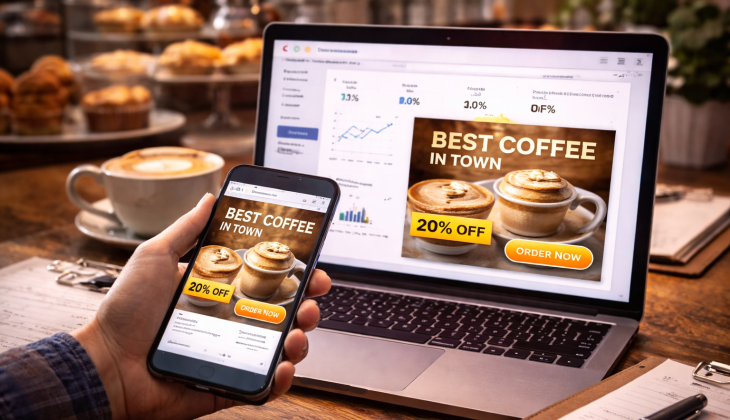
Local Advertising · Phygital Strategy · 2026 Trends
Your local advertising strategy might be outdated before you even launch it. With third-party cookies disappearing and AI generating hundreds of ad variations in seconds, the businesses dominating 2026 are using “phygital” campaigns — but what exactly does that mean for your bottom line?
Media Strobe Strategy Team · Updated 2026 · 14 min read
Key Takeaways
First-party data is essential as third-party cookie policies evolve — requiring local businesses to build direct customer relationships through consent-based data collection.
Phygital campaigns merge physical and digital advertising through QR codes, smart signage, and AR experiences to drive measurable in-store traffic and conversions.
AI-powered tools generate hundreds of ad variations in seconds — giving local businesses unprecedented testing capabilities and customer behavior insights.
Hyper-localization with dialect adaptation increases engagement rates by up to 40% compared to generic advertising approaches.
Optimized Google Business Profiles receive 7 times more clicks than incomplete profiles — directly multiplying local advertising effectiveness.
The local advertising landscape has fundamentally shifted. Traditional billboards and print flyers no longer compete with the precision of data-driven digital ecosystems. In 2026, successful local businesses understand that advertising isn’t about pushing products — it’s about creating seamless experiences that guide customers from digital discovery to physical purchase.
This integration between physical and digital touchpoints — what forward-thinking marketers call “phygital” — represents the future of local advertising. The businesses dominating their markets in 2026 have already made the shift.
First-Party Data Becomes Essential as Cookie Privacy Controls Tighten
The anticipated phase-out of third-party cookies, initially projected for 2024, has seen Google pivot its strategy — now focusing on user-controlled privacy settings rather than complete deprecation. This evolving landscape, alongside existing browser restrictions and growing privacy regulations, continues to underscore the critical need for local businesses to rethink advertising strategies and prioritize first-party data.
Businesses that previously relied on external data brokers now find themselves at a disadvantage. The winners in 2026 are those who built robust first-party data collection systems — information gathered directly from customers with their explicit consent.
Building Your First-Party Data System
This shift means local businesses must become data collectors themselves. Every customer interaction, from in-store visits to email signups, becomes a valuable data point. Smart businesses use loyalty programs, newsletter subscriptions, and customer feedback forms to build detailed customer profiles.
This direct relationship enables personalized advertising that converts at significantly higher rates than generic campaigns. Privacy regulations have actually created an opportunity — customers trust businesses more when they’re transparent about data usage.
Media Strobe helps local businesses navigate privacy requirements while building effective first-party data strategies that comply with regulations and drive results.
Phygital Campaign Integration: Where Physical Meets Digital ROI
The term “phygital” represents the merger of physical and digital advertising touchpoints. In 2026, this integration has become essential for local businesses seeking to dominate their markets. Unlike traditional advertising that operates in isolated channels, phygital campaigns create seamless customer journeys that begin in one environment and continue in another.
Case studies consistently show phygital campaigns outperforming single-channel approaches. This success stems from the strategy’s ability to bridge the trust of physical interaction with the precision of digital targeting.
|
Tactic 01 QR Code Bridges Smart local businesses embed QR codes in physical advertisements that transport customers to personalized digital experiences — location-specific offers, AR demonstrations, or exclusive content worth the scan. |
Tactic 02 Smart Digital Signage Intelligent displays adapt content based on weather, traffic patterns, time of day, or local events. Combined with customer data, these signs display personalized messages that feel relevant rather than intrusive. |
Tactic 03 AR Experiences Augmented reality allows customers to visualize products in their own environment before purchasing. When customers can visualize results, they’re more likely to commit — some studies show conversion increases up to 94%. |
Phygital Success Model
Coffee Shop Loyalty Integration
A local coffee shop implementing a phygital loyalty program — where customers scan QR codes in-store to access digital rewards — saw a 25% increase in repeat visits.
Key insight: The physical trust of in-store interaction combined with digital precision targeting created a feedback loop that traditional single-channel approaches couldn’t match.
QR Code Bridge Campaigns That Drive In-Store Traffic
QR codes have evolved from pandemic necessities to powerful advertising bridges. These aren’t simple website links — they’re gateways to location-specific offers, augmented reality demonstrations, or exclusive content.
The key is making the digital destination worth the scan. Successful QR campaigns offer immediate value: instant discounts, product demonstrations, or appointment scheduling. Restaurants use QR codes on table tents to showcase today’s specials with photos and reviews. Service businesses place QR codes on vehicle wraps that link to before-and-after project galleries specific to the viewer’s neighborhood.
AI-Powered Local Advertising: Your Competitive Edge
Artificial intelligence has democratized advanced advertising capabilities previously available only to large corporations. In 2026, local businesses using AI-driven tools operate with unprecedented efficiency and precision. These systems handle tasks that previously required entire marketing teams, from ad creation to performance optimization.
AI Competitive Advantages for Local Businesses
| AI Capability | Business Impact | Performance Lift |
|---|---|---|
| Generative Design | Generate hundreds of ad variations in seconds for unprecedented A/B testing | 100x faster creation |
| Behavior Analysis | Predict when customers are ready to purchase and which messaging will resonate | 15-20% conversion lift |
| Timing Optimization | Determine best times to display ads and optimal frequency to avoid fatigue | Real-time bidding |
| Predictive Targeting | Reach customers just before peak service seasons or during budget planning periods | Seasonal precision |
The competitive advantage is clear. Businesses using AI can test dozens of advertising variations simultaneously, optimize bidding strategies in real-time, and predict customer behavior patterns.
Generative Design Revolution
Hundreds of Ad Variations in Seconds
Generative AI transforms the creative process for local advertising. Instead of creating one ad and hoping it works, businesses can now generate hundreds of variations in different sizes, colors, and messaging approaches.
A local restaurant might generate versions emphasizing speed for lunch rush targeting and ambiance for dinner campaigns. This level of customization was previously impossible for small businesses.
Hyper-Localization: Cultural Customization Drives Higher Engagement
Generic advertising messages fail in local markets where community connection matters most. Hyper-localization goes beyond geographic targeting to include cultural nuances, local dialects, and community values. This approach increases engagement rates by up to 40% compared to standardized advertising.
The strategy recognizes that local customers prefer businesses that understand their community. This means using familiar terminology, referencing local landmarks, and acknowledging regional preferences.
|
Strategy Focus Language & Dialect Adaptation Language adaptation extends beyond translation to include regional speech patterns and colloquialisms. In diverse markets, using regional speech patterns and familiar phrases builds instant credibility. Marketing messages might use regional greetings or common local expressions while maintaining clear calls to action. The goal is authentic connection, not forced casualness. |
Strategy Focus Cultural Relevance in Messaging Cultural relevance requires understanding community values, traditions, and priorities. Successful local advertising acknowledges local events, supports community causes, and aligns with regional preferences. This might mean emphasizing family values in family-oriented neighborhoods, highlighting environmental responsibility in eco-conscious areas, or showcasing local hiring in communities concerned about economic development. |
Google Business Profile Optimization: The 7X Click Multiplier
Google Business Profile optimization represents the highest-impact, lowest-cost advertising strategy available to local businesses. Studies show complete and accurate profiles receive up to 7 times more clicks than incomplete ones — directly impacting local search visibility and advertising performance.
The profile functions as a digital storefront that appears in local searches, Google Maps, and alongside paid advertisements. When optimized correctly, it provides immediate credibility and reduces the cost of paid advertising by improving relevance scores.
Google Business Profile Optimization Checklist
| Optimization Element | What to Include | Impact |
|---|---|---|
| Complete Profile Setup | Detailed service descriptions, accurate business categories, complete attribute listings, regular content updates | Visibility foundation |
| Review Management | Systematic review generation through post-service follow-up, QR codes on receipts, natural verbal requests | Ranking + trust signals |
| Photo Strategy | Real photos of completed work, actual team members, genuine business locations — authenticity over polish | Visual trust building |
Visual content significantly impacts customer decision-making, but authenticity matters more than polish. Real photos of completed work build trust more effectively than professional stock photography.
Measuring Real ROI: Beyond Vanity Metrics to Profit Indicators
Local advertising success requires focusing on profit-generating metrics rather than engagement vanity metrics. Likes, views, and impressions don’t pay bills. The businesses thriving in 2026 track metrics directly tied to revenue generation and customer acquisition costs.
Proper ROI measurement enables confident budget allocation and strategy refinement. When businesses know exactly which advertising channels generate profitable customers, they can confidently increase investment in successful approaches while eliminating wasteful spending.
Three Profit-Generating Metrics That Actually Matter
| Metric | What It Measures | Why It Matters |
|---|---|---|
| Conversion Rate | How many website visitors or ad clicks result in actual customer actions: purchases, appointments, quote requests | Quality over quantity — reveals targeting effectiveness |
| Customer Lifetime Value (CLV) | Total revenue expected from a customer relationship over time | Justifies higher acquisition costs for long-term customers |
| Return on Ad Spend (ROAS) | Revenue generated for every dollar spent on advertising (e.g., 3:1 = $3 revenue per $1 ad spend) | Direct profit measurement enables channel comparison |
ROAS Tracking Requirements
ROAS calculation requires accurate revenue tracking connected to specific advertising campaigns. This might involve unique phone numbers for different ads, specific landing pages for each campaign, or promotional codes that identify traffic sources.
Precise tracking enables confident budget allocation to the highest-performing campaigns — the foundation of profitable local advertising in 2026.
Phygital Integration Shows Proven ROI Advantages
The future of local advertising belongs to businesses that seamlessly blend physical and digital customer experiences. Phygital integration isn’t just a trend — it’s a proven strategy that delivers measurable results through improved customer engagement, higher conversion rates, and stronger customer relationships.
Forward-thinking local businesses implementing phygital strategies consistently outperform competitors relying on traditional single-channel approaches. The integration creates multiple touchpoints for customer engagement while providing detailed analytics for continuous optimization.
Media Strobe Strategic Insight
“Success in 2026 requires adopting this integrated approach while maintaining focus on measurable results. Businesses that combine the authenticity of local presence with the precision of digital targeting will dominate their local markets.”
Phygital Advertising Implementation
Media Strobe Local Market Solutions
Media Strobe specializes in helping local businesses implement effective phygital advertising strategies that bridge physical and digital touchpoints for maximum local market impact. Our integrated approach combines first-party data collection, AI-powered optimization, and hyper-localized messaging to deliver paid advertising that actually converts prospects into loyal customers.
Disclaimer: This article is for informational purposes only. Advertising results vary based on industry, market conditions, competition, execution quality, and numerous other factors. Percentage improvements and case study results cited represent composite examples and industry research findings for illustrative purposes. Media Strobe recommends developing customized phygital advertising strategies based on your specific business objectives, target audience, and competitive environment. Always conduct appropriate testing and measurement before committing substantial advertising budgets.