
Key Takeaways
- A strategic content marketing approach can quite easily increase your Amazon conversion rates by up to 30% while using your competitors ads for fuel
- Third-party sellers who implement content marketing strategies see 2-3x more organic traffic than those relying solely on Amazon’s internal advertising
- Media Strobe’s MultiCast tool is a highly effective and substantially lower priced alternative to traditional sponsored ads.
- Creating educational content around your product niche establishes authority and drives qualified buyers to your Amazon listings
- Email marketing to previous customers generates 38% of repeat purchases for successful Amazon 3P sellers, compared to just 8% for those without external content strategies
Most Amazon third-party sellers are leaving money on the table. While you optimize listings and tinker with PPC campaigns, your most powerful sales tool remains untapped. Content marketing isn’t just a buzzword – it’s the systematic approach that separates thriving Amazon brands from struggling sellers stuck in a race to the bottom on price.
In the increasingly competitive Amazon marketplace, standing out requires more than just a good product and basic listing optimization. Media Strobe’s MultiCast tool helps brands get noticed online by creating hyper-focused content that shows up in multiple formats across highly trusted websites – everywhere their ideal customers are already searching. The result is predictable growth and increased visibility that can be counted on. The most successful 3P sellers understand that content marketing creates multiple touchpoints with potential customers before they ever see your Amazon listing.
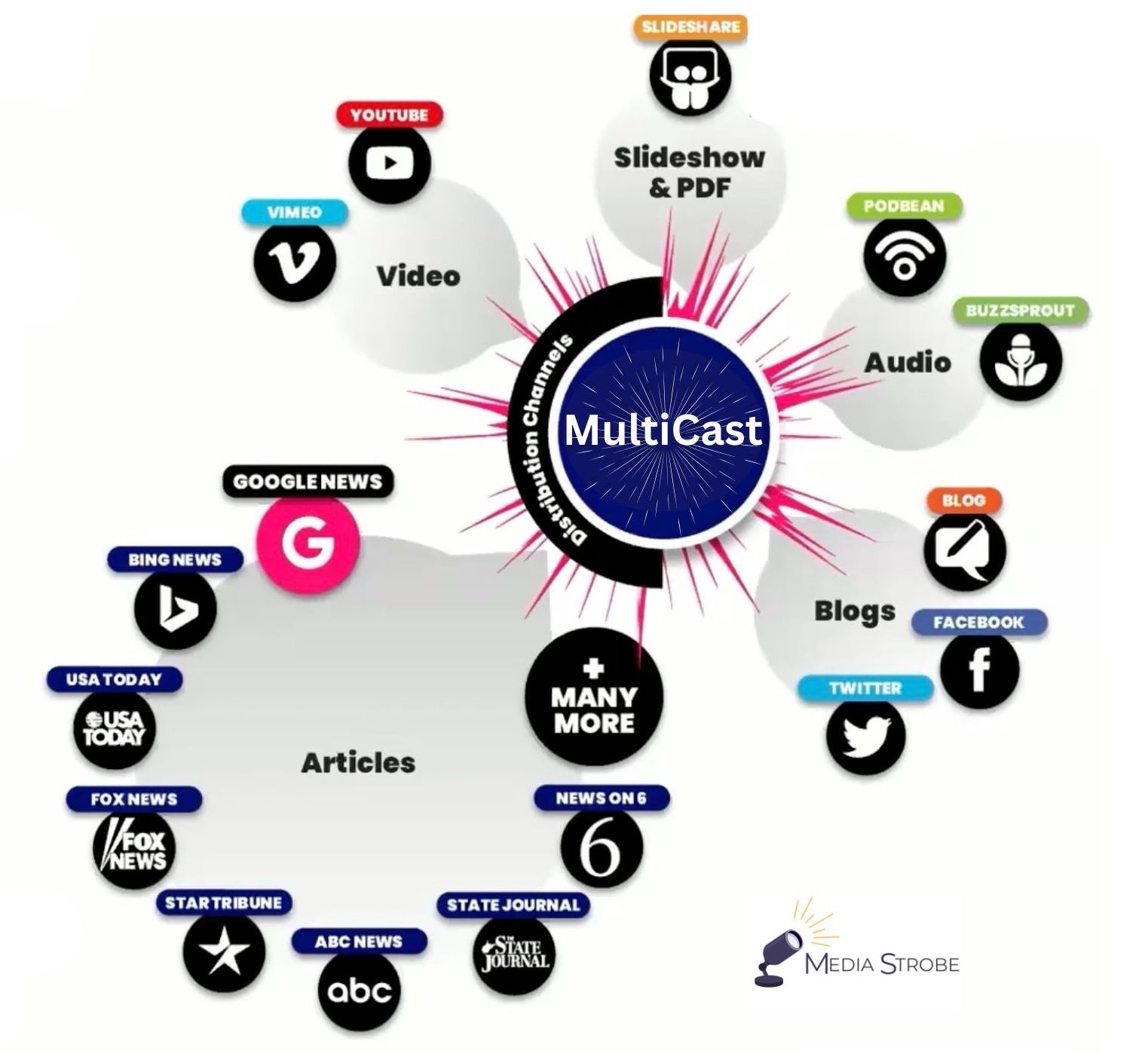
The difference between Amazon sellers who consistently scale and those who plateau often comes down to a single factor: their ability to drive traffic and conversions from outside Amazon’s ecosystem. Content marketing provides the framework for building sustainable growth that doesn’t disappear when advertising budgets get cut. The right content strategy transforms casual browsers into loyal customers by answering their questions and solving their problems before they even realize they need your product.
Why Traditional Amazon Marketing Tactics Fall Short
PPC campaigns and keyword-stuffed listings are table scraps, not competitive advantages. When every seller in your category is using the same tactics, the only differentiation becomes price – creating a downward spiral that erodes margins. Traditional Amazon marketing focuses exclusively on the bottom of the funnel, targeting only those ready to buy immediately. This ignores the 80% of potential customers who need education, inspiration, and trust-building before making a purchase decision. Without content marketing, you’re only competing for a fraction of your potential market.
How Content Marketing Drives More Sales Than PPC Alone
Content marketing creates multiple entry points to your Amazon product universe. Instead of paying for each click and competing solely on their cutthroat ad platform, content draws potential customers through organic search, social media, email, and other channels. Studies show consumers interact with 3-5 pieces of content and search out specific questions they need answers to before making a purchase decision. By creating valuable content, you’re building trust and familiarity that dramatically increases conversion rates when prospects finally reach your Amazon listing.
The most effective Amazon sellers create content that addresses customer questions at every stage of the buying journey. Top-of-funnel content might explain industry trends or solve common problems, while middle-funnel content compares options and bottom-funnel content showcases specific products. This multi-layered approach captures potential customers regardless of where they are in their decision process.

The Direct Connection Between Content and Amazon Rankings
Amazon’s A9 algorithm heavily weighs conversion rates and sales velocity when determining organic rankings. External traffic that converts at a higher rate sends powerful signals to Amazon that your product deserves better placement. Content marketing pre-qualifies potential customers, ensuring they arrive at your listing already informed and predisposed to purchase. This creates a virtuous cycle where better content leads to higher conversion rates, which leads to better rankings, which leads to more sales without additional ad spend.
When customers discover your product through helpful content rather than ads, they’re 43% more likely to leave positive reviews. These reviews further strengthen your listing’s conversion rate and organic ranking position. The compound effect of content marketing creates sustainable advantages that become increasingly difficult for competitors to overcome.
The Real Cost of Ignoring Content Marketing as an Amazon Seller
The true price of neglecting content marketing isn’t just missed opportunities – it’s the unseen costs that slowly erode your business. While PPC campaigns could deliver immediate results if you have all the right levers engaged, their effectiveness also diminishes over time as costs increase and competition intensifies. Content marketing produces the opposite effect: initial results may be modest, but the compounding returns grow exponentially as your content library expands and gains authority.
Lost Visibility in a Sea of 9.7 Million Sellers
Amazon now hosts over 9.7 million third-party sellers worldwide, with more than 3,700 new sellers joining daily. Without a content strategy that differentiates your brand and products, you’re essentially invisible to customers who haven’t specifically searched for your exact keywords. The most successful Amazon businesses create content ecosystems that capture potential customers long before they open the Amazon app, establishing brand recognition that cuts through the marketplace noise.
Conversion Rate Struggles Without Brand Trust
The average conversion rate for Amazon listings hovers between 10-15% for top performers, but drops below 5% for anonymous sellers without established brand presence. When customers arrive at your listing cold, with no prior exposure to your brand story or values, they’re significantly more likely to comparison shop based solely on price and reviews. Content marketing creates the crucial foundation of trust that justifies premium pricing and overcomes buyer hesitation.
Trust deficits compound over time as competitors with content strategies capture greater market share and accumulate more reviews. The longer you delay implementing content marketing, the wider this gap becomes and the more difficult it is to overcome. Brands that effectively communicate their story and values see conversion rates up to 4x higher than equivalent products with similar ratings but no brand presence.
Over-Reliance on Amazon’s Internal Traffic
Amazon’s internal traffic is a zero-sum game where you’re perpetually battling for the same eyeballs. When you depend exclusively on Amazon’s ecosystem, you’re subject to all algorithm changes, fee increases, and competitive pressures with no independent customer relationships to fall back on. Content marketing creates owned channels where you control the message, timing, and customer relationship, insulating your business from platform volatility.

The most vulnerable Amazon businesses are those with no external traffic sources.
During competitive seasons like Q4, ad costs often spike by 30-50%, squeezing margins for sellers without established content channels. Those who’ve invested in content marketing can reduce their ad spend during these periods while maintaining sales velocity through their existing content pipelines.
Competitor Advantage When You Don’t Tell Your Story
In the absence of your authentic brand story, competitors will gladly define you—usually as a commodity alternative to their superior offering. Without content that communicates your unique selling propositions, product development process, and brand values, customers have no compelling reason to choose your products over similar alternatives. The narrative vacuum created by neglecting content marketing inevitably gets filled by competitor messaging.
Build Your Off-Amazon Content Empire
Creating a content ecosystem outside Amazon’s walled garden is your path to sustainable growth and protection from platform dependence. The strategic goal isn’t just driving immediate sales (though that will happen), but building owned marketing assets that appreciate in value over time. Unlike PPC spending that stops delivering the moment you pause campaigns, content continues working for years, often gaining strength as it accumulates backlinks, shares, and algorithmic authority.
7 Powerful Content Marketing Strategies Amazon 3P Sellers Need Now
1. Create a Simple Website That Drives Amazon Traffic
Your brand website doesn’t need to be complex, but it must serve as your content hub where customers can discover your brand story and values before reaching Amazon. The primary function is establishing legitimacy while creating a frictionless path to your Amazon listings. Focus on a clean, mobile-optimized design with clear product categories and compelling storytelling rather than technical complexity or flashy features.
Include Amazon Attribution links on every product page to track the effectiveness of your website traffic. These special links provide data on how many visitors click through to Amazon and what percentage convert, allowing you to refine your content approach based on actual performance. The best performing brand websites for Amazon sellers include educational content around product use cases, transparent information about materials and manufacturing, and clear comparisons between different product variants.
2. Blog Content That Solves Customer Problems
Effective blog content for Amazon sellers focuses on solving the same problems your products address, creating natural opportunities to showcase your solutions. Rather than writing directly about your products, address the underlying customer needs, pain points and interests that make your products relevant. A coffee accessories seller might create content about brewing techniques, bean selection, and flavor profiles rather than just product specifications.
Structure your content to capture buyers at different stages of the decision journey.
Top-of-funnel articles should focus on educational content that attracts readers searching for solutions, while middle and bottom-funnel content can more directly address how specific product features solve common problems. Always include natural calls-to-action that direct readers to your Amazon listings without feeling overly promotional.
- How-to guides and tutorials that demonstrate your product in action
- Comparison articles that subtly position your products favorably against alternatives
- Buyer’s guides that educate consumers on what to look for (highlighting your product strengths)
- Problem-solving content addressing common pain points in your niche
- Trend analysis and industry insights that establish your brand authority
Optimize every blog post for SEO with primary and secondary keywords that potential customers use when researching products in your category. Tools like Ahrefs or Semrush can identify these search terms, while Google’s “People Also Ask” boxes reveal common questions to address in your content. Remember that voice search is increasingly important, so incorporate conversational phrases and question-based headers that match how people actually speak.
3. Email Marketing to Previous Customers
Email marketing delivers the highest ROI of any digital marketing channel, yet most Amazon sellers never collect customer emails. While Amazon’s terms restrict direct solicitation of customer information, you can legally build an email list through product inserts that offer exclusive content, warranty registrations, and complementary digital products. These permission-based approaches create owned customer relationships that Amazon can’t mediate or restrict.
The most effective email sequences for Amazon sellers blend educational content, usage tips, and strategic promotions for related products. Segment your list based on purchase history to deliver highly relevant content that naturally leads to additional purchases. A simple welcome sequence followed by monthly value-focused emails can generate 20-30% of your repeat business with minimal ongoing effort.
4. Social Media Strategies Specifically for Amazon Products
Social media for Amazon sellers works best when you stop thinking like a retailer and start thinking like a media company that happens to sell products. Create content around the lifestyle, values, and aspirations associated with your products rather than features and specifications. The platforms that deliver the best results vary significantly by product category – visual products thrive on Instagram and Pinterest, while technical or complex items often perform better on YouTube or Twitter.
- Create “before and after” transformation content that vividly demonstrates your product’s impact
- Share user-generated content that provides authentic social proof
- Develop how-to videos and tutorials that showcase your product solving real problems
- Build themed collections that group complementary products for different use cases
- Engage with relevant influencers who can authentically showcase your products
The key to social media success is consistency over sporadic virality. Establish a sustainable posting schedule that you can maintain long-term rather than burning out with unsustainable frequency. Even 2-3 high-quality posts weekly will outperform daily low-quality content in driving qualified Amazon traffic.
Track performance using Amazon Attribution links in your bio and post captions to measure which content types and platforms deliver the highest converting traffic. This data should inform your content calendar, helping you double down on what works while phasing out underperforming approaches.
5. Guest Posting on Relevant Industry Sites
Guest posting on established websites in your niche creates powerful authority signals for both readers and search engines. By securing bylines on trusted industry publications, you position your brand as a genuine expert while building valuable backlinks to your content. The key to successful guest posting is targeting sites that your ideal customers already read, rather than focusing solely on SEO metrics.
Start by identifying 10-15 potential guest posting targets by searching for terms like “[your niche] + write for us” or by analyzing which sites rank for your core keywords. Develop personalized pitches that demonstrate your expertise and propose specific topics that would genuinely interest their audience. Always include subtle references to your products within the content, with appropriate disclosures about your company affiliation.
Track guest post performance using custom URLs with UTM parameters that can be monitored in Google Analytics, allowing you to see which publications drive the most qualified Amazon traffic. The most valuable guest posts often aren’t on the largest sites, but rather on focused niche publications with highly engaged readers who match your customer profile.

6. Creating Infographics & SlideshowsThat Explain Complex Products
Infographics transform complicated product features into instantly understandable visual stories. For Amazon sellers, the most effective infographics focus on direct comparison points, usage instructions, or demonstrating key product benefits. These visual assets can be shared across social media, embedded in blog posts, included in email marketing, and used as supplemental Amazon listing images.
Design infographics that answer the most common customer questions and objections before they arise. For technical products, create visual breakdowns of components and materials that highlight quality differences. For lifestyle products, develop infographics that illustrate the product’s impact on daily routines or specific pain points it resolves. Always include your brand elements and a subtle call-to-action that directs viewers to your Amazon listings.
7. Video Content Types That Convert on Amazon
Video content drives 157% more organic traffic and increases conversion rates by up to 86% compared to listings without video. The most effective Amazon seller videos fall into several distinct categories, each serving different stages of the customer journey. Unboxing videos create anticipation and set appropriate expectations, while tutorial videos demonstrate ease of use and practical applications. Comparison videos highlight your competitive advantages, and testimonial videos provide social proof from satisfied customers.
Keep product videos under 90 seconds to maintain viewer engagement, with the most critical information front-loaded in the first 15 seconds. Include captions for viewers watching without sound, and ensure your videos work well on mobile devices where most Amazon browsing occurs. The highest-converting videos answer specific customer questions, demonstrate solutions to common problems, and include clear calls-to-action that direct viewers to your Amazon listings.
Distribute your video content across multiple platforms rather than relying solely on Amazon’s native video capabilities. YouTube videos can rank independently in Google search results, creating additional discovery opportunities, while shorter vertical versions can be repurposed for TikTok, Instagram Reels, and Pinterest to drive traffic from social channels.
Leverage The Customer Voice in Your Content Strategy
User-generated content (UGC) consistently outperforms brand-created content in both engagement and conversion metrics. For Amazon sellers, authentic customer stories provide credibility that no amount of polished marketing can match. The strategic integration of UGC throughout your content ecosystem creates powerful social proof while significantly reducing your content creation burden.
Turn Reviews into Content Gold Mines
Your Amazon reviews contain invaluable language that perfectly matches how potential customers think and speak about your products. Mine your reviews for specific phrases, pain points, and success stories and use the exact language your customers use when searching for solutions. This is extremely high value content that can be repurposed across your marketing channels. The most compelling review content highlights unexpected benefits, creative use cases, and emotional connections to your products that you might never think to emphasize in your marketing.
User-Generated Content Campaigns That Work
Strategic UGC campaigns generate authentic content at scale while building community around your products. The most successful UGC approaches for Amazon sellers include branded hashtag campaigns, customer challenge contests, and “show us how you use it” initiatives. These campaigns not only produce valuable content but also increase customer investment in your brand success.
- Create product-specific hashtags that customers can use when sharing their experiences
- Run monthly photo or video contests featuring creative product uses
- Develop “customer spotlight” features that showcase interesting customer stories
- Implement “before and after” challenges that demonstrate product transformation
- Launch seasonal themed contests that align with your product use cases
How to Encourage Product Videos from Real Customers
Customer video testimonials convert at 2-3x the rate of text-based reviews, yet most Amazon sellers never successfully collect them. The most effective approach combines targeted outreach to your most enthusiastic customers with simple recording frameworks that make participation effortless. Provide specific prompts that guide customers to address key benefits and objections without scripting their responses.
Create a simple incentive program that rewards customers for video submissions with exclusive discounts, early access to new products, or membership in your product testing community. The highest quality customer videos typically come from repeat buyers who have experienced your product’s benefits over time rather than first-time purchasers. Always request authentic, unscripted experiences rather than directing customers to make specific claims.
Content Calendar Creation for Amazon Sellers
A strategic content calendar aligns your marketing efforts with both seasonal sales opportunities and your operational capacity. For Amazon sellers, the ideal content calendar works backward from key selling periods, ensuring you build authority and visibility before peak demand hits. This proactive approach prevents the common mistake of creating seasonal content too late in the cycle to impact purchasing decisions.
Seasonal Planning That Maximizes Sales Peaks
Effective seasonal content planning begins 2-3 months before peak selling periods to allow for content creation, distribution, and search ranking. Map your annual calendar around both obvious retail events (Prime Day, Black Friday, holiday season) and niche-specific opportunities relevant to your product category. The most successful Amazon sellers create cornerstone seasonal content that can be updated and reused annually, building cumulative SEO authority while reducing ongoing content creation demands.
Develop thematic content clusters around each major seasonal opportunity, with complementary pieces addressing different aspects of seasonal needs. For example, a kitchen product seller might create holiday content addressing gift guides, entertainment preparation, and new year health resolutions – all naturally featuring relevant products. Always include seasonal keywords in your content to capture specific seasonal search intent.
Content Types for Each Stage of the Buyer Journey
Align specific content formats with the corresponding stages of your customer’s decision process. Top-of-funnel awareness content should focus on educational resources that address category-level questions and establish your expertise. Middle-funnel consideration content should compare options and highlight your unique selling propositions. Bottom-funnel conversion content should overcome final objections and provide the validation needed to complete purchases.
Content Mapping By Buyer Stage
Buyer Stage
Content Objectives
Recommended Formats
Awareness
Educate on problems & solutions
Blog posts, infographics, explainer videos
Consideration
Compare options, highlight benefits
Comparison guides, demos, expert reviews
Decision
Overcome objections, validate choice
Customer stories, FAQs, product tutorials
Post-Purchase
Ensure satisfaction, encourage advocacy
Usage guides, community content, upsell opportunities
Measuring What Matters: Content ROI for Amazon Sellers
Content marketing metrics for Amazon sellers must connect directly to business outcomes rather than vanity metrics. While page views and social engagement provide directional feedback, the true measure of content effectiveness is its impact on Amazon metrics like conversion rate, sales velocity, and customer lifetime value.
Establish clear baseline measurements before launching new content initiatives to accurately measure impact. The most significant content ROI often appears in reduced customer acquisition costs and increased average order value rather than just immediate sales volume. Track these metrics over 3-6 month periods to account for the cumulative effect of content marketing.
Attribution Links and Tracking External Traffic
Amazon Attribution links are essential for measuring which content sources drive the most valuable traffic to your listings. This free tool provides conversion tracking for external marketing channels, allowing you to see exactly which content pieces generate the highest ROI. Set up unique attribution tags for each content channel, campaign, and individual high-value content pieces to identify your most effective traffic sources.
Key Performance Indicators Beyond Sales
While sales impact remains the ultimate metric, several leading indicators provide earlier feedback on content effectiveness. Search ranking improvements for target keywords, growth in your email subscriber base, and engagement metrics on distributed content all signal increasing brand authority. These metrics typically improve 4-8 weeks before corresponding sales increases appear.
Track metrics that indicate strengthening brand equity like direct search volume for your brand name, customer retention rates, and average review ratings. Effective content marketing consistently improves these indicators by attracting better-qualified customers who arrive with appropriate expectations and stronger brand affinity.
For ongoing optimization, monitor content efficiency metrics like cost per acquisition by channel, conversion rate by content type, and customer acquisition payback period. These metrics reveal which content investments deliver the highest returns and deserve increased resources.
Content Marketing KPIs for Amazon Sellers
• Amazon Attribution click-through rate (CTR)
• External traffic conversion rate vs. Amazon average
• Organic keyword ranking improvements
• Email list growth and engagement metrics
• Social following growth and engagement rate
• Direct brand name search volume
• Customer lifetime value by acquisition channel
• Repeat purchase rate from content-driven customers
When to Double Down vs. Pivot Your Content Strategy
Content strategy optimization requires both patience and decisive action based on clear performance thresholds. Establish specific review points at 30, 60, and 90 days after implementing new content initiatives to evaluate early results. Content that shows promising engagement metrics but hasn’t yet delivered sales conversions typically deserves continued investment through the 90-day mark, as search rankings and distribution often lag behind content creation.
Pivot away from underperforming content strategies that show no positive traction after your established evaluation periods. Rather than completely abandoning these efforts, first attempt format modifications, distribution changes, or targeting adjustments before eliminating the content type entirely. Often, the core content concept remains valid while execution elements need refinement.
- Double down when content drives measurable increases in Amazon conversion rates
- Double down when organic traffic shows consistent month-over-month growth
- Double down when customer acquisition costs decrease from specific content channels
- Pivot when engagement metrics remain low after multiple optimization attempts
- Pivot when content production costs exceed reasonable customer acquisition targets
- Pivot when seasonal content fails to drive corresponding sales increases
The MultiCast tool produces increased traffic and sales in a much shorter timeframe because it creates
the equivalent of a dozen pieces of content instantly – and distributes all of it to
over 300 high authority, respected & trusted news and social media sites.
This is how you jump the queue and get almost instant authority.
Transforming your Amazon selling business through content marketing requires systematic implementation rather than random acts of content. This the edge that will set you apart from the millions of other Amazon sellers on the platform, even with limited resources a focused content strategy targeting the top questions your customers are asking will outperform scattered efforts across too many platforms.
The most successful Amazon sellers treat content marketing as a business system rather than a creative exercise. Develop standard operating procedures for content creation, approval, distribution, and measurement to ensure consistency even as your team evolves. Document your brand voice, visual guidelines, and key messaging to maintain cohesive communication across all channels.
Remember that content marketing effectiveness compounds over time. Consistent execution leads to exponential growth as your content library expands, search authority increases, and audience relationships deepen. The Amazon sellers who achieve sustainable success commit to content marketing as a core business function rather than a temporary tactic.
Step 1: Identify The Burning Questions Your Customers Are Asking About Your Product
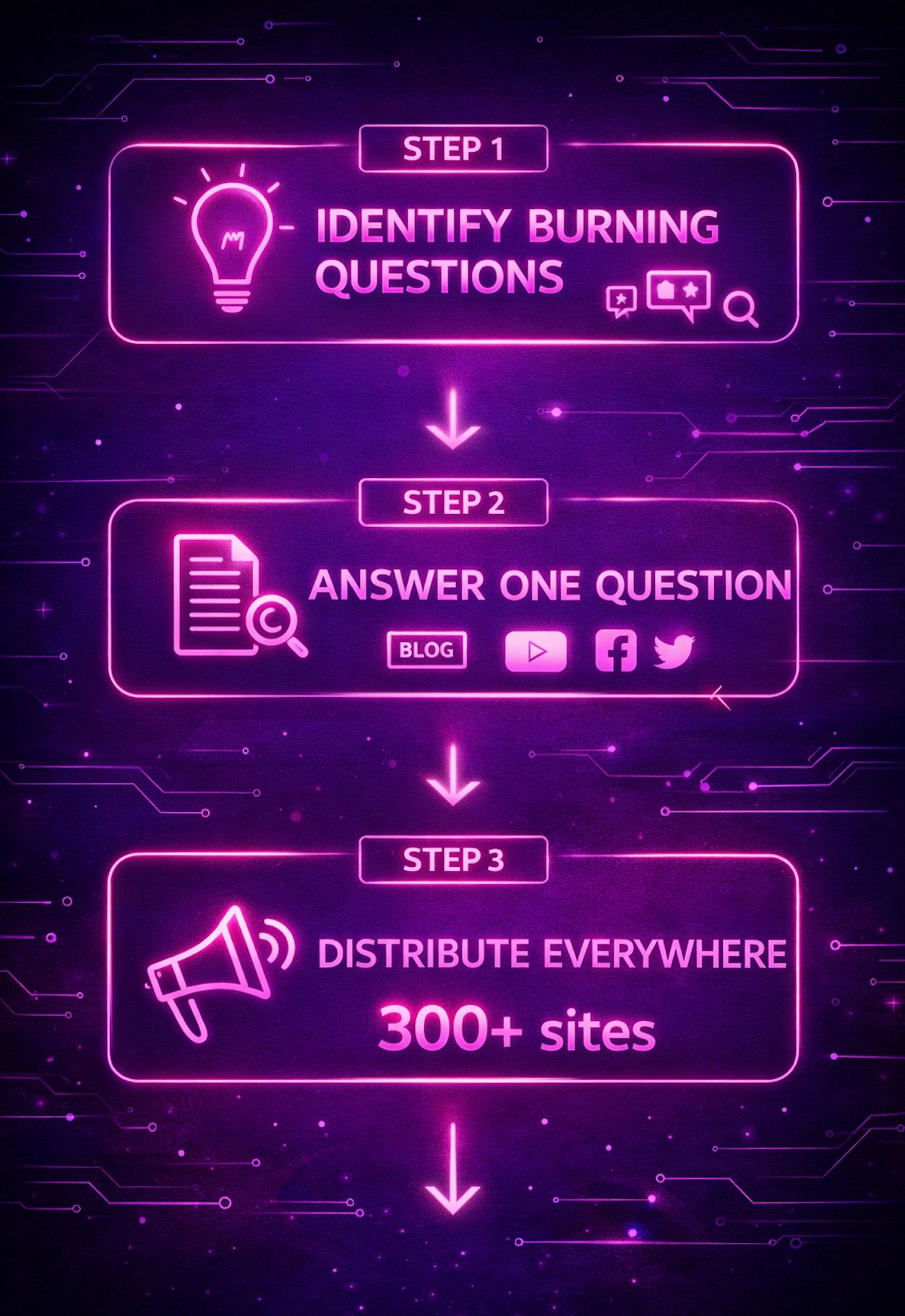
Begin your content marketing journey by establishing the fundamental infrastructure and strategy that will guide all future efforts. Conduct a comprehensive competitor content analysis to identify gaps and opportunities, then document your unique brand positioning and voice guidelines. Create your basic content hub (whether website or landing page), set up Amazon Attribution links for all channels, and develop templates for your primary content formats. These foundational elements ensure all subsequent content aligns with your brand strategy while enabling efficient creation processes.
Step 2: Start Answering The Questions One Piece At A Time
One question, one piece of content scattered everywhere your reach can possibly go. Not that popular online? No problem, 1 MultiCast will catapult you leagues ahead of where you are right now.
Step 3: Rinse & Repeat
Forget the time-consuming focus groups and combing through pages of reviews or competitor info. The most effective way to utilize the content marketing strategy today is this 3 step process.
Frequently Asked Questions
As you implement your content marketing strategy, you’ll inevitably encounter questions about resource allocation, content creation approaches, and expected outcomes. These common questions reflect the challenges most Amazon sellers face when transitioning from pure marketplace tactics to comprehensive content marketing.
How much time should I spend on content marketing versus other Amazon seller activities?
In a perfect world where you have nothing but an abundance of time everyday, the ideal allocation typically ranges from 15-30% of your total marketing time and budget, depending on your business maturity and category competitiveness. But that’s not reality is it, because you barely have time to actually run your business and slicing off 10+ a week means something else in your life is going to suffer.
So how about 10 minutes instead? Media Strobe can get everything needed from you in about 10 minutes to create a MultiCast cycle that will quickly ignite growth in your business.
Do I need to hire professionals to create content for my Amazon products?
It depends on how fast you want to go. If you have 6-8 months to wait before seeing any marked increase in traffic or sales then go ahead and start dabbling at it yourself now. The reasons this is the least effective option is because 1) you will procrastinate, 2) there is a learning curve for creating effective content (don’t think AI is going to save you here because it can just as easily sink you), and 3) if you fall in with the “majority” of people you’ll produce less then 10 below average pieces, determine this doesn’t work and quit! And that’s when desperate sellers start ramping up paid ads and burn through thousands of dollars, hoping one of the ads will take off and become profitable. Multicasting creates permanent traffic assets that will live online forever.
How can I create content if I sell generic or commodity products?
Generic products actually present unique content opportunities by shifting focus from product features to usage contexts, customer problems, and creative applications. Develop content around the problems your products solve rather than the products themselves. A seller of standard kitchen utensils might create content about how to use the utensil, how to clean it, what to never do with it, how it helps save time with meal prep – all contextually relevant to their products without requiring unique features.
Consider creating comparison content that educates consumers on quality differences between seemingly similar products, highlighting the specific attributes that distinguish your offerings. Some of the most successful content marketing for commodity products focuses on adjacent interests that naturally lead consumers to your product category, creating brand affinity before specific product needs arise.
Will content marketing help if I’m in a highly competitive Amazon category?
Yes! Content marketing provides even greater advantages in competitive categories by creating differentiation beyond price and basic features. While direct Amazon competition often devolves into price wars and PPC bidding battles, content marketing establishes unique brand positioning that attracts customers before they enter the competitive marketplace environment. The most effective approach in crowded categories focuses on specific customer segments or use cases overlooked by larger competitors who target broader audiences.
How quickly can I expect to see results from content marketing efforts?
With a MultiCast, usually within days. DYI takes a lot longer and if you are consistently posting a few times per week, you should start seeing social interactions and email sign ups within 30-45 days. Website traffic and sales increases should start within 60-90 days as your content begins ranking and audience relationships develop. Significant ROI and compound growth effects generally manifest between 4-6 months as your content library expands and cross-promotion opportunities multiply.
The exact timeline varies based on your category competitiveness, content quality, and distribution effectiveness. Categories with longer consideration cycles naturally show delayed conversion impacts compared to impulse purchase categories. Focus on leading indicators like organic traffic growth and engagement metrics during the initial phases while building toward the long-term sales and profitability improvements that content marketing ultimately delivers.
Implementation consistency matters more than initial content volume. Amazon sellers who maintain modest but regular content production consistently outperform those who create sporadic bursts of content followed by extended gaps. Start with sustainable production levels that align with your resources, then gradually increase volume as systems and results develop.
Ready to elevate your Amazon brand through strategic content marketing? Try a MultiCast on your top seller and see how fast your reputation and rank soar – something no paid ad can do!
DISCLAIMER: Media Strobe works with a limited number of business in order to preserve quality and media relationships. You can inquire if there is an opening here results@mediastrobe.com