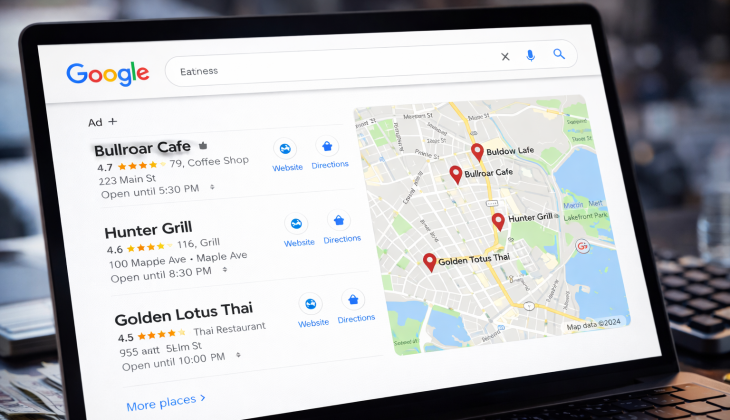
Local SEO · Google Maps · 2026 Visibility Guide
How to dominate Google Maps rankings in 2026 and get your business recommended by AI Overviews, ChatGPT, and Google Gemini through strategic GBP optimization and schema markup.
Media Strobe Strategy Team · Updated 2026 · 25 min read
Article-At-A-Glance: Boost Your Google Maps Visibility
Google Maps rankings in 2026 are driven by three core signals: relevance, distance, and prominence — and AI Overviews now pull directly from your Google Business Profile data.
Your Google Business Profile (GBP) is the single most important asset for local visibility — incomplete profiles are leaving real money on the table.
NAP consistency (Name, Address, Phone) across every online platform is a silent ranking factor most businesses ignore — and it’s quietly killing their rankings.
AI tools like ChatGPT and Google Gemini cross-reference multiple trusted sources when recommending local businesses — showing up in one place isn’t enough anymore.
There’s a specific content structure that gets your business picked up by AI systems — and most local businesses aren’t using it yet. Keep reading to find out what it is.
Google Maps and AI recommendations are no longer two separate strategies — they’re the same game, and the businesses winning right now know exactly how to play both. Understanding Google Maps rankings in 2026 is what separates businesses that get found from those that stay invisible.
Local visibility has fundamentally shifted. When someone asks Google, ChatGPT, or Gemini for a recommendation near them, the answer they get isn’t random. It’s pulled from a network of structured data, verified profiles, consistent citations, and trusted content. Understanding how to feed that system the right information is what separates businesses that get found from businesses that stay invisible.
Google Maps and AI Are Now the Same Game
Google processes billions of local searches every month, and the way it surfaces results has changed dramatically. AI is now embedded directly into the search experience through features like AI Overviews, which pull real business data — your hours, reviews, categories, photos, and website content — to generate recommendations. If your business data is incomplete, inconsistent, or unstructured, AI systems simply won’t trust it enough to recommend you.
This isn’t just about ranking in the Local Pack anymore. Visibility now means appearing across Maps, Search, AI Overviews, and third-party AI tools simultaneously. Each platform cross-references the others. A weak signal in one place weakens your presence everywhere.
What Drives Google Maps Rankings in 2026
→Google Maps rankings directly influence what AI Overviews recommend
→AI Overviews pull from your GBP, your website, and your reviews — all three must align
→ChatGPT and Perplexity pull from high-authority directories and structured web content
→Inconsistent business data creates conflicting signals that AI systems flag as untrustworthy
→Businesses with fully optimized, structured profiles are appearing in AI recommendations without any paid promotion
The opportunity here is real. Most local businesses haven’t adapted to this new reality yet, which means the gap between an optimized profile and an unoptimized one has never been wider.
The gap between an optimized profile and an unoptimized one has never been wider — and most local businesses haven’t adapted yet.
How Google Maps Rankings Actually Work in 2026
Google’s local ranking algorithm hasn’t abandoned its core principles — it’s built on them and layered AI on top. To increase your Google Maps listings visibility, you need to understand what Google is actually measuring and why.
The Three Core Ranking Signals Google Uses
Google evaluates every local business using three fundamental signals. Relevance measures how well your business profile matches what someone searched for. Distance calculates how close your business is to the searcher or the location specified. Prominence reflects how well-known and trusted your business is based on links, reviews, directory listings, and online mentions. All three must be strong for your business to appear consistently in top results.
Google’s Three Core Ranking Signals
1.Relevance: How well your business profile matches what someone searched for
2.Distance: How close your business is to the searcher or the location specified
3.Prominence: How well-known and trusted your business is based on links, reviews, directory listings, and online mentions
Prominence is the factor most businesses underestimate. It’s not just about being popular — it’s about being verifiable. Google rewards businesses that have consistent, accurate data appearing across multiple trusted platforms. Every credible mention of your business online acts as a vote of confidence that Google’s algorithm counts.
Why AI Overviews Now Pull From Your Google Maps Data
When Google rolls out an AI Overview for a local query, it isn’t generating information from thin air. It’s synthesizing data from your GBP, your website, user-generated reviews, and structured third-party sources. The more aligned and complete your data is across all of these, the more likely your business gets cited in the AI response.
AI Overviews Pull From Multiple Sources
→AI Overviews prioritize businesses with complete and accurate GBP data
→Review content — especially keyword-rich reviews — feeds directly into AI summaries
→Your website’s structured data (schema markup) signals to AI what your business actually does
→Businesses mentioned in high-authority local content are more likely to be recommended
The Connection Between Your Website, GBP, and AI Recommendations
Think of your GBP, website, and review profile as a three-legged stool. If one leg is shorter than the others, the whole thing becomes unstable. Google’s AI systems check whether the information on your website matches your GBP, whether your reviews reinforce your categories, and whether your structured data supports your claimed services. Mismatches across these sources create doubt — and AI systems don’t recommend businesses they’re unsure about.
Your Google Business Profile Is the Foundation
Everything else in this guide builds on your Google Business Profile. Before worrying about schema markup or AI content strategies, your GBP needs to be complete, accurate, and actively maintained. This is non-negotiable.
Google’s own documentation confirms that businesses with complete profiles are significantly more likely to be considered reputable by both users and the algorithm. A complete profile means filling in every available field — not just the basics. Most businesses stop at name, address, and phone number. The businesses that dominate local results go much further.
Quick Audit Checklist
Before optimizing anything else, verify your GBP has the following:
✓ Business name exactly as it appears everywhere else online
✓ Correct primary and secondary categories
✓ Full address with suite or unit number if applicable
✓ Local phone number (not a call center number)
✓ Website URL linking to the most relevant landing page
✓ Complete and accurate business hours including holidays
✓ Business description using natural keyword-rich language
✓ At least 10 photos including interior, exterior, team, and products
The Non-Negotiable Fields Every Business Must Complete
Your business name in your GBP must match exactly what appears on your website, social profiles, and every directory listing across the web. Even small variations — like using “St.” in one place and “Street” in another — create data conflicts that weaken your ranking signal. Use your legal business name, and then stay consistent everywhere.
Your business description is one of the most underused ranking opportunities in the entire GBP. You have 750 characters to tell Google and potential customers who you are, what you do, and where you do it. Use natural language that includes your primary service keywords and your city or neighborhood. Don’t stuff keywords — write it the way a knowledgeable human would describe your business to a friend.
Business Description Best Practices
→Include your primary service and location in the first sentence of your description
→Mention specific services, specialties, or differentiators that customers search for
→Avoid generic phrases like “best in class” or “top quality” — be specific
→Update your description seasonally or when you launch new services
How to Pick the Right Categories to Rank for the Right Searches
Your primary category is the single most influential field in your entire GBP. Google uses it to determine which searches your listing is eligible to appear in. Choose it with precision — it should reflect the core service your business provides, not a broad industry label. A plumbing company should select “Plumber,” not “Contractor.”
Secondary categories give you additional ranking opportunities without diluting your primary focus. A restaurant that also does catering can add “Caterer” as a secondary category, making the business eligible for both sets of searches. You can add up to nine additional categories, but only add ones that genuinely reflect what you offer — irrelevant categories can hurt more than help.
Category Selection Examples by Business Type
| Business Type | Strong Primary Category | Useful Secondary Categories |
|---|---|---|
| Italian Restaurant | Italian Restaurant | Pizza Restaurant, Catering Food & Drink Supplies |
| Dental Practice | Dentist | Cosmetic Dentist, Teeth Whitening Service |
| Auto Repair Shop | Auto Repair Shop | Tire Shop, Oil Change Service, Brake Shop |
| Law Firm | Law Firm | Personal Injury Attorney, Family Law Attorney |
Attributes and Features That Directly Impact Visibility
Attributes are the checkboxes inside your GBP that describe specific features of your business — things like “wheelchair accessible entrance,” “free Wi-Fi,” “outdoor seating,” or “women-owned.” These aren’t just for customer information. Google uses attributes to match businesses to highly specific search queries. Someone searching for “coffee shop with outdoor seating near me” will only see businesses that have that attribute enabled.
Enabling every applicable attribute takes less than ten minutes and can meaningfully expand the range of searches your listing appears in. Review the full list of available attributes for your business category — Google updates these regularly and new ones appear without notification. For more insights on marketing strategies, explore the differences between local and national brand marketing.
How Often You Should Be Updating Your Profile
An active profile ranks better than a dormant one. Google’s algorithm treats recent activity as a signal of a legitimate, operating business. Post a GBP update at least once per week — this can be a promotional post, a new photo, a product update, or an answer to a common customer question. Businesses that post regularly see measurably higher engagement and visibility compared to those that set up their profile once and never return.
An active profile ranks better than a dormant one — post to your GBP at least once per week.
NAP Consistency: The Silent Ranking Killer
NAP stands for Name, Address, and Phone number — the three core identifiers Google uses to verify that your business is real and that all the online mentions of it are referring to the same entity. When these details are inconsistent across directories, review sites, social profiles, and your own website, Google’s confidence in your listing drops. That drop in confidence directly translates to lower rankings.
What NAP Consistency Means and Why It Matters to AI
NAP consistency means your business name, address, and phone number appear in exactly the same format across every platform where your business is listed. This includes Google Business Profile, Yelp, Facebook, Apple Maps, Bing Places, industry-specific directories, and your own website. AI systems — including Google’s local ranking algorithm — compare these data points across sources to confirm your business is legitimate. When the data matches, it strengthens your ranking signal. When it doesn’t, it creates conflicting citations that confuse both Google and potential customers.
How to Find and Fix Inconsistencies Across the Web
Start with a manual audit of the five most important platforms: Google Business Profile, Yelp, Facebook, Apple Maps, and Bing Places. Then use a tool like Moz Local, BrightLocal, or Yext to run a broader citation scan across dozens of directories simultaneously. These tools will flag every instance where your NAP details deviate from your master record. Fix discrepancies starting with the highest-authority platforms first, then work down the list. Once you’ve corrected the data, set a quarterly reminder to re-audit — directories sometimes revert changes or pull outdated data from third-party aggregators.
Reviews Are Your Most Powerful Ranking Signal
If there’s one local SEO factor that influences both human behavior and AI recommendations simultaneously, it’s reviews. Google’s algorithm weighs review volume, recency, rating, and content when determining which businesses to surface in competitive local searches. More importantly, AI systems like Google’s own Gemini and third-party tools like ChatGPT read the actual text of your reviews to understand what your business does, who it serves, and how well it performs.
Why Review Volume and Recency Both Matter
A business with 200 reviews from three years ago will consistently lose ground to a competitor with 80 reviews that are actively coming in every month. Google interprets a steady flow of new reviews as a sign that a business is active, relevant, and still serving customers. Recency signals trust in a way that volume alone cannot — it tells both the algorithm and the searcher that your business is operating right now, not just historically popular.
Review content matters just as much as star ratings. When customers naturally mention your services, location, or specific staff members in their reviews, those keywords feed directly into Google’s understanding of your business. A review that says “best emergency plumber in Austin — fixed our burst pipe in under two hours” is doing active SEO work for your listing. Encourage customers to be specific when leaving feedback, without scripting their responses or violating Google’s review policies. For more tips on promoting local services, check out this guide on marketing a local-based service business.
Review Strategy Essentials for Google Maps Rankings
→A business with 200 old reviews consistently loses to a competitor with 80 recent reviews
→Recency signals trust — active businesses get active reviews consistently
→Review content feeds directly into Google’s understanding of your business
→Respond to every review — positive and negative — with keyword-rich responses
How to Get More Reviews Without Violating Google’s Guidelines
Google prohibits incentivizing reviews — meaning you cannot offer discounts, gifts, or any form of reward in exchange for a review. What you can do is make the process as frictionless as possible. Create a short Google review link using the “Get more reviews” button in your GBP dashboard and share it via email follow-ups, SMS, printed receipts, or a QR code at your point of sale. Timing matters — ask for a review immediately after a positive interaction, when the experience is still fresh. Businesses that build review requests into their post-purchase workflow consistently outperform those that ask sporadically.
What to Include in Your Review Responses to Boost Local SEO
Responding to every review — positive and negative — signals to Google that your business is actively managed. But your responses can also do additional SEO work. When responding to positive reviews, naturally incorporate your business name, primary service, and city. For example: “Thank you for trusting Austin Plumbing Co. with your emergency repair — we’re glad our team could help.” This reinforces your keyword associations without keyword stuffing. For negative reviews, respond professionally, address the issue directly, and invite the customer to continue the conversation offline. Google reads these responses too.
Review responses are an underutilized SEO opportunity — naturally incorporate your business name, service, and location in every reply.
Schema Markup Makes You Readable to AI
Schema markup is structured data code added to your website that tells search engines and AI systems exactly what your business is, where it’s located, what it offers, and how to contact you. Without it, AI tools have to infer this information from your page content — and inference is less reliable than explicit structured data. Schema markup is one of the most underutilized tools in local SEO, and it’s one of the clearest signals you can send to AI systems that are deciding whether to recommend you.
What LocalBusiness Schema Is and Why You Need It
LocalBusiness schema is a specific type of structured data from Schema.org that is designed for physical businesses with a service area or storefront location. It allows you to explicitly declare your business name, address, phone number, opening hours, accepted payment methods, price range, geographic coordinates, and more — all in a format that machines can read instantly and accurately.
When Google’s crawlers or AI systems visit your website, they don’t read it the way a human does. They parse the code and look for structured signals. A page that simply displays your address in plain text is readable but not structured. The same address wrapped in LocalBusiness schema is both readable and machine-verified — a fundamentally stronger signal for ranking and AI citation purposes.
Implementing LocalBusiness schema doesn’t require advanced coding skills. You can generate the JSON-LD code — which is Google’s preferred format — using free tools like Google’s Structured Data Markup Helper or Merkle’s Schema Markup Generator. Once generated, the code gets added to the <head> section of your website’s relevant pages. For multi-location businesses, each location should have its own dedicated page with its own schema markup.
After implementation, validate your markup using Google’s Rich Results Test tool to confirm there are no errors. Broken schema is worse than no schema — it creates conflicting signals that can actively suppress your visibility in structured search results and AI recommendations.
Essential Schema Implementation Checklist
✓ Use JSON-LD format — Google explicitly recommends it over Microdata and RDFa
✓ Add schema to every location page, not just the homepage
✓ Include geo coordinates (latitude and longitude) for precision location matching
✓ Specify your service area if you serve customers beyond your physical address
✓ Link your schema’s sameAs property to your GBP URL, Facebook, and other verified profiles
✓ Validate with Google’s Rich Results Test after every website update
The Key Schema Fields That Influence AI Citations
Not all schema fields carry equal weight when it comes to AI citations. The fields that matter most are the ones that help AI systems verify your identity and understand your relevance to a specific query. Start with the non-negotiables: name, address (using the PostalAddress sub-type), telephone, openingHoursSpecification, and url. These are the foundation — without them, everything else is secondary.
Beyond the basics, the hasMap property (linking directly to your Google Maps listing), the aggregateRating property (pulling in your review data), and the servesCuisine or serviceType properties depending on your industry are the fields that directly expand your AI visibility. These fields give AI systems the context they need to match your business to specific user intents — not just location-based queries, but service-specific ones too.
The sameAs property deserves special attention. It allows you to list the URLs of all your verified business profiles — your GBP, Facebook page, LinkedIn, Yelp listing, and industry directories — in one place within your schema. This creates a web of verified connections between your website and your off-site profiles, which is exactly the kind of cross-platform signal that AI systems use to confirm your business is legitimate and authoritative.
How to Get Recommended by AI Overviews and Tools Like ChatGPT
Ranking on Google Maps gets you visibility in traditional search results. Getting recommended by AI Overviews and tools like ChatGPT gets you visibility in the next generation of search — and the businesses that crack this in the next 12 months will have a significant competitive advantage. The good news is that the same principles that improve your Google Maps rankings also improve your AI recommendation potential. The key is knowing which additional steps push you from being indexed to being cited. Learn more about how to market a local-based service business to enhance your online presence.
Why AI Tools Cross-Reference Multiple Trusted Sources
When ChatGPT, Google Gemini, or Perplexity recommends a local business, that recommendation isn’t based on a single data point. These systems are designed to cross-reference multiple trusted sources before surfacing a recommendation — because a business that appears consistently across authoritative platforms is statistically more likely to be legitimate, operational, and high quality. A business that only exists in one place online gets filtered out by this verification process. Learn more about the role of AI in digital marketing and how it reshapes strategies.
The platforms these AI tools treat as authoritative include Google Business Profile, Yelp, TripAdvisor (for hospitality), Healthgrades and Zocdoc (for healthcare), Avvo (for legal), Houzz (for home services), and major local news outlets. Being present and highly rated across the platforms relevant to your industry isn’t just good for direct traffic from those sites — it’s a prerequisite for AI recommendation eligibility.
Think of it as a trust threshold. Each high-authority listing, each positive review mention, each structured data signal, and each piece of locally relevant content you publish pushes your business closer to that threshold. Cross it, and AI systems start recommending you organically. Stay below it, and you remain invisible regardless of how good your actual business is.
AI Citation Trigger Comparison by Platform
Google Gemini: Pulls from GBP data, schema markup, E-E-A-T signals on your website, and Google Maps reviews. Prioritizes businesses with complete structured profiles and high review recency. Best content format: FAQ-style pages with clear headings and LocalBusiness schema.
ChatGPT (with Browse): Pulls from high-authority directories, local news mentions, and structured web content. Prioritizes businesses with consistent NAP data across multiple sources and content that directly answers user questions. Best content format: Data-rich service pages with clear source attribution and sameAs schema links.
Perplexity AI: Prioritizes content freshness and citation density. Businesses mentioned in recently published, authoritative web content rank higher in recommendations. Best content format: Recently updated pages with verified facts, statistics, and links to credible sources.
The Content Structure That Gets Picked Up by AI Systems
AI systems are built to find clear, direct answers to specific questions. The content on your website and in your GBP posts needs to be structured with that in mind. Use descriptive H2 and H3 headings that mirror the exact questions your customers are searching for. Follow each heading with a direct, concise answer in the first sentence — then expand with supporting detail. This question-answer format is the single most effective content structure for getting cited in AI Overviews, because it makes your content easy to parse, verify, and excerpt.
AI systems are built to find clear, direct answers to specific questions. Structure your content accordingly.
Which High-Authority Platforms to Publish Your Content On
Not all directories carry equal weight with AI systems. Focus your energy on platforms that AI tools consistently treat as credible sources. For most local businesses, the core set includes Google Business Profile, Yelp, Facebook Business, Apple Maps, Bing Places, and the Better Business Bureau. Beyond these universal platforms, prioritize the industry-specific directories that AI tools reference most frequently in your category — Healthgrades and Zocdoc for healthcare, Avvo and FindLaw for legal, Houzz and Angi for home services, and TripAdvisor and OpenTable for hospitality.
How to Identify the Exact Questions AI Is Answering About Your Business
The fastest way to find out what AI is saying about businesses in your category is to simply ask. Open ChatGPT, Gemini, and Perplexity and search for the services you offer in your city. Pay close attention to which businesses get named, what specific questions trigger recommendations, and what language the AI uses to describe the recommended businesses. This gives you a direct window into the content gaps your website and GBP need to fill.
AI Research Audit Process
→Search for your primary service + city in at least three AI tools and record the results
→Note which competitors appear consistently across multiple AI platforms
→Identify the exact phrasing AI uses to describe recommended businesses — then use that language in your own content
→Search for question-format queries like “best [service] near [city]” and “who offers [service] in [city]”
→Check whether your business appears at all — if it doesn’t, your structured data and citation footprint need immediate attention
Once you have your list of questions and gaps, turn them into content. Create dedicated FAQ sections on your website that directly answer the queries AI tools are responding to. Use the exact question as your H3 heading and provide a clear, factual answer in the first sentence. This is the content structure that gets excerpted and cited — not long-form narrative, but direct question-answer pairs backed by supporting detail.
Do this audit quarterly. AI tools update their training data and browsing indexes regularly, and the questions your potential customers are asking will shift as your industry evolves. Businesses that treat AI visibility as a one-time setup will consistently lose ground to those that monitor and adapt.
AI Tools That Help You Rank Faster on Google Maps
Manual optimization gets you started, but AI-powered tools help you scale, monitor, and maintain your local visibility without spending hours each week on repetitive tasks. The right toolset catches the issues you’d miss on your own — listing inconsistencies across hundreds of directories, emerging negative sentiment in reviews, sudden drops in ranking position, and competitor moves that affect your relative visibility.
The most impactful tools fall into two categories: those that manage and audit your listing data across platforms, and those that analyze your reputation and review content using AI. Both are essential, and the best local SEO stacks use at least one tool from each category running simultaneously.
Essential Local SEO Tools for Google Maps Rankings
→BrightLocal — Citation tracking, rank monitoring, and GBP audit reports with detailed accuracy scoring across hundreds of directories
→Moz Local — Automated NAP consistency management and distribution to major data aggregators including Foursquare, Neustar, and Factual
→Yext — Real-time listing management across 200+ platforms with AI-powered duplicate detection and suppression
→Whitespark — Citation building and local rank tracking with a focus on competitive gap analysis
→GatherUp — AI-assisted review request automation and sentiment analysis across Google, Yelp, and Facebook
→Media Strobe — Multi-location listing management with AI-driven insights for chains and franchise businesses operating across multiple cities
Choose tools based on your business size and complexity. A single-location business can manage effectively with BrightLocal and a dedicated review request process. Multi-location businesses operating across multiple cities need enterprise-level platforms like Yext or Media Strobe to maintain consistency at scale without manual intervention at every location.
Tools for Detecting Listing Gaps and Inconsistencies
BrightLocal’s Citation Tracker and Moz Local’s listing score tool are the two most practical starting points for identifying where your business data is incomplete, inaccurate, or missing entirely. Run a full audit using either tool, export the results, and prioritize fixes based on platform authority. Google, Apple Maps, Bing, Yelp, and Facebook come first — these are the platforms that feed the most data into AI recommendation systems. Secondary directories like Foursquare, YellowPages, and industry-specific listings come next. The goal is 100% accuracy on the top 20 platforms before expanding further.
Reputation Management Tools That Use AI Sentiment Analysis
GatherUp and Birdeye both use AI to analyze the sentiment and keyword themes within your review content — not just the star rating, but the actual language customers use. This matters because Google’s AI reads review text the same way these tools do. When sentiment analysis reveals that customers consistently mention “fast response” or “transparent pricing” but your GBP description never uses those phrases, you have a clear optimization opportunity. Align your profile language with the language your happiest customers are already using, and you’ll strengthen the keyword relevance signal that both Google and AI recommendation tools use to match you to search queries.
Media Strobe’s MultiCast: Amplifying Your Local Visibility at Scale
Media Strobe MultiCast System
AI-Powered Content Distribution Across 300+ High-Authority Channels
Google Maps rankings and AI recommendations require consistent, authoritative mentions across multiple trusted platforms. Media Strobe’s MultiCast amplifies your local presence by distributing your business content across high-authority news sites, local publications, and major content networks — building the exact citation signals that both Google Maps and AI tools use to verify business legitimacy and prominence.
Whether you’re publishing service updates, business announcements, or local expertise content, MultiCast ensures your message reaches the networks where AI systems are actively crawling and indexing. Every piece of distributed content becomes a trust-building citation that reinforces your Google Maps rankings while simultaneously improving your AI recommendation eligibility.
Your Action Plan Starts Today, Not Tomorrow
Every day your Google Business Profile sits incomplete, your NAP data stays inconsistent, or your website lacks LocalBusiness schema is a day a competitor with a better-optimized profile is capturing the customers you should be serving. Start with your GBP audit today — fill every field, select precise categories, enable all applicable attributes, and post an update. Then run a citation scan, fix your top 20 directory listings, and add LocalBusiness schema to your website. Build a weekly review request process and a monthly content update schedule. This isn’t a one-time project — it’s an ongoing system that compounds over time, and the businesses that build it now will be the ones AI tools recommend by default six months from now.
This isn’t a one-time project — it’s an ongoing system that compounds over time.
Frequently Asked Questions
The questions below address the most common points of confusion local business owners have about Google Maps rankings and AI visibility — answered directly, with the specifics that actually matter for your strategy.
Can a Small Local Business Compete With Big Brands on Google Maps?
Yes — and Google Maps is one of the few digital channels where small businesses have a genuine structural advantage over large brands. Google’s ranking algorithm heavily weights proximity and relevance, which means a well-optimized local business will consistently outrank a national chain for searches conducted in its immediate area. A neighborhood dental practice with a fully optimized GBP, 80 recent reviews, and consistent citations will outrank a corporate dental group with thousands of national locations for someone searching “dentist near me” from two blocks away. The national brand’s scale doesn’t help it win local. Your optimization depth does. Focus on completing every field in your GBP, building reviews aggressively, and maintaining perfect NAP consistency — those are the levers that close the gap between you and any larger competitor.
How Long Does It Take to See Results After Optimizing a Google Business Profile?
Typical Timeline for GBP Optimization Results
Week 1–2: Google recrawls your updated profile. Accuracy improvements to NAP data and category selections are processed. No visible ranking changes yet, but the foundation is set.
Week 3–4: Initial ranking improvements begin to appear for lower-competition queries. New photos and GBP posts start generating incremental engagement signals.
Month 2–3: Consistent posting, active review responses, and citation fixes compound into measurable ranking movement for primary keywords. Businesses in low-to-medium competition markets often reach the Local Pack by this stage.
Month 3–6: Schema markup gets fully indexed and begins influencing AI Overview citations. Review volume improvements start accelerating visibility for competitive queries.
Month 6+: Full compounding effect of all optimizations is visible. Businesses that maintain active profiles, consistent reviews, and fresh content see sustained top-3 Local Pack positions and regular AI recommendation appearances.
Results vary significantly based on your market’s competition level. A plumber in a small regional town may see Local Pack rankings within two to three weeks of a full optimization. A personal injury attorney in a major metropolitan market may need four to six months of consistent effort before breaking into the top three positions.
The single biggest mistake businesses make is optimizing once and then waiting passively for results. Google’s algorithm rewards ongoing activity. Profiles that receive weekly posts, monthly new photos, and a steady flow of reviews consistently outperform profiles that were optimized thoroughly but then left static. Treat your GBP like a social media channel that directly affects your revenue — because that’s exactly what it is.
Does Having More Google Maps Listings for the Same Business Help or Hurt Rankings?
Having multiple Google Maps listings for a single physical location almost always hurts your rankings. Google’s algorithm treats duplicate listings as a trust signal problem — if it can’t determine which listing is the authoritative one, it reduces the ranking strength of all of them. Duplicate listings also split your review count across multiple profiles, which weakens the prominence signal for each individual listing. For more insights on optimizing your business presence, consider exploring how to market a local-based service business.
Listing Rules by Business Type
→One physical location should have exactly one verified GBP listing
→Multiple legitimate locations (separate addresses) each deserve their own verified listing
→Service Area Businesses operating from a home address should hide their address and define their service area instead of creating multiple listings
→If you find duplicate listings for your business, claim them through GBP and request removal or mark them as duplicates through the “Suggest an edit” feature
→Franchises and multi-location businesses should manage each location’s listing individually with location-specific content, photos, and review management
If you’re managing a multi-location business and struggling to maintain consistency across all listings, tools like Yext or Media Strobe allow you to manage every location’s data from a single dashboard, ensuring that updates, promotions, and hour changes propagate accurately across all listings simultaneously — eliminating the risk of inconsistency that comes with manual management at scale. For more insights on managing local businesses, check out this guide on marketing a local-based service business.
What Is the Difference Between Ranking on Google Maps and Being Recommended by AI?
Ranking on Google Maps means your business appears in the Local Pack — the map and three-listing block that appears in Google Search results for local queries. This ranking is determined by Google’s local algorithm using relevance, distance, and prominence signals. It’s a traditional search ranking that has existed for over a decade, and it drives significant click and call volume for businesses that appear in the top three positions.
Being recommended by AI is a newer and separate visibility channel. When Google’s AI Overview generates a response to a local query, or when ChatGPT or Gemini responds to “what’s the best [service] in [city],” the businesses mentioned in those responses are being actively recommended — not just ranked. AI recommendations pull from a broader set of signals than traditional Maps rankings, including structured web content, cross-platform citation consistency, review sentiment analysis, and the alignment between your website content and your GBP data. A business can rank in the Local Pack without appearing in AI recommendations, and increasingly, a business that appears in AI recommendations will generate trust and traffic that amplifies its Maps ranking over time. The two systems reinforce each other — optimizing for one strengthens the other.
Do Google Maps Rankings Affect How Often AI Tools Like ChatGPT Recommend My Business?
Yes — but the relationship is indirect rather than direct. ChatGPT doesn’t read Google Maps rankings the way Google’s own systems do. What it does read are the underlying signals that cause high Google Maps rankings: consistent NAP data across authoritative directories, high review volume and positive sentiment, structured website data, and mentions in credible online content. For more insights on leveraging online presence, explore how media distribution can help your brand.
Think of Google Maps rankings as a proxy for business credibility. A business that ranks highly on Google Maps has, by definition, strong citation consistency, an active and complete GBP, and a healthy review profile. Those are exactly the characteristics AI tools look for when deciding which businesses to recommend. So while ChatGPT isn’t pulling your Maps ranking position directly, the work you do to improve that ranking is simultaneously improving your AI recommendation eligibility.
The additional step that connects Maps optimization to AI recommendations specifically is content. Google Maps rankings don’t require you to have well-structured website content — but AI recommendations do. A business can rank in the Local Pack with a minimal website, but to get cited by ChatGPT or Gemini, your website needs to have clear, structured, question-answering content that AI systems can parse and trust. Adding FAQ pages, LocalBusiness schema, and locally relevant service content to your website is what bridges the gap between Maps visibility and AI recommendation frequency.
The bottom line is that Google Maps optimization and AI recommendation optimization are converging strategies. Every action that strengthens your Maps ranking — completing your GBP, building citations, generating reviews, adding schema — also moves you closer to the trust threshold that AI tools require before recommending a business. Start with Maps fundamentals, add the content and schema layer, and your AI visibility will follow naturally.
Google Maps optimization and AI recommendation optimization are converging strategies. Every action that strengthens one strengthens the other.
Disclaimer: This article is for informational purposes only and does not constitute professional SEO, legal, or marketing advice. Google Maps ranking results vary based on market competition, business category, optimization consistency, and local market dynamics. Media Strobe recommends working with licensed professionals and developing a sustained, strategic approach rather than expecting immediate results from any single optimization.