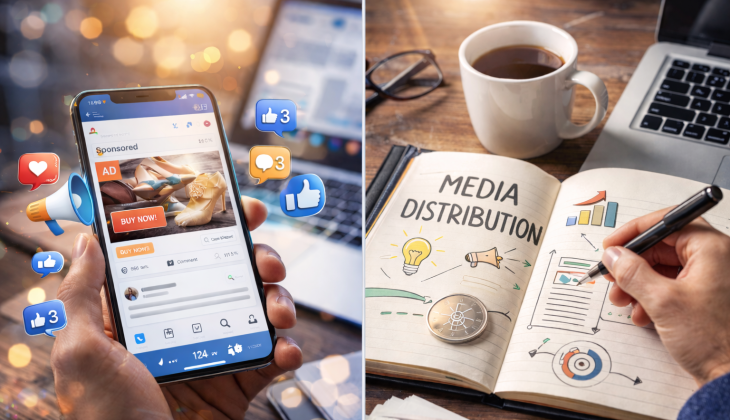
Marketing Strategy · Content Distribution · 2026 Framework
Most marketers don’t realize they’re losing 85% of their organic reach to social media algorithms. The hidden costs of renting attention versus building owned distribution channels could be quietly draining your marketing budget—and there’s a smarter way to balance both.
Media Strobe Strategy Team · Updated 2026 · 14 min read
Key Takeaways
Social media marketing offers immediate engagement but sacrifices message control, while content marketing distribution builds long-term authority through owned channels and third-party platforms.
Algorithm dependency limits organic reach on social platforms by up to 85%, forcing brands to balance paid promotion with authentic relationship building.
Traditional press release distribution creates third-party credibility that social media cannot replicate, establishing brand authority through media validation.
Smart marketers use integrated hub-and-spoke models that maximize channel synergy, with multicasting platforms serving as central content hubs supported by targeted paid campaigns.
Privacy regulations are transforming paid advertising effectiveness, making content distribution strategies increasingly valuable for sustainable growth.
The content distribution landscape has fundamentally shifted in 2026, creating distinct trade-offs between social media marketing and broader content marketing strategies. Understanding these differences determines whether marketing efforts build lasting value or simply rent temporary attention.
The Real Cost of Control vs Reach
Every marketing manager faces the same fundamental dilemma: maximize immediate reach or maintain message control. This trade-off has intensified as social media algorithms prioritize engagement over organic visibility, while traditional content distribution channels offer more predictable outcomes at potentially smaller scale.
The choice between broad reach and message precision shapes everything from budget allocation to team structure. Social media platforms promise massive audiences but deliver them through algorithmic filters that brands cannot control. Content marketing distribution through owned channels and strategic partnerships provides more reliable visibility but requires longer development timelines and deeper resource investment.
The Fundamental Marketing Dilemma of 2026
Maximize Immediate Reach OR Maintain Message Control
Platform consolidation has made this decision even more critical. Advanced content distribution platforms now offer alternatives that bridge traditional gaps between reach and control, enabling sophisticated marketers to achieve both objectives through integrated approaches.
Social Media Marketing’s Hidden Trade-Offs
Social media marketing’s apparent advantages mask significant strategic limitations that become more pronounced as platforms evolve their business models in 2026. The promise of direct customer engagement comes with costs that extend far beyond advertising budgets.
1. Algorithm-Dependent Visibility Limits Your Reach
Platform algorithms now control organic reach more aggressively than ever before. Recent analysis shows organic content reaches only 5-15% of followers without paid promotion, creating an invisible tax on every social media marketing initiative.
The Algorithm Impact on Organic Reach — 2026 Reality
5-15%
Organic reach without paid promotion
85%
Reach loss to algorithm filtering
24-48
Hours typical content lifespan
This algorithmic gatekeeping means brands cannot guarantee their content reaches intended audiences, even among their own followers. The situation becomes more complex when algorithms change without warning. Brands that invest heavily in building social media presence find their reach decimated overnight when platforms adjust their content distribution policies.
2. Audience Interactions Shape Brand Perception
Social media’s two-way communication model creates opportunities for authentic engagement but also introduces risks that traditional content distribution avoids. Comments, shares, and user-generated content can amplify brand messages in positive ways, but they can also hijack conversations and drive narratives in unintended directions.
Brand managers must constantly monitor social channels to address negative comments and maintain brand voice consistency across thousands of potential touchpoints.
3. Real-Time Analytics vs Long-Term Value
Social media platforms provide detailed real-time analytics that content distribution efforts often cannot match. Marketers can track impressions, engagement rates, and audience demographics with granular precision, making optimization decisions within hours of content publication.
However, this analytical advantage comes at the cost of long-term asset development. Social media content typically has short lifespans, generating most engagement within 24-48 hours of publication. Content marketing assets distributed through press releases, industry publications, and syndication networks continue driving value for months or years, creating cumulative returns that social media rarely achieves.
Traditional Content Distribution: Building Mass Awareness With Authority
Traditional content distribution channels maintain unique advantages that social media platforms cannot replicate, particularly in building third-party credibility and creating lasting content assets. These approaches require different investment models but often deliver superior long-term returns for brands willing to commit to longer development cycles.
Press Release Distribution Builds Third-Party Credibility
Press releases provide something social media cannot: third-party validation through established media outlets. When journalists and editors choose to cover company announcements, they lend their publication’s credibility to the brand message, creating trust signals that self-published content struggles to achieve.
Why Press Release Distribution Still Matters in 2026
→Third-party validation through established media outlets creates trust signals self-published content cannot achieve
→Permanent digital footprint in news archives and search results that supports SEO for years
→Message consistency maintained across all distribution channels with exact wording and positioning
→Long-term authority building that becomes part of company’s permanent reference materials
Content Syndication Creates SEO Benefits When Done Right
Content syndication through industry publications and content networks generates backlinks and domain authority that social media shares cannot provide. When authoritative websites republish content, they create valuable inbound links that improve search rankings and drive long-term organic traffic.
Effective syndication also exposes content to audiences who never engage with social media platforms. B2B decision-makers, for example, often consume industry publications and trade journals rather than following brands on social channels. Content syndication reaches these valuable audiences through their preferred information sources.
Content that appears simultaneously across relevant industry publications creates topic authority signals that search engines use for ranking decisions.
Social Media Marketing vs Content Distribution: Complete Comparison
Strategic Comparison — Choose Based on Business Objectives
| Factor | Social Media Marketing | Content Distribution |
|---|---|---|
| Reach Speed | Immediate with paid promotion | Builds over weeks/months |
| Organic Reach | 5-15% without paid boost | Predictable through syndication |
| Content Lifespan | 24-48 hours typical | Months to years |
| Message Control | Limited (audience can reshape) | High (exact positioning maintained) |
| SEO Value | Minimal (no backlinks) | High (backlinks, domain authority) |
| Credibility Signal | Self-published content | Third-party media validation |
| Analytics Depth | Real-time, granular detail | Longer-term, aggregate metrics |
| Best For | Immediate engagement, rapid testing | Long-term authority, sustainable growth |
Multichannel Content Adaptation: Evolving Distribution Strategies
Modern content distribution has evolved beyond simple channel selection to sophisticated adaptation strategies that optimize messages for each platform’s unique characteristics. This evolution requires new approaches to content creation and distribution that maximize effectiveness across diverse digital touchpoints in 2026.
AI-Driven Personalization Across Numerous Channels
Advanced content management systems now automatically create platform-specific variations that maintain brand voice while optimizing for each channel’s technical requirements and audience expectations. These systems analyze performance data across channels to identify which message variations drive the highest engagement for specific audience segments.
This technological sophistication enables multichannel strategies that were previously impractical due to resource constraints. Brands can now maintain consistent presence across dozens of platforms while delivering personalized experiences that feel native to each environment.
Why Paid Advertising Still Wins for Speed
Despite growing challenges, paid advertising maintains crucial advantages for marketers who need immediate results or precise audience targeting. Understanding when paid channels deliver superior value helps optimize overall marketing mix decisions in 2026.
Three Advantages Paid Advertising Still Delivers
1Guaranteed Visibility Regardless of Algorithms — Only guaranteed visibility in crowded digital environments; essential for product launches and time-sensitive campaigns
2Rapid Testing Delivers Initial Insights in Days — Controlled testing environments produce statistically significant results within days, not weeks
3Privacy-Compliant Innovation — New contextual advertising and first-party data activation maintain effectiveness while respecting user privacy
Brands that diversify between paid and organic approaches maintain marketing effectiveness even when platform policies shift unexpectedly.
The Integrated Approach That Smart Marketers Choose
The most effective marketing strategies in 2026 combine content distribution and social media approaches in coordinated frameworks that maximize the strengths of each while minimizing their individual limitations. These integrated approaches create synergistic effects that exceed the performance of either channel used independently.
Hub-and-Spoke Model Maximizes Channel Synergy
Successful integrated campaigns typically follow hub-and-spoke architectures where content distribution platforms serve as central hubs that paid social media campaigns direct traffic toward. This structure uses paid advertising’s precision targeting to build audiences while using content marketing’s engagement capabilities to deepen relationships once prospects arrive.
The Hub-and-Spoke Integration Model
Content Distribution = Hub | Paid Social = Spokes
This structure creates natural attribution pathways as prospects move from paid touchpoints to owned content channels. The integration allows each channel to perform its optimal function rather than competing for the same outcomes.
Result: Organizations implementing this approach have seen significant improvements in lead generation and customer acquisition costs compared to single-channel strategies.
Dynamic Budget Allocation Based on Performance
Advanced marketing organizations implement budget allocation systems that shift resources between content distribution and paid social based on current performance data. These systems eliminate artificial boundaries between channel budgets, ensuring marketing resources flow to their highest value applications throughout campaign lifecycles.
Real-time performance monitoring enables automated adjustments that optimize for changing market conditions, seasonal patterns, or competitive dynamics. When content distribution generates strong organic momentum, budgets can shift toward amplification. When paid channels identify new high-value audiences, resources move to capture those opportunities immediately.
Media Strobe’s MultiCast Campaign System: The Best of Both Worlds
Building sustainable marketing presence requires balancing immediate social media engagement with long-term content distribution authority. Most businesses struggle to execute both strategies effectively — until now.
Media Strobe MultiCast System
Publish Once, Distribute Everywhere — With Full Message Control
Media Strobe’s MultiCast system solves the core dilemma between reach and control by automatically distributing your content across 300+ high-authority platforms simultaneously — including Google News, industry publications, and regional media outlets — while maintaining exact message positioning.
How it bridges social media and content distribution: Instead of choosing between algorithm-dependent social reach or slow-building traditional distribution, MultiCast delivers both. Your content achieves immediate visibility across hundreds of credible third-party platforms while social media amplifies key messages to engaged audiences — creating the hub-and-spoke model automatically.
MultiCast transforms fragmented marketing efforts into a unified distribution engine that builds long-term SEO authority while maintaining the speed and targeting precision modern businesses require.
Choose Based on Your Growth Stage and Resources
The optimal balance between social media marketing and content distribution depends heavily on company growth stage, available resources, and specific business objectives. Early-stage companies often benefit from paid advertising’s immediate visibility despite higher costs, while established brands typically achieve better long-term economics through content distribution strategies.
Growth Stage Decision Matrix — 2026
| Business Stage | Primary Strategy | Secondary Support |
|---|---|---|
| Early-Stage Startup | Paid social for immediate visibility and rapid testing | Begin building content foundation |
| Growth-Stage Company | Balanced hub-and-spoke model with MultiCast | Dynamic budget allocation between channels |
| Established Enterprise | Content distribution for long-term authority | Targeted paid campaigns for specific initiatives |
The most important factor is implementation excellence rather than channel selection. Organizations that execute their chosen approach with discipline, measurement rigor, and continuous optimization consistently outperform competitors regardless of which channel mix they emphasize. Success depends more on strategic commitment and execution quality than on theoretical channel advantages.
Advanced Content Distribution Solutions
Media Strobe — Stop Choosing Between Reach and Control
For content distribution solutions that bridge traditional and social media approaches, Media Strobe provides advanced multicasting platforms that maximize reach while maintaining message control across diverse digital channels. Stop renting attention. Start building owned distribution.
Disclaimer: This article is for informational purposes only. Marketing performance varies based on industry, audience, execution quality, budget allocation, competitive environment, and numerous other factors. Statistics cited represent industry research findings and typical outcomes for illustrative purposes. Media Strobe recommends developing customized marketing strategies based on your specific business objectives, resources, and growth stage.