
Key Takeaways
- Multicast marketing enables brands to broadcast a hyper-focused message across multiple formats and channels simultaneously, each with unique content, creating a compound visibility effect that traditional single-channel approaches can’t match.
- Unlike multichannel marketing which operates in silos, multicast creates a cohesive ecosystem where your content reinforces itself across platforms, generating higher recognition and conversion rates.
- Implementing a multicast strategy reduces dependence on any single platform’s algorithm changes or policy updates, creating marketing stability and predictable growth.
- Brands using multicast marketing typically see 3-5x higher recognition rates as consumers encounter their messaging multiple times in various formats.
- The same core message transformed into different media types (articles, videos, podcasts, etc.) allows brands to reach audiences regardless of content consumption preferences.
What Multicast Marketing Really Means for Your Business
Multicast marketing isn’t just another industry buzzword—it’s a fundamental shift in how successful brands communicate with their audience. At its core, multicast marketing is a strategic system that transforms a single message into multiple formats distributed across numerous channels simultaneously, creating an omnipresent brand experience. This approach stands in stark contrast to the fragmented, channel-by-channel tactics most businesses still rely on.
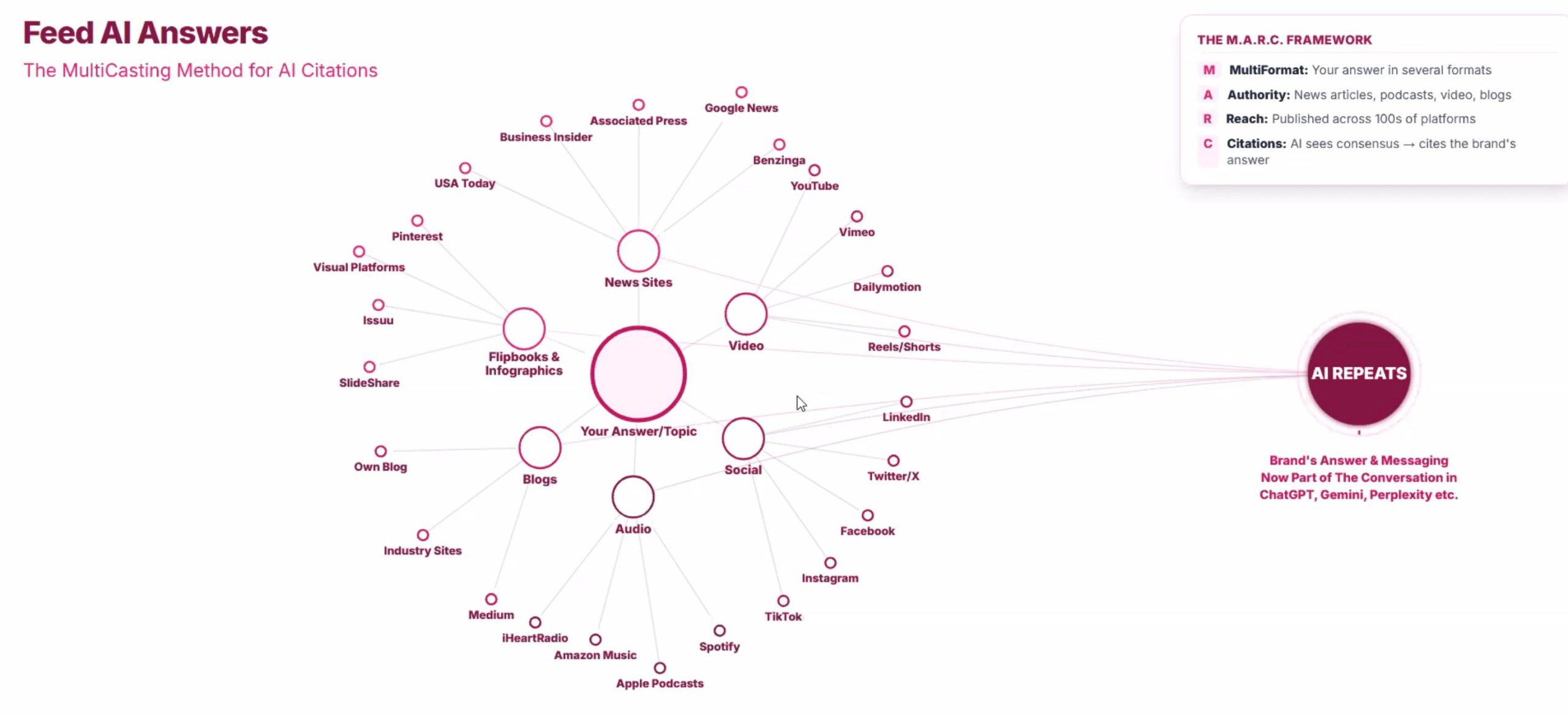
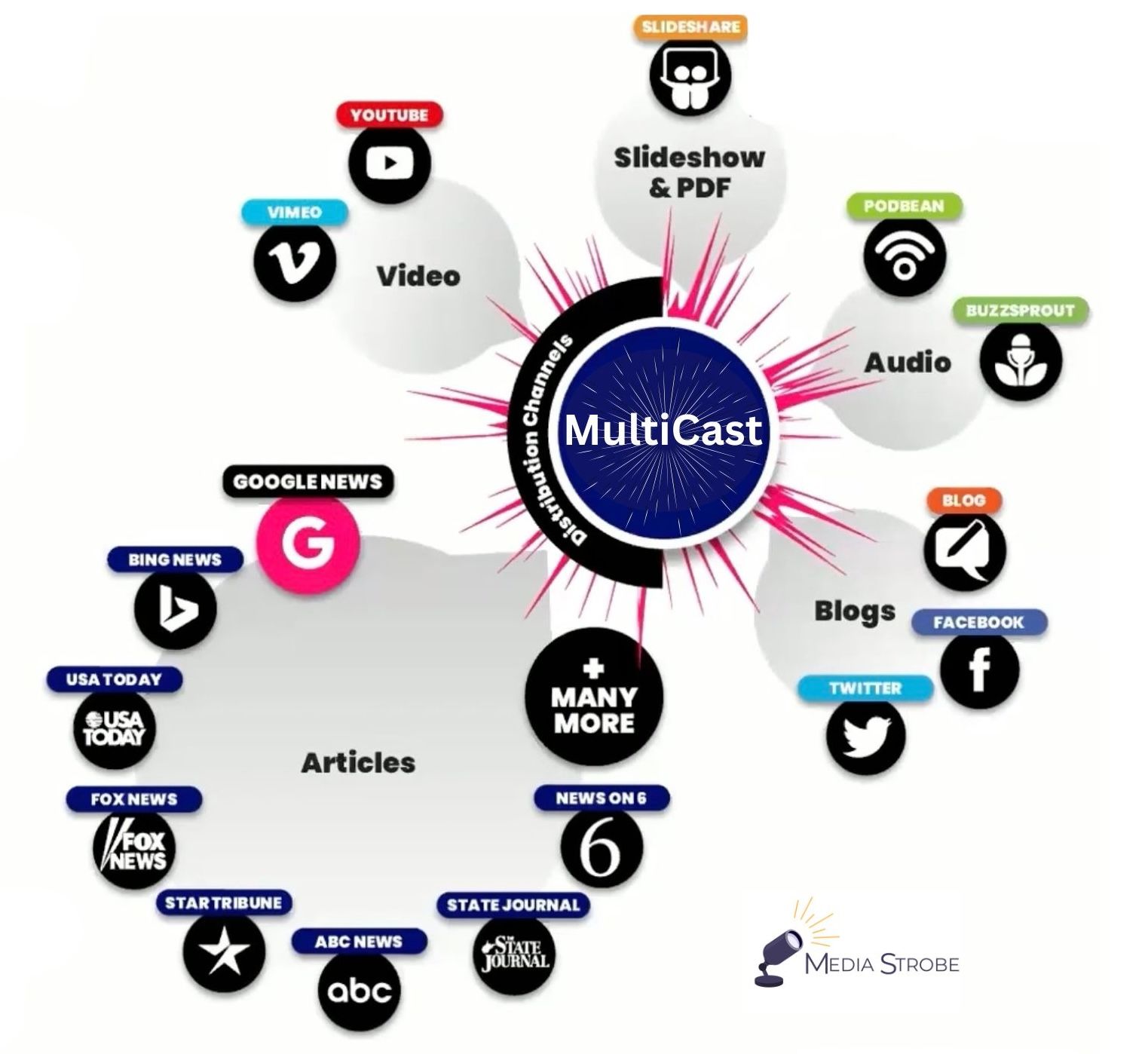
Think of multicast marketing as creating a visibility bundle rather than isolated content pieces. One core message becomes an article, video, podcast episode, social media series, and more—all working in concert to reinforce your brand’s position and value proposition. This isn’t about being everywhere for the sake of reach; it’s about strategic omnipresence that builds recognition through consistent, format-diverse messaging.
For businesses struggling to break through today’s overwhelming digital noise, multicast offers a systematic solution that leverages the psychological principle that familiarity breeds trust. When potential customers encounter your message across multiple touchpoints in formats they personally prefer, the compound effect accelerates brand recognition and shortens the path to conversion.

“Your Marketing: One-to-One or One-to …” from getclientsnow.com and used with no modifications.
The One-to-Many Marketing Revolution
Traditional marketing has always aimed for reach, but multicast redefines what effective reach actually means in today’s fractured media landscape. Instead of hoping a single format connects with your entire target audience, multicast acknowledges the reality that different people consume content differently—some prefer reading, others video, others audio—and adapts accordingly.
This revolution is built on the understanding that content is the vehicle, but the system of creation and distribution is what drives results. While most brands create content then decide where to publish it, multicast flips the script by designing a coordinated system where one strategic message is transformed into multiple content types simultaneously, each optimized for its destination platform but carrying the same core value.
Definition Beyond the Buzzword
Multicast marketing is a systematic approach to content creation and distribution where a single, strategic message is transformed into multiple format variations and distributed across numerous channels simultaneously. Unlike traditional broadcasting which pushes identical content to mass audiences, multicast adapts the format while preserving the core message, ensuring it resonates regardless of how or where your audience consumes content.
This approach creates what marketing strategists call a “compound visibility effect”—where each piece of content doesn’t just exist in isolation but reinforces and amplifies others in the ecosystem. The result is accelerated recognition and familiarity that single-channel strategies simply cannot achieve in today’s fragmented attention economy.
What makes multicast truly powerful is that it’s not dependent on luck or algorithm changes on any single platform. By creating a diversified visibility portfolio, brands build resilience against the whims of any single channel while maximizing their message’s impact through format-appropriate variations that all reinforce the same strategic position.
How It Differs From Traditional Broadcasting
- Broadcasting sends identical content to everyone; multicasting adapts format while maintaining message consistency
- Traditional approaches rely heavily on individual channel success; multicast creates an interconnected ecosystem
- Broadcasting typically requires massive budgets for impact; multicast creates compound effects with more efficient resource allocation
- One-way communication dominates broadcasting; multicast incorporates engagement across multiple touchpoints
- Traditional broadcasting measures single-channel metrics; multicast examines cross-platform recognition and conversion patterns
The Technology Behind Multicast Distribution
While the concept of multicast marketing is straightforward, its implementation relies on sophisticated technology stacks that enable seamless content transformation and distribution. Modern content management systems, digital asset management platforms, and channel-specific publishing tools form the backbone of effective multicast operations.
The technological revolution making multicast viable for businesses of all sizes includes AI-powered content repurposing tools that can transform a single video into blog posts, social snippets, and podcast episodes with minimal human intervention. These tools preserve the core message while optimizing for each format’s unique requirements and audience expectations.
Proprietary distribution networks have been created that ensure content appears on multiple platforms simultaneously, creating a wave of visibility rather than the trickle most marketing campaigns produce. Their system demonstrates how technology enables the synchronization that makes multicast marketing so much more powerful than traditional approaches.
Why Traditional Marketing Methods Are Failing
Traditional marketing tactics are delivering diminishing returns at precisely the moment businesses need more visibility than ever. The days of dominating a single channel or relying on sporadic content drops have passed, yet many companies still operate as if their audience will find them through happenstance rather than strategic omnipresence.
The digital landscape has fundamentally changed how people discover and interact with brands. Information overload has created defense mechanisms in consumers who now actively filter out most marketing messages. Your customers aren’t just on one platform waiting to be found – they’re everywhere, briefly, with increasingly fractured attention spans and growing skepticism. For marketers, understanding these shifts is crucial, which is why many are exploring strategies like multicasting vs. paid ads to effectively reach their audience.
Rising Ad Costs and Diminishing Returns
Digital advertising costs have skyrocketed across nearly every platform. Facebook CPMs have increased by over 61% year-over-year in some industries, while Google’s keyword costs continue their relentless climb. This inflation isn’t matched by corresponding increases in conversion rates, creating an unsustainable equation for businesses relying primarily on paid channels.
The dominance of duopoly platforms has created a seller’s market where businesses compete for increasingly expensive attention. Many companies find themselves trapped in bidding wars for the same audience segments, driving up costs while click-through rates and engagement metrics plateau or decline. The math simply doesn’t work anymore for businesses hoping to scale through paid channels alone.
Even brands with substantial advertising budgets are questioning the long-term viability of strategies heavily weighted toward paid placement. The solution isn’t abandoning these channels entirely but rather creating an ecosystem where organic visibility and strategic content distribution reduce dependency on increasingly expensive advertising.
Ad Blockers and Consumer Resistance
Nearly 42.7% of internet users worldwide now employ ad blocking technology, with higher percentages among desirable demographic segments like millennials and higher-income professionals. This technological resistance is just the visible manifestation of a deeper psychological shift – consumers actively avoiding obvious marketing messages.
Beyond technology, psychological ad blindness has developed where consumers unconsciously filter out content that resembles traditional advertising. This evolutionary response to information overload means even ads that do display technically often fail to register cognitively with viewers. The only messages breaking through combine relevance, proper format for the platform, and repeated exposure across multiple touchpoints.
Companies still relying on interruptive advertising as their primary visibility strategy are fighting against both technology and psychology. Multicast marketing approaches this challenge differently by creating value-first content adapted to each platform’s native experience, allowing messages to bypass both technological and psychological filters.
Content Saturation Across Platforms
Content production has exploded exponentially, with over 7 million blog posts published daily and hundreds of hours of video uploaded to YouTube every minute. Standing out in this environment through isolated content pieces is mathematically improbable regardless of quality. The signal-to-noise ratio has fundamentally shifted against single-format approaches.
Algorithm changes across platforms have progressively reduced organic reach, with Facebook page posts now typically reaching less than 5.5% of page followers without paid amplification. These changes force brands to constantly adapt to shifting algorithmic preferences rather than building sustainable visibility systems. The multicast approach creates resilience against any single platform’s changes by diversifying both format and distribution channels.
5 Core Elements of Effective Multicast Marketing
Successful multicast marketing isn’t about random content distribution or merely increasing output volume. It’s a strategic system built on five foundational elements that work in concert to create compound visibility. Understanding these elements is crucial before implementation, as each serves a specific purpose in the overall ecosystem. For more insights on this topic, check out this article on multichannel marketing.
1. Strategic Content Creation
Unlike traditional content marketing that often begins with format (“let’s make a video”), multicast starts with message strategy. This approach identifies core value propositions and key messages that align with specific business objectives before determining formats. The strategic foundation ensures every content variation, regardless of medium, reinforces the same fundamental position and value.
Content planning in multicast systems happens at the message level first, with format considerations secondary. This hierarchy prevents the common trap of creating visually impressive but strategically empty content that fails to advance business goals. By establishing message clarity first, the subsequent format transformations maintain strategic integrity even as they adapt to platform-specific requirements.
The most successful multicast campaigns begin with a comprehensive message architecture that identifies primary, secondary, and supporting messages. This structured approach ensures that even when content is atomized across platforms, the strategic core remains intact, creating consistency that builds recognition and trust.
2. Format Diversification
Effective multicast marketing acknowledges that different audience segments consume information differently based on preference, context, and available time. By transforming one core message into multiple formats – written, audio, video, visual, interactive – brands ensure their message connects regardless of how their audience prefers to consume content. For more insights on optimizing your marketing strategy, explore the luxury marketing secret that nobody’s talking about.
This diversification isn’t merely about repurposing after the fact but planning for multi-format distribution from conception. A well-executed multicast campaign might transform one strategic message into a long-form article, video explainer, podcast episode, infographic series, and interactive tool – each optimized for its medium while maintaining message consistency. This approach respects audience preferences rather than forcing consumers to adapt to the brand’s preferred delivery format.
Format diversification also creates multiple entry points to your brand’s ecosystem. Someone who would never read a 2,000-word article might happily consume the same information in a 3-minute video or during a podcast commute. By removing format barriers, multicast marketing dramatically expands potential audience reach without diluting the core message.
3. Multiple Distribution Channels
The channel diversification element of multicast marketing ensures your content appears across owned, earned, and shared media simultaneously. This strategic omnipresence might include your website, email newsletters, social platforms, industry publications, podcast networks, video platforms, and partner channels – all carrying format-appropriate variations of the same core message. The power comes not just from being on multiple channels but from the synchronized appearance that creates a perception of ubiquity.
4. Consistent Brand Messaging
While formats and channels vary in multicast marketing, core messaging maintains absolute consistency. This doesn’t mean identical wording but rather consistent value propositions, positioning, and strategic messaging regardless of where the content appears. This consistency is what transforms separate content pieces into a cohesive ecosystem that builds cumulative recognition.
The psychological principle at work is the mere exposure effect – the tendency for people to develop preferences for things simply because they are familiar. When potential customers encounter variations of the same message across multiple touchpoints, recognition compounds, and trust accelerates. Without this consistency, you’re just creating disconnected content rather than a multicast ecosystem.
5. Compounding Visibility Effect
The ultimate power of multicast marketing comes from the compounding visibility effect that occurs when all elements work in concert. Unlike traditional marketing where content pieces compete for attention independently, multicast creates a network effect where each piece reinforces and amplifies others. A potential customer might discover you through a social video, recognize your brand later in an industry publication, and finally convert after hearing your podcast – all experiencing variations of the same core message.
This compound effect creates accelerated familiarity that shortens the traditional marketing funnel. Research shows consumers typically need 7-12 brand impressions before converting, but multicast marketing can condense this timeline by delivering multiple impressions across preferred formats and channels in a synchronized manner. The result is faster recognition, increased trust, and shortened paths to conversion.
“Omnichannel Marketing | Universal …” from marketing-dictionary.org and used with no modifications.
Multicast vs. Omnichannel vs. Multichannel: Clear Differences
While they may sound similar, multicast marketing fundamentally differs from multichannel and omnichannel approaches in both strategy and execution. Multichannel marketing simply means being present on multiple platforms, but typically with disconnected strategies and messaging for each. Each channel operates in its own silo with separate goals and content approaches, lacking the strategic cohesion that defines multicast marketing.
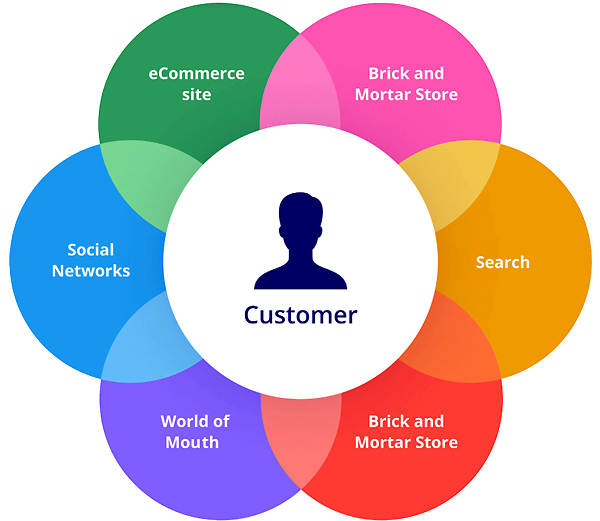
Omnichannel marketing improves upon multichannel by focusing on a seamless customer experience across channels, but still generally maintains separate content creation processes for each platform. The primary goal is continuity of experience rather than amplification of a core message through format diversification. While valuable, this approach often requires substantially more resources than multicast marketing while delivering less compound visibility.
Multicast marketing represents the evolution beyond both approaches—maintaining the channel diversity of multichannel and the consistency of omnichannel while adding the crucial elements of synchronized distribution and format transformation of a unified message. The result is greater efficiency, faster recognition, and stronger brand reinforcement across all touchpoints.
Where Multichannel Falls Short
Multichannel strategies typically create content specifically for each channel, resulting in disconnected messaging that fails to reinforce a cohesive brand narrative. This approach not only multiplies production costs but dilutes impact as each piece exists in isolation without the reinforcement effect that makes multicast so powerful. Marketing teams end up trapped in endless content production cycles rather than strategically amplifying core messages.
Another critical limitation of multichannel marketing is its vulnerability to platform disruption. When your Instagram and Facebook strategies exist independently of your blog and email approaches, algorithm changes on any single platform can devastate visibility. The siloed nature of multichannel creates brittle marketing systems dependent on platform stability rather than the resilient ecosystems multicast marketing builds.
Resource inefficiency represents perhaps the greatest weakness of traditional multichannel approaches. Creating unique content for each channel from scratch requires substantially more time, talent, and budget than transforming one strategic message into multiple formats. This inefficiency forces compromises in either quality or consistency that multicast approaches avoid through their systematic transformation process.
Omnichannel’s Integration Challenges
While omnichannel marketing addresses some multichannel limitations through consistent customer experiences across platforms, it introduces significant technical integration challenges. Most organizations struggle with the data integration requirements of true omnichannel—connecting customer interactions across physical locations, digital properties, and third-party platforms into a unified view. These technical hurdles often delay implementation and limit effectiveness.
Omnichannel approaches also typically require substantial technology investments in cross-platform tracking, unified customer databases, and integrated marketing automation. For many businesses, especially small and mid-sized companies, these infrastructure requirements create prohibitive barriers to entry that don’t exist with multicast marketing, which focuses more on message consistency than technical integration.
Setting Up Your First Multicast Campaign
Implementing multicast marketing doesn’t require wholesale transformation of your marketing organization. You can begin with a single campaign focused on one strategic message, then expand as you validate the approach. The key is starting with clarity about what specific message deserves amplification across formats and channels.
Success depends on planning for multiformat distribution from the beginning rather than creating content in one format and then trying to repurpose it afterward. This proactive approach ensures each format variation maintains the strategic integrity of your message while optimizing for platform-specific requirements.
Identifying Your Core Message or Question
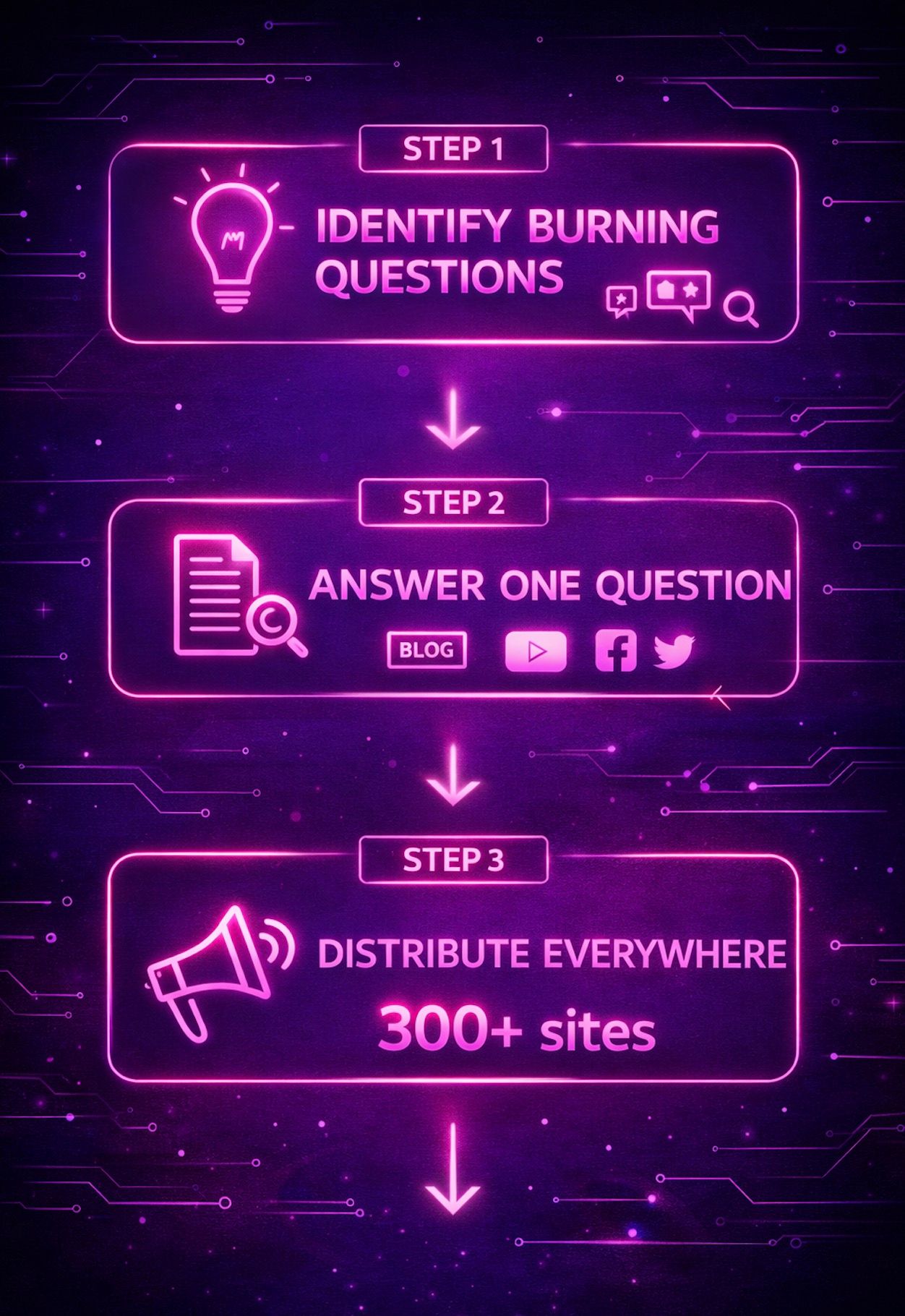
Every effective multicast campaign begins with a single, strategically significant message that directly supports a business objective. This isn’t about broad topics but specific, compelling value propositions or positioning statements that differentiate your brand. The more focused this core message, the more effectively it will translate across formats while maintaining consistency.
When selecting this message, prioritize strategic importance over what seems “content-worthy.” Ask what single message would most impact your business if every prospect understood and believed it. This clarity prevents the common trap of creating content that’s interesting but strategically irrelevant, a challenge often faced in multicasting vs. paid ads strategies.
Document this core message in a format-neutral way that captures its essence without platform-specific language. This documentation becomes the strategic anchor for all format variations, ensuring that regardless of whether someone encounters your video, article, or podcast, they absorb the same fundamental value proposition.
Creating Content Variations
With your core message defined, the next step is systematic transformation into multiple formats. Rather than random repurposing, effective multicast marketing follows a deliberate process that adapts content to each format’s strengths while maintaining message integrity. This might include transforming a strategic concept into long-form articles, short-form videos, audio content, visual assets, interactive tools, and conversation-focused social content.
Each format requires respecting platform-specific best practices while ensuring the core message remains intact. A video script isn’t simply a narrated article, and an infographic isn’t just visualized text—each requires format-specific adaptation that preserves strategic messaging while optimizing for how people consume that particular media type. This specialized transformation is what separates true multicast marketing from simple cross-posting.
Channel Selection Strategy
Not every channel deserves equal investment in your multicast strategy. Prioritize platforms based on audience presence, competitive opportunity, and format compatibility with your message. The goal isn’t being everywhere but rather creating strategic omnipresence where your ideal customers already spend time.
Consider both owned, earned, and shared channels in your distribution strategy. Owned channels (your website, email list, podcast) provide control, while earned (media coverage, guest appearances) and shared (social platforms, partner channels) extend reach. The most effective multicast campaigns leverage all three types to create maximum visibility with minimal vulnerability to any single platform. Learn more about how third-party sellers can compete with Amazon using organic marketing strategies.
Map specific format variations to their optimal channels rather than trying to force all content onto all platforms. A 25-minute video might perform brilliantly on YouTube but fail completely on Instagram, while the same core message transformed into carousel images could thrive on Instagram but get lost on YouTube. This strategic matching of format to channel maximizes impact without wasting resources.
Tools That Streamline the Process
Several technology solutions can dramatically improve multicast marketing efficiency. Content transformation tools like Repurpose.io, Headliner, and Descript help convert content between formats with minimal manual effort. Distribution platforms like Buffer, SocialBee, and SocialPilot enable synchronized publishing across multiple channels from a central dashboard. For more insights on how marketers are leveraging these tools, check out this article on multicasting vs. paid ads.
Project management systems specifically designed for content workflows – like CoSchedule, Asana, or ClickUp with their marketing templates – help maintain visibility of the entire multicast ecosystem rather than managing each channel in isolation. These tools ensure nothing falls through the cracks in complex, multi-format campaigns.
Analytics platforms that aggregate performance data across channels provide critical insights into how your multicast ecosystem functions as a whole. Tools like Databox, Google Data Studio, or even custom dashboards can combine metrics from disparate platforms to reveal patterns invisible when viewing channels in isolation.
If you prefer a done-for-you option where the pros can get it done fast-and-right the first time, the MultiCast by Media Strobe is currently the best available option in MultiCast marketing.
Real Results: Multicast Marketing Success Stories
The theoretical benefits of multicast marketing are compelling, but real-world results provide the most convincing evidence of its effectiveness. Across industries and company sizes, organizations implementing multicast principles have achieved remarkable improvements in recognition, engagement, and conversion metrics compared to their previous siloed approaches.
Small Business Growth Case Study
A consulting business and advisory firm in Austin Texas, transformed their marketing approach from traditional blog-centered content marketing to a multicast strategy focused on their core message of “accessible expertise.” Within 90 days, they converted their flagship research report into 8 different format variations distributed across 12 channels, creating 37 distinct touchpoints from a single strategic message.
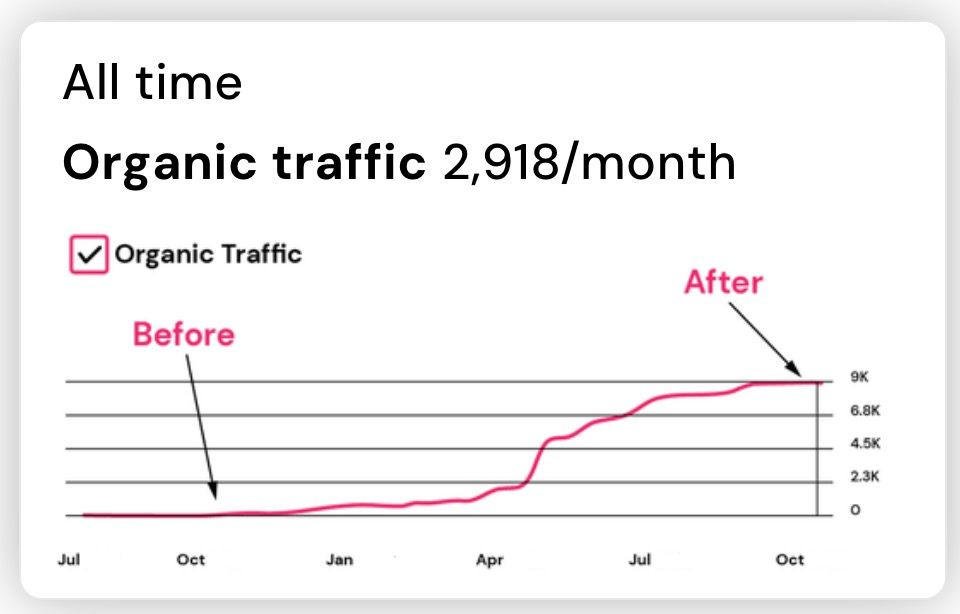
The results were transformative: website traffic increased 218%, consultation requests rose 87%, and most importantly, their sales cycle shortened from an average of 62 days to 39 days as prospects arrived already familiar with their methodology through multiple exposures across formats. Their investment in content creation actually decreased by 23% while results improved dramatically through more strategic deployment of resources.
Enterprise-Level Implementation
A global technology provider in California implemented multicast marketing principles across their product divisions after traditional demand generation tactics showed declining effectiveness. Their approach centered on transforming quarterly thought leadership themes into coordinated multiformat campaigns, with each core message adapted into white papers, executive videos, data visualizations, diagnostic tools, and training webinars.
By synchronizing these format variations across their marketing ecosystem, Nexus achieved 340% higher engagement rates compared to their previous siloed approach. More significantly, they documented a 57% increase in marketing-attributed pipeline value while reducing content production costs by reallocating resources from creation to strategic transformation.
ROI Metrics That Matter
Traditional ROI calculations often fail to capture the full value of multicast marketing because they measure channels in isolation rather than as an ecosystem. The most meaningful metrics combine cross-channel attribution with recognition acceleration and conversion path analysis to reveal how multiformat exposure compounds effectiveness.
Companies implementing multicast principles typically report 30-45% higher brand recall compared to control groups exposed to single-format messaging. This recognition advantage translates directly to conversion metrics, with multiformat-exposed prospects converting at rates 2-4X higher than those who encountered the brand through only one format or channel.
Perhaps most significantly, the operational efficiency of multicast marketing frequently delivers these improved results with similar or reduced resource requirements compared to traditional approaches. By focusing on strategic transformation rather than creating separate content strategies for each channel, organizations achieve more impact without corresponding budget increases.
Common Multicast Marketing Pitfalls
Despite its effectiveness, manual multicast marketing implementation can encounter predictable challenges that can undermine results. Understanding these common pitfalls before you begin helps ensure your strategy delivers its full potential rather than creating impressive-looking activity that fails to drive business results.
Message Inconsistency Across Formats
The most common failure point in multicast marketing occurs when format transformations drift from the core strategic message. This typically happens when different team members or departments handle different formats without proper message documentation, resulting in subtly different value propositions appearing across channels. This inconsistency neutralizes the compound recognition effect that makes multicast marketing so powerful.
Preventing this drift requires creating a comprehensive message document that outlines not just what to say but why it matters strategically. This document should include the exact language for key claims, supporting evidence, call-to-action specifications, and brand voice guidelines that ensure all format variations maintain strategic alignment regardless of who creates them. For more insights on crafting impactful messages, you might explore the use of psychological hooks in ad copy.
Technical Distribution Hurdles
Many organizations underestimate the technical complexity of synchronized distribution across multiple platforms. Each channel has unique specifications, posting limitations, and formatting requirements that can create bottlenecks in the publishing process. Without proper systems, content often publishes inconsistently or with platform-specific errors that diminish impact.
Successful multicast marketers invest in both technology and process development to streamline multi-channel distribution. This includes creating channel-specific templates, developing QA checklists for each platform, and implementing workflow automation that reduces manual handling. The goal is creating a systematic distribution machine rather than treating each platform as a separate publishing challenge. For more insights, explore how multicasting compares to paid ads in modern marketing strategies.
Resource Allocation Mistakes
Ineffective resource allocation represents another common multicast marketing pitfall. Many organizations invest heavily in initial content creation but underfund the equally important transformation and distribution phases. This imbalance results in high-quality core content that never reaches its full potential because format adaptations are rushed or distribution is inconsistent.
- Over-investing in a single “hero” format while treating others as afterthoughts
- Failing to budget for platform-specific optimizations that improve performance
- Underestimating the time required for proper format transformation
- Neglecting measurement and analytics across the entire ecosystem
- Insufficient resources for engaging with audience responses across channels
The most successful multicast marketing programs allocate resources across the entire content lifecycle, with particular emphasis on strategic planning and cross-format transformation. This balanced approach ensures every element of the ecosystem receives appropriate investment rather than creating resource bottlenecks that limit overall effectiveness.
Another resource mistake is treating multicast marketing as an “add-on” to existing channel-specific strategies rather than an integrated approach. This creates unnecessary duplication and competing priorities that prevent true ecosystem development. Effective implementation requires reallocating resources from siloed channels to the multicast system, which often means difficult but necessary prioritization decisions.
Teams frequently underestimate the coordination requirements of true multicast marketing. Without dedicated orchestration resources, even well-produced content variations can fail to achieve the synchronized distribution that creates maximum impact. Assigning specific responsibility for cross-format and cross-channel coordination proves essential for preventing this common breakdown point.
To avoid any of these pitfalls we highly recommend the done-for-you MultiCast by Media Strobe.

Future-Proofing Your Marketing With Multicast Principles
The marketing landscape continues evolving at an accelerating pace, with new platforms emerging while others fade in relevance. This constant change creates significant vulnerability for channel-dependent strategies but actually advantages multicast approaches. By focusing on message and format diversity rather than platform-specific tactics, multicast marketing creates inherent resilience against industry disruption.
The future belongs to marketing systems that maintain strategic consistency while adapting tactically to evolving channels and formats. Multicast principles provide exactly this balance—a stable strategic core with flexible implementation that can quickly incorporate new platforms or format types without rebuilding from scratch. This adaptability creates sustainable competitive advantage in an environment where marketing approaches often become obsolete almost as quickly as they emerge.
“The most resilient marketing systems don’t rely on any single channel, format, or tactic. They build recognition through strategic omnipresence that transcends platform-specific disruptions. That’s why multicast marketing isn’t just another tactic—it’s an organizational capability that delivers sustainable advantage regardless of how channels evolve.”
— Sarah Henderson, Chief Marketing Officer, Datafy Solutions
Organizations that embed multicast principles into their marketing operations develop what strategists call “dynamic capabilities”—the ability to reconfigure resources quickly in response to market changes. This operational flexibility becomes increasingly valuable as platform volatility accelerates and consumer attention fragments further across an expanding media landscape.
Frequently Asked Questions
As multicast marketing gains adoption, certain questions consistently arise from organizations considering implementation. These answers address the most common concerns and misconceptions about this approach based on real-world implementation experience across industries and company sizes.
Understanding these practical aspects of multicast marketing helps organizations set realistic expectations and prepare properly for implementation. While every company’s experience varies somewhat based on industry, audience, and existing marketing maturity, these patterns hold true across diverse implementation contexts.
How much does implementing a multicast marketing strategy typically cost?
Multicast marketing often requires minimal additional investment beyond existing marketing budgets when implemented through resource reallocation rather than pure addition. Most organizations find they can maintain or even reduce content creation costs while dramatically improving results by focusing on strategic transformation of fewer, higher-quality core messages rather than producing high volumes of disconnected content across channels. For more insights, explore how multicasting compares to paid ads in the evolving marketing landscape.
The primary investment comes in workflow development and team training rather than increased production costs. Organizations typically spend $3,000-15,000 on system development and training during initial implementation, with ongoing costs similar to or lower than previous siloed approaches. The efficiency gains from format transformation versus creating channel-specific content from scratch generally offset any new technology investments within 3-6 months.
Can small businesses effectively use multicast marketing with limited resources?
Small businesses often benefit most dramatically from multicast marketing principles precisely because of their resource constraints. By focusing on transforming one strategic message into multiple formats rather than creating separate content strategies for each channel, small teams achieve much greater visibility and impact without corresponding resource increases. This focused approach prevents the common small business trap of spreading limited resources too thinly across too many disconnected initiatives.
The key for small business implementation is starting with a single, highly strategic message and a limited set of formats and channels rather than attempting comprehensive implementation immediately. A focused pilot demonstrating the approach’s effectiveness can then justify expanded implementation. Many small businesses begin with just three format variations (typically written, video, and visual) across 4-5 key channels, then expand as resources and results warrant.
How long before I see results from a multicast marketing campaign?
Initial visibility metrics typically show improvement within 14-21 days of synchronized multicast implementation as the compound effect begins building recognition. However, full business impact generally takes 60-90 days to manifest as prospects move through awareness to consideration and conversion stages. This timeline varies somewhat by industry, with B2B and complex sales cycles showing longer paths to revenue impact than consumer-focused campaigns. For more insights on marketing strategies, explore multicasting vs paid ads and how smart marketers are choosing traffic in 2026.
The most reliable early indicators come from recognition and familiarity metrics rather than direct conversion data. Surveys measuring aided and unaided brand recall often show significant improvements within the first month, while engagement depth metrics like time-on-site and return visitor rates typically improve within 2-3 weeks as visitors arrive with higher familiarity from multiple previous exposures.
Organizations with established attribution models typically observe prospects encountering 3-5 content variations before conversion compared to 8-12 touches in traditional multichannel approaches. This acceleration creates faster sales cycles even when initial awareness building follows similar timelines.
|
Metric |
Typical Timeframe |
Expected Improvement |
|---|---|---|
|
Cross-channel visibility |
7-14 days |
150-300% increase |
|
Brand recall (aided) |
14-30 days |
35-70% improvement |
|
Engagement metrics |
14-21 days |
40-90% increase |
|
Conversion rates |
30-60 days |
20-45% improvement |
|
Sales cycle length |
60-90 days |
15-30% reduction |
Do I need specialized technical knowledge to implement multicast marketing?
While specialized knowledge certainly helps, most organizations successfully implement multicast marketing using existing team capabilities supplemented by readily available tools and templates. The most critical requirements are strategic clarity and project management discipline rather than advanced technical skills. Many teams begin with simplified workflows focusing on 2-3 primary formats, then gradually incorporate additional formats and automation as they gain experience and validate results.
How does multicast marketing impact SEO and organic visibility?
Multicast marketing typically delivers significant SEO benefits through what search specialists call “entity reinforcement” – the consistent appearance of your brand connected to specific topics across diverse platforms. This cross-platform consistency sends powerful relevance signals to search algorithms, often resulting in improved topic authority and higher rankings for targeted terms.
The format diversity inherent in multicast approaches also creates multiple entry points to your content ecosystem through various search verticals. While traditional approaches might only capture text searches, multicast campaigns can simultaneously appear in video results, image search, podcast directories, and standard text listings—dramatically expanding search visibility without additional keyword targeting.
Should I buy a MultiCast campaign or do it myself?
It depends on how fast you want the visibility and organic traffic, and of course who you hire. Since most of us are in business to make money and grow, this author does not know why anyone would choose to take the slower path other than affordability. The reality is that DIY content marketing requires 15-20 hours per piece when you factor in creation, optimization for each platform, manual uploading to dozens of sites, and ongoing distribution management – and even then, you’re waiting 4-6 months to see meaningful results as search engines slowly index and rank your content. MultiCast delivers the equivalent of a dozen content pieces distributed across 300+ high-authority sites in a matter of days, requiring just 10 minutes of your time. If you have 6-8 months to experiment, a high tolerance for the steep learning curve of effective content creation (and no, AI alone won’t save you here), and can commit to producing consistent content weekly without the procrastination that derails most DIY attempts, then the slow path might work. But if you value your time, need results that impact your business this quarter rather than next year, and want permanent traffic assets that start working immediately instead of eventually, MultiCast is the clear choice.
The question isn’t really whether you can do it yourself – it’s whether the money you save is worth the six months of revenue you’ll lose while waiting for DIY efforts to gain traction.